
Atlantic West Europe, 376–387: Crisis at the …
Years: 376 - 387
Atlantic West Europe, 376–387: Crisis at the Frontiers, Imperial Instability, and Religious Expansion
Political and Military Developments
-
Gothic Crisis and Frontier Instability (376–378)
-
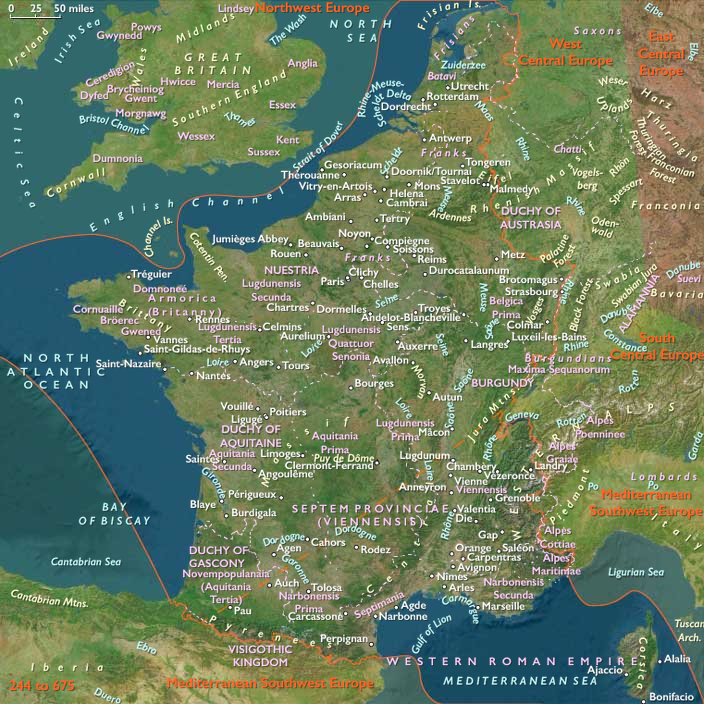
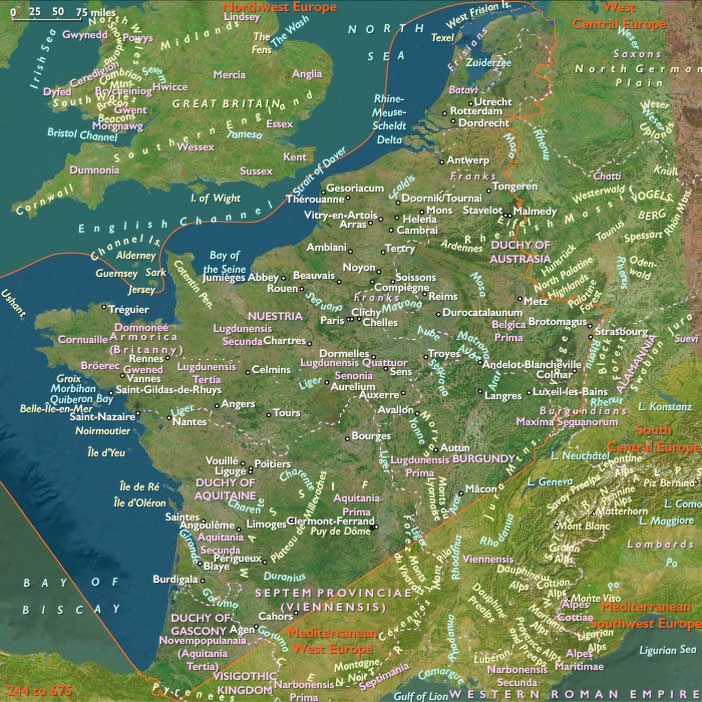
The influx of Gothic refugees fleeing the Huns around 376 destabilized Roman frontier defenses along the Rhine and Danube, indirectly impacting Atlantic West Europe. Troop redeployments and weakened frontier garrisons exposed Gaul's northeastern borders (Alsace and the Rhineland) to renewed pressure from Germanic incursions.
-
-
Battle of Adrianople and Western Consequences (378)
-
The disastrous defeat of Roman Emperor Valens by Goths at the Battle of Adrianople (378) severely weakened imperial military capacity. Its repercussions resonated across Gaul and the Rhine frontier, increasing the vulnerability of Atlantic West Europe to raids and incursions.
-
-
Rise of Magnus Maximus (383–387)
-
In 383, Roman general Magnus Maximus, commander in Britain, revolted and was proclaimed emperor by his troops. He rapidly secured control over Gaul, establishing his capital in Trier, briefly restoring regional stability.
-
Magnus Maximus expanded his authority over Hispania, becoming a dominant figure in Atlantic West Europe. His reign temporarily strengthened imperial governance but ended when defeated by Theodosius I in 387.
-
Economic and Social Developments
-
Disruption and Economic Instability
-
Recurrent instability from military actions, troop movements, and frontier incursions disrupted trade and economic activity, particularly in Alsace and eastern Gaul. Major cities like Trier, while prosperous under Maximus, experienced fluctuating conditions due to shifting imperial fortunes.
-
-
Urban Centers as Refuge and Resistance
-
Cities such as Trier, Bordeaux, and Lyon remained vital economic and administrative hubs, often serving as refuges amid turmoil. Urban elites played critical roles in maintaining social order and governance amidst shifting imperial allegiances.
-
Religious and Cultural Developments
-
Christianity's Expansion amid Turmoil
-
Despite instability, Christianity continued to flourish, strengthened by charismatic religious leaders such as Martin of Tours (active until 397) and Ambrose of Milan, whose influence extended deeply into Atlantic West Europe.
-
Martin’s extensive missionary work, particularly in rural regions, facilitated the widespread adoption of Christianity, embedding the faith permanently in regional social structures.
-
-
Intellectual and Cultural Continuity
-
Despite political and military turbulence, cities such as Bordeaux retained vibrant intellectual and cultural life, preserving classical learning and fostering the growth of Christian literature.
-
Significance
The era from 376 to 387 was marked by frontier crises, political upheaval, and the rise and fall of regional strongmen. Despite the disruptions, Atlantic West Europe saw Christianity deepen its influence, cultural continuity persist, and urban centers demonstrate resilience. These complex dynamics set a critical backdrop for the transformative transitions to follow.
People
Groups
- Polytheism (“paganism”)
- Franks
- Gallo-Roman culture
- Gallia Lugdunensis (Roman province)
- Gallia Belgica (Roman province)
- Gallia Aquitania (Roman province)
- Goths (East Germanic tribe)
- Alamanni (Germanic tribal alliance)
- Christianity, Arian
- Christianity, Nicene
- Roman Empire: Valentinian dynasty (Rome)
- Hunnic Empire
- Roman Empire: Theodosian dynasty (Constantinople)
Topics
Commodoties
Subjects
Regions
Subregions
Years: 376 - 387
People
Groups
- Polytheism (“paganism”)
- Franks
- Gallo-Roman culture
- Gallia Lugdunensis (Roman province)
- Gallia Belgica (Roman province)
- Gallia Aquitania (Roman province)
- Goths (East Germanic tribe)
- Alamanni (Germanic tribal alliance)
- Christianity, Arian
- Christianity, Nicene
- Roman Empire: Valentinian dynasty (Rome)
- Hunnic Empire
- Roman Empire: Theodosian dynasty (Constantinople)
Topics
Commodoties
Subjects
Regions
Subregions