
Atlantic West Europe (592–603): Consolidation of Frankish…
592 CE to 603 CE
Atlantic West Europe (592–603): Consolidation of Frankish Realms, Queenly Rivalries, and Ecclesiastical Ascendancy
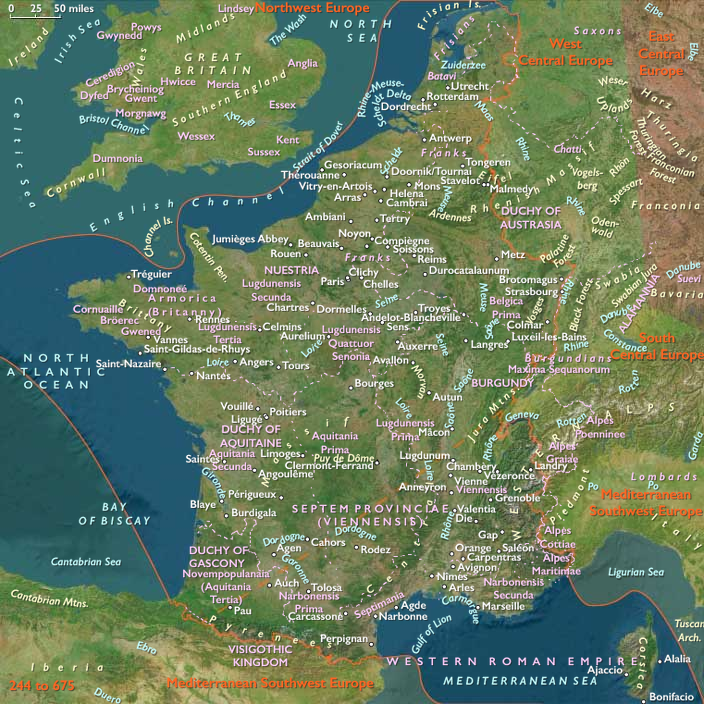
Between 592 and 603, Atlantic West Europe—encompassing Neustria, Austrasia, Burgundy, Aquitaine, and the emerging territories in the Low Countries—continued to experience intense Merovingian dynastic rivalries, shaped by powerful regencies, particularly those of Queens Brunhilda and Fredegund. This era was characterized by shifting political alliances, military confrontations, the strengthening of the church’s political and social influence, and gradual stabilization after decades of turmoil.
Political and Military Developments
Resolution of the Neustrian–Austrasian Conflict
- Fredegund, regent in Neustria, decisively defeated the Austrasian forces at the Battle of Droizy in 593, reaffirming Neustrian independence and power.
- Her victory temporarily stabilized Neustria’s position and laid foundations for her son, Chlothar II, to eventually reunify the Frankish kingdoms.
Regency and Influence of Brunhilda
- After Fredegund’s death in 597, Brunhilda solidified her position as the dominant power behind her grandson, Theudebert II of Austrasia, and his brother, Theuderic II of Burgundy.
- Brunhilda's policies sought to centralize royal power and strengthen administrative control, encountering fierce resistance from the Austrasian nobility, who opposed her growing influence.
Diplomatic and Dynastic Maneuvering
- Continuous political intrigue characterized this period, as Brunhilda and Austrasian-Burgundian interests worked to undermine Neustria’s influence, preparing for further power struggles after Fredegund’s death.
- Regional tensions continued, particularly around Aquitaine and the frontiers between Austrasia, Neustria, and Burgundy.
Economic and Social Developments
Stable Agrarian Economy and Urban Resilience
- Agricultural production continued to thrive in areas less directly affected by warfare, notably Burgundy, Aquitaine, and Loire valley estates, preserving economic stability.
- Important trade centers—Tours, Paris, Bordeaux, Lyon—remained resilient, sustaining regional commerce and providing continuity despite political uncertainty.
Localized Governance and Nobility
- The nobility solidified regional autonomy, establishing networks of localized governance in response to central political instability.
- Aristocratic families increasingly wielded significant local authority, laying the foundation for future feudal fragmentation.
Religious and Cultural Developments
Continued Ecclesiastical Strengthening
- Church councils, notably the Council of Auxerre (595), reinforced ecclesiastical authority, regulating clerical behavior, and reinforcing episcopal control over secular matters.
- Bishops such as Gregory of Tours (d. 594) left enduring legacies, shaping religious life, documenting history, and advocating for church involvement in political mediation.
Monastic Expansion and Cultural Patronage
- Monastic communities expanded further, becoming significant landowners and influential cultural centers, particularly in Burgundy, Neustria, and Austrasia.
- Institutions such as Luxeuil, under the influence of Columbanus, experienced substantial growth, reinforcing religious education, manuscript production, and intellectual life.
Cultural and Intellectual Activity
- Frankish-Gallo-Roman cultural synthesis continued to shape regional identity, reflected in art, architecture, and manuscript illumination.
- Ecclesiastical and monastic scriptoria fostered Latin literacy and scholarship, preserving and transmitting classical and early Christian texts.
Legacy and Significance
The period from 592 to 603 marked critical stages in the eventual reunification of the Frankish kingdoms under Chlothar II. The influential roles of powerful queens, combined with regional aristocratic autonomy and strengthened ecclesiastical authority, helped shape the political and cultural landscape of Atlantic West Europe. This era’s consolidation set the groundwork for future political unity and cultural flourishing in the Frankish realms.
People
Groups
Commodities
Subjects
Regions
West Europe
View →Subregions
