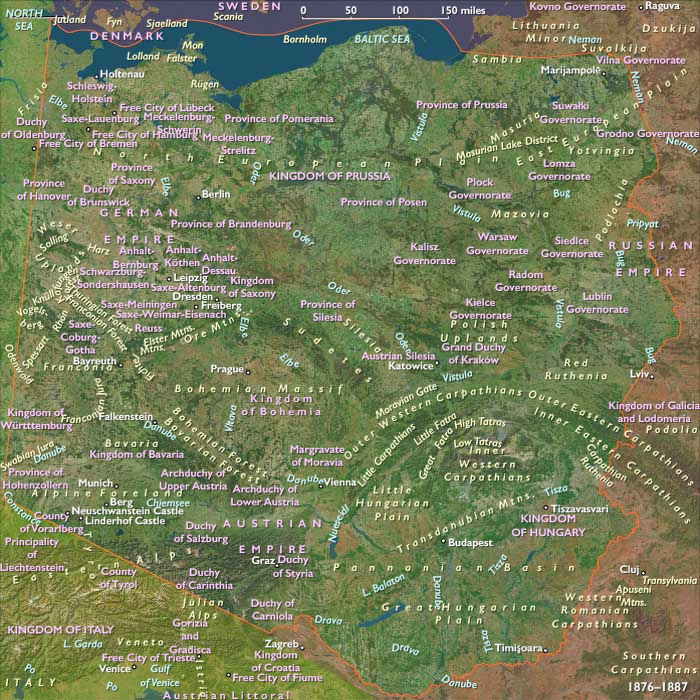
Austria-Hungary, to counter Russian and French interests…
1882 CE
By the late 1870s, Austrian territorial ambitions in both the Italian peninsula and Central Europe had been thwarted by the rise of Italy and Germany as new national powers.
With the decline and failed reforms of the Ottoman Empire, Slavic discontent in the occupied Balkans had grows, and both Russia and Austria-Hungary saw an opportunity to expand in this region.
In 1876, Russia had offered to partition the Balkans, but Hungarian statesman Gyula Andrássy had declined because Austria-Hungary was already a "saturated" state and it could not cope with additional territories.
On the heels of the Great Balkan Crisis, Austro-Hungarian forces had occupied Bosnia and Herzegovina in August 1878 and the empire will eventually annex Bosnia and Herzegovina in October 1908 as a common holding under the control of the finance ministry, rather than attaching it to either Austria or Hungary.
The occupation of Bosnia-Herzegovina was a step taken in response to Russian advances into Bessarabia.
Unable to mediate between Turkey and Russia over the control of Serbia, Austria–Hungary had declared neutrality when the conflict between the two powers escalated into the Russo-Turkish War (1877–1878).
Locations
People
Groups
Ottoman Empire
View →
Russian Empire
View →
Austria-Hungary
View →
German Empire (“Second Reich”)
View →
France (French republic); the Third Republic
View →
Herzegovina, Ottoman viyalet of
View →
Bosnia, Ottoman viyalet of
View →
Bulgaria (Ottoman vassal), Principality of
View →
Romania, Kingdom of
View →
Serbia, Kingdom of
View →
Britain (United Kingdom of Great Britain and Northern Ireland)
View →
Italy (Italian Republic)
View →
Subjects
Regions
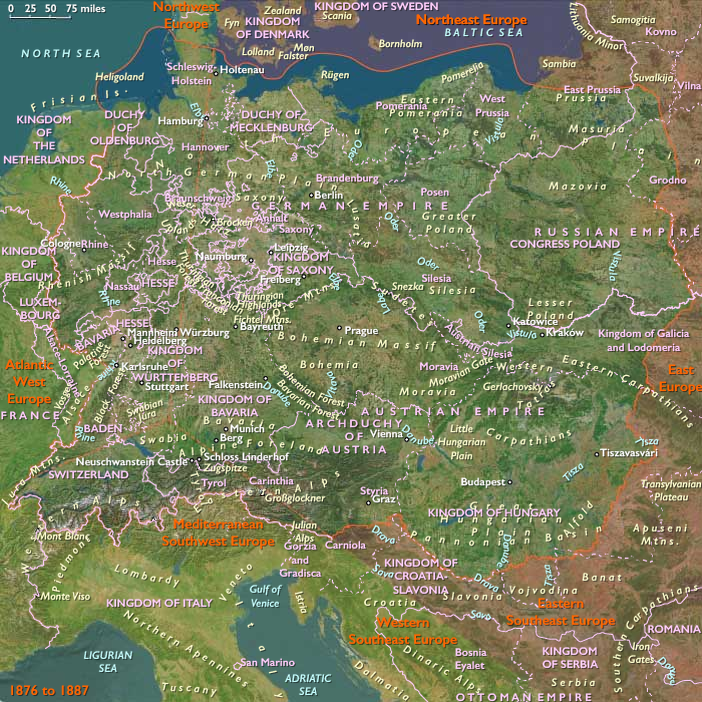
Central Europe
View →Subregions