
Gulf and Western North America (2637 – …
Years: 2637BCE - 910BCE
Gulf and Western North America (2637 – 910 BCE): Desert Basins, River Valleys, and Gulf Shores
Geographic and Environmental Context
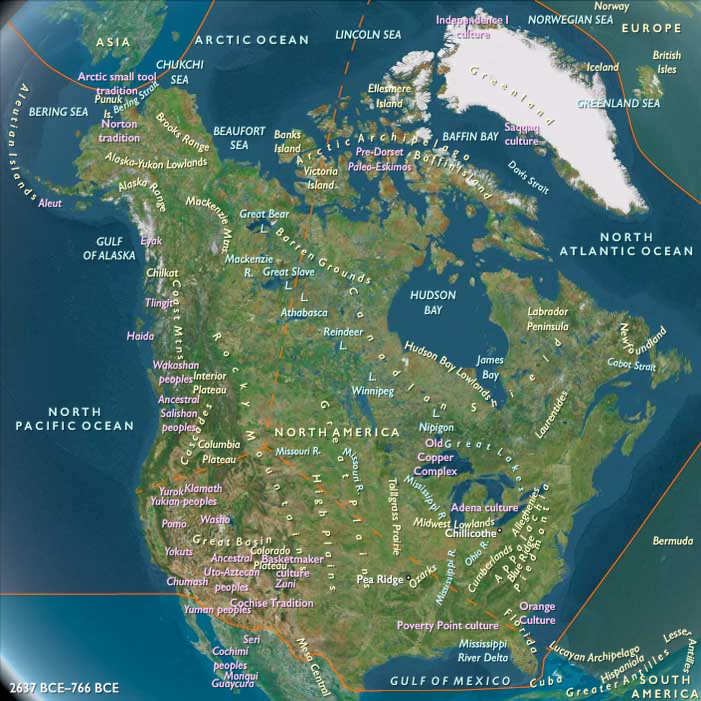
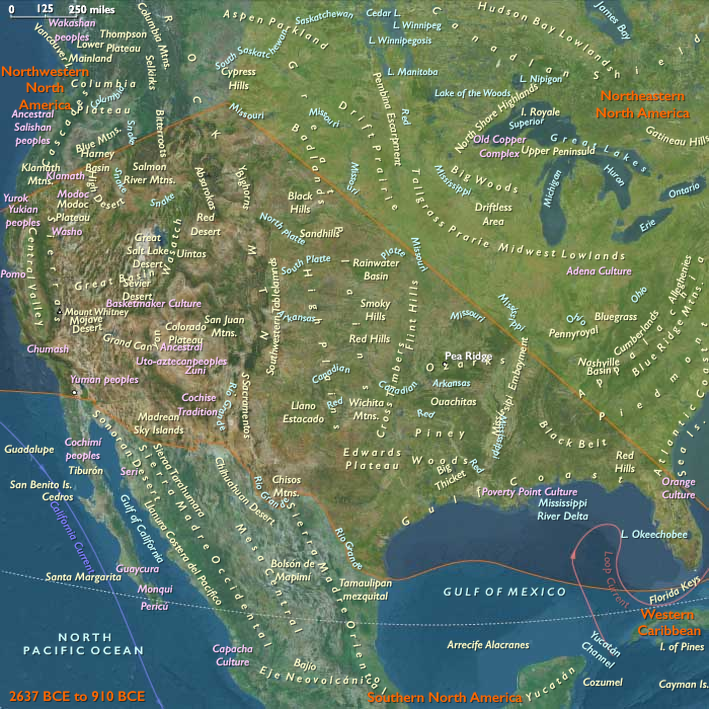
Gulf and Western North America—including Mississippi, Louisiana, Arkansas, Texas, Oklahoma, Kansas, New Mexico, Colorado, Wyoming, Arizona, Utah, Nevada, all of California except its far northwest, most of Alabama (except the far northeast), southwestern Georgia, most of Nebraska (except the far northeast), southwestern Tennessee, Illinois’ Little Egypt, southwestern Missouri, southeastern South Dakota, southern Montana, southern Idaho, and southeastern Oregon, as well as most of Florida (except the extreme northeast)—was an immense region of ecological contrasts. It encompassed the Gulf Coast’s wetlands and estuaries, the arid Sonoran and Mojave Deserts, the fertile valleys of the Colorado River and Central California, and the mountainous terrain of the southern Rockies and Sierra Nevada.
Subsistence and Settlement
By the mid–third millennium BCE, subsistence strategies varied widely:
-
Along the Gulf Coast, communities harvested fish, shellfish, and estuarine resources, supplemented by hunting deer, small game, and waterfowl.
-
In the arid Southwest, early cultivation of squash, sunflower, and other native plants began to complement foraging and hunting of bison, pronghorn, and desert small game.
-
In California’s Central Valley and along the Pacific Coast, acorn gathering, salmon fishing, and shellfish collection were major staples.
Settlements were often seasonal, shifting between resource zones—coastal in warmer months, inland in cooler or wetter seasons.
Technological and Cultural Developments
Stone and bone toolkits included grinding stones, manos, metates, projectile points, and fishing gear. In wetter zones, dugout canoes enabled estuarine and nearshore travel; in arid areas, water storage techniques—such as lined pits and natural cistern use—were critical. Basketry was highly developed for food gathering and storage, often waterproofed for boiling foods with hot stones.
Pottery was largely absent in most of the region during this period, though early ceramic experimentation may have begun in parts of the Southeast.
Maritime and Overland Networks
The Gulf Coast linked this region to eastern North America via canoe routes along the shore and major rivers like the Mississippi. Inland trade moved lithic materials, marine shells, pigments, and plant products between desert, mountain, and coastal communities. California’s coast and Channel Islands supported exchange of shell beads, obsidian, and fish products between mainland and island groups.
Cultural and Symbolic Expressions
Shell ornaments, bone carvings, and pigment use in burials reflected symbolic and social roles. Large shell middens on the Gulf and Pacific coasts marked long-term fishing and gathering sites. In the Southwest, petroglyphs and pictographs depicted animals, hunting scenes, and geometric designs, potentially linked to spiritual traditions tied to land and water.
Environmental Adaptation and Resilience
Communities in the Gulf lowlands adapted to hurricanes and seasonal flooding by building mounds or situating camps on higher ground. In arid areas, mobility and reliance on drought-resistant plants reduced risk during dry years. Coastal and riverine peoples preserved fish and meat by drying or smoking, creating surplus stores for lean seasons.
Transition to the Early First Millennium BCE
By 910 BCE, Gulf and Western North America supported diverse, specialized lifeways adapted to local ecologies. The foundations of later agricultural intensification in the Southwest and complex coastal trade in California and the Gulf were already visible in the networks and seasonal strategies of this era.
Groups
Topics
Commodoties
Subjects
Regions
Subregions
Years: 2637BCE - 910BCE
Groups
Topics
Commodoties
Subjects
Regions
Subregions