
Ban Chao enlists the aid of the…
90 CE
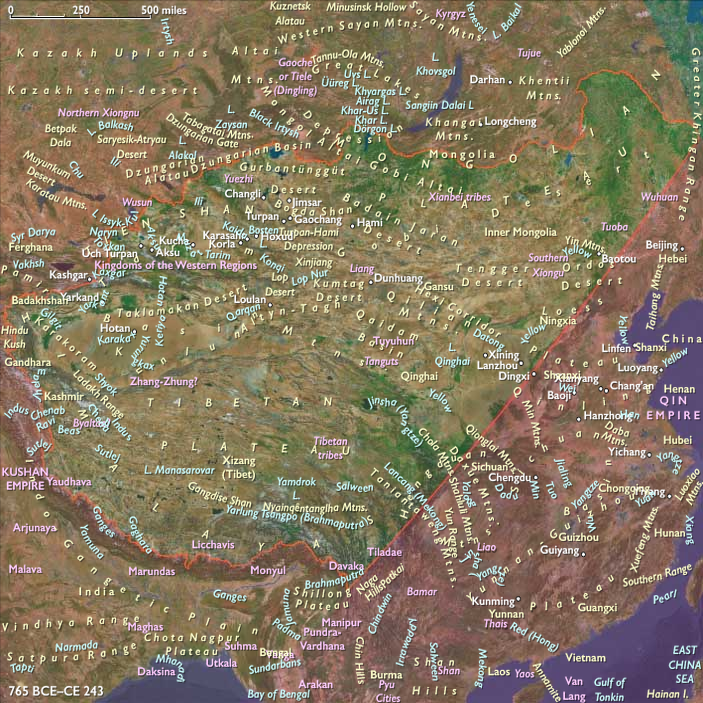
Ban Chao enlists the aid of the Kushan Empire, occupying the area of modern India, Pakistan, Afghanistan, and Tajikistan, to subdue Kashgar and its ally Sogdiana.
When a request by Kushan ruler Vima Kadphises for a marriage alliance with the Han is rejected in 90 CE, he sends his forces to Wakhan (Afghanistan) to attack Ban Chao.
The conflict ends with the Kushans withdrawing because of lack of supplies.
Groups
Topics
Commodities
Subjects
Regions

East Asia
View →Subregions
Upper East Asia
View →Related Events
No active filters.
Showing 10 events out of 61476 total
Epictetus, a former slave who has become a leading representative of Stoicism in Rome, is with several other philosopher exiled in 90 by Emperor Domitian.
He moves to Nicopolis and continues to teach the perfection of the God-ruled universe and that humans must try to calmly and dispassionately accept their powerlessness before fate.
Epictetus also maintains, however, that individuals are totally responsible for their deeds and must learn how to judge their actions by rigorous daily self-examination.
The "wise man," he believes, will face up to his duty toward society and his fellow humans, for all humans are alike and entitled to basic rights.
His Manual and Discourses (as recorded and edited by his pupil, the Greek historian, Arrian, or Flavius Arrianus), emphasize his view that philosophy is a way of life rather than an art of using words.
Domitian opens the year following the revolt by sharing the consulship with Marcus Cocceius Nerva, suggesting the latter had played a part in uncovering the conspiracy, perhaps in a fashion similar to the one he played during the Pisonian conspiracy under Nero.
Although little is known about the life and career of Nerva before his accession as Emperor in 96, he appears to have been a highly adaptable diplomat, surviving multiple regime changes and emerging as one of the Flavians' most trusted advisors.
His consulship may therefore have been intended to emphasize the stability and status quo of the regime.
The revolt had been suppressed and the Empire returned to order.
Hadrian, the future emperor, was born Publius Aelius Hadrianus in Italica, or, less probably, in Rome,from a well-established family which had originated in Picenum in Italy and had subsequently settled in Italica, Hispania Baetica (the republican Hispania Ulterior), near the present-day location of Seville, Spain.
Although it is an accepted part of Hadrian's personal history that he was born in Spain, his biography in Augustan History states that he was born in Rome on January 24, CE 76, of a family originally Italian, but which had lived in Spain for many generations.
However, this may be a ruse to make Hadrian look like a person from Rome instead of a person hailing from the provinces.
His father was Publius Aelius Hadrianus Afer, who as a senator of praetorian rank would spend much of his time in Rome.
Hadrian's forefathers came from Hadria, modern Atri, an ancient town of Picenum in Italy, but the family had settled in Italica in Hispania Baetica soon after its founding by Scipio Africanus.
Afer was a paternal cousin of the future Emperor Trajan.
His mother was Domitia Paulina who came from Gades (Cádiz).
Paulina was a daughter of a distinguished Spanish-Roman Senatorial family.
Hadrian’s elder sister and only sibling is Aelia Domitia Paulina, married with the triple consul Lucius Julius Ursus Servianus; his niece is Julia Serviana Paulina and his great-nephew is Gnaeus Pedanius Fuscus Salinator, from Barcino.
His parents died in 86 when Hadrian was ten, and the boy then became a ward of both Trajan and Publius Acilius Attianus (who was later Trajan’s Praetorian Prefect).
Hadrian was schooled in various subjects particular to young aristocrats of the day, and was so fond of learning Greek literature that he was nicknamed Graeculus ("Greekling").
Hadrian visits Italica when (or never leaves it until) he is fourteen years old, when he is recalled by Trajan, who thereafter looks after his development.
He soon becomes a favorite of Trajan's wife, Plotina.
Dou Xian scores another major victory over the North Xiongnu in 91, essentially wiping North Xiongnu out as a political entity.
As a result, Dou Xian so dominates the government that all dissenting officials face the threat of demotion or even death.
The office of Protector General of the Western Regions is reinstated in 91 when the Han government bestows it on Ban Chao.
The Dous suddenly fall in 92, however, as the result of a coup d'etat.
The details are unclear, but it appears that Emperor He, perhaps encouraged by his brother Prince Qing (whose mother had died at the Dous' hand and whose status as crown prince had been stripped away by their machinations) and the eunuch Zheng Zhong, were involved.
Based on the traditional historical accounts, some of the Dous' relatives (but not the Dous themselves) had considered murdering the emperor.
(The utter lack of motive, however, has led modern historians to generally discredit this assertion.)
Emperor He, fearful of being murdered, had planned along with Zheng and Liu Qing to destroy the Dous' power.
They received some help—in the form of historical accounts that would inspire them as to what to do—from another brother of the emperor, Liu Kang, the Prince of Qiancheng.
In the summer, Emperor He makes a sudden move, issuing an edict ordering the imperial guards to go on alert and to close the gates of the capital Luoyang.
The Dous' relatives who are accused of plotting to murder the emperor are executed.
An imperial messenger is sent to seize Dou Xian's seal as the commander of the armed forces.
All of the empress dowager's brothers are sent back to their marches but under close guard—the emperor wants to execute them but does not want to do so publicly.
Once they return to their marches, he orders all of them, except for the more humble Dou Gui, to commit suicide.
After the coup d'état against the Dous, Emperor He, despite being only thirteen, appears to actually have taken power, and Empress Dowager Dou loses all power, although he continues to honor her as his mother, apparently having some inkling but not knowing for sure that she is not his birth mother.
Prince Qing becomes a trusted advisor of his, as does Zheng—which begins an escalating trend of eunuchs being involved with government matters that will last for the rest of the Eastern Han Dynasty(in fact, in 102, Zheng will be created marquess, in an unprecedented action).
In the aftermath of the coup d'état, innumerable officials accused of being the Dous' associates are arrested or removed from their posts.
Chief among them is the historian Ban Gu, who had been a chief assistant of Dou Xian and who had apparently been complicit in Dou's autocracy, as well as the commander of the armed forces Song You, although Ban Gu's brother Ban Chao is not affected and continues to enjoy imperial support in his Xiyu (modern Xinjiang and former Soviet central Asia) campaigns.
The dynastic history compiled by Ban Gu, like the comprehensive history of Sima Qian of two centuries before, emphasizes personalities and various cyclical changes.
Ban Gu dies in the purges of 92.
The city of Pompeii, located south of Naples, had been one of the most important wine centers of the Roman world.
The area was home to a vast expanse of vineyards, serving as an important trading city with Roman provinces abroad and the principal source of wine for the city of Rome.
The Pompeians themselves developed a widespread reputation for their wine-drinking capacity.
The prevalent worship of Bacchus, the god of wine, left depictions of the god on frescoes and archaeological fragments throughout the region.
Amphoras stamped with the emblems of Pompeian merchants have been found across the modern-day remnants of the Roman empire, including Bordeaux, Narbonne, Toulouse and Spain.
Evidence in the form of counterfeit stamps on amphorae of non-Pompeian wine suggests that its popularity and notoriety may have given rise to early wine fraud.
The 79 CE eruption of Mount Vesuvius had had a devastating effect on the Roman wine industry.
Vineyards across the region and warehouses storing the recent 78 vintage had been decimated, resulting in a dramatic shortage of wine.
The damage to the trading port had hindered the flow of wine from Rome's outlying provinces, aggravating its scarcity.
Available wine rose sharply in price, making it unaffordable to all but the most affluent.
The wine famine had caused panicking Romans to hurriedly plant vineyards in the areas near Rome, to such an extent that grain fields were uprooted in favor of grapevines.
The subsequent wine surplus created by successful efforts to relieve the wine shortage has caused a depression in price, hurting the commercial entrance of wine producers and traders.
The uprooting of grain fields now contribute to a food shortage for the growing Roman population.
In 92, Roman Emperor Domitian issues an edict that not only bans new vineyards in Rome but orders the uprooting of half of the vineyards in Roman provinces.
Although there is evidence to suggest that this edict was largely ignored in the Roman provinces, wine historians have debated the effect of the edict on the infant wine industries of Spain and Gaul.
The intent of the edict is that fewer vineyards will result in only enough wine for domestic consumption, with sparse amount for trade.
While vineyards are already established in these growing wine regions, the ignoring of trade considerations may have suppressed the spread of viticulture and winemaking in these areas.
Domitian's edict will remain n effect for nearly two centuries until Emperor Probus repeals the measure in 280.
Agrippa II, son of Agrippa I, and like him originally named Marcus Julius Agrippa, was the seventh and last king of the family of Herod the Great, thus last of the Herodians.
Having grown up in the court of the emperor Claudius, Agrippa had inherited, on the death of his uncle Herod of Chalcis, the oversight of the Temple in 48; Claudius had later invested him with the tetrarchy of Chalcis around 49/50.
In 53, he had been deprived of that kingdom by Claudius, who made him governor over the tetrarchy of Philip and Lysanias (Acts 25:13; 26:2, 7).
It was before him and his sister Berenice that, according to the New Testament, Paul of Tarsus had pleaded his cause at Caesarea Maritima (Acts 26), in 59.
During the First Jewish-Roman War of 66–73, Agrippa had sent two thoiusand men to support Vespasian, by which it appears that, although a Jew in religion, he was yet entirely devoted to the Romans.
He also supplied the Jewish historian and apologist Josephus with information for his history, Antiquities of the Jews.
According to Photius, writing in the ninth century, Agrippa died, childless, at the age of seventy, in the third year of the reign of Trajan, that is, 100, but statements of historian Josephus, in addition to the contemporary epigraphy from his kingdom, cast this date into serious doubt.
The modern scholarly consensus holds that he died before 93/94.
He is the last prince of the house of the Herods.
Qiang rebellions, which are to be a persistent issue for the Eastern Han Dynasty, also become a major problem during Emperor He's reign.
(They had first started during his father Emperor Zhang's reign, but were not a major problem until his reign.)
In 92, when the official in charge of Qiang affairs, Deng Xun dies, the Qiang had apparently been pacified by Deng's good governance, but after Deng's death, it appears that the new official Nie Shang inadvertently offends the Qiang chief Mitang, and Mitang rebels.
In 93, the new official in charge of Qiang affairs, Guan You, is able to defeat Mitang by alienating the other tribes from Mitang's own, but Mitang is not captured and remains a threat.
The authority of the Roman Senate had largely eroded since the fall of the Republic.
The quasi-monarchical system of government established by Augustus, known as the Principate, had allowed the existence of a de facto dictatorial regime, while maintaining the formal framework of the Roman Republic.
Most Emperors have upheld the public facade of democracy, and in return the Senate has implicitly acknowledged the Emperor's status as a de facto monarch.
Some rulers handle this arrangement with less subtlety than others however, among them Domitian.
From the outset of his reign, he has stressed the reality of his autocracy.
He dislikes aristocrats and has no fear of showing it, withdrawing every decision-making power from the Senate, and instead relying on a small set of friends and equestrians to control the important offices of state.
The dislike is mutual.
Nevertheless, the evidence suggests that Domitian did make concessions toward senatorial opinion.
Whereas his father and brother had concentrated consular power largely in the hands of the Flavian family, Domitian has admitted a surprisingly large number of provincials and potential opponents to the consulship, allowing them to head the official calendar by opening the year as an ordinary consul.
Whether this was a genuine attempt to reconcile with hostile factions in the Senate cannot be ascertained.
By offering the consulship to potential opponents, Domitian may have wanted to compromise these senators in the eyes of their supporters.
When their conduct proved unsatisfactory, they were almost invariably brought to trial and exiled or executed, and their property was confiscated.
Both Tacitus and Suetonius speak of escalating persecutions toward the end of Domitian's reign, identifying a point of sharp increase around 93, or sometime after the failed revolt of Saturninus in 89.
At least twenty senatorial opponents were executed, including Domitia Longina's former husband Lucius Aelius Lamia and three of Domitian's own family members, Titus Flavius Sabinus IV, Titus Flavius Clemens and Marcus Arrecinus Clemens.
Some of these men were executed as early as 83 or 85 however, lending little credit to Tacitus' notion of a "reign of terror" late in Domitian's reign.
According to Suetonius, some were convicted for corruption or treason, others on trivial charges, which Domitian justified through his suspicion: He used to say that the lot of Emperors was most unfortunate, since when they discovered a conspiracy, no one believed them unless they had been murdered.
(Suetonius, De Vita Caesarum, "Life of Domitian", 21) Josephus, in his Jewish Antiquities, published in 93, covers the history of the Jews from the Creation on, delivering a particularly full account of the Maccabees and the dynasty of Herod.
In his historical works, as well as his apologia entitled Against Apion.
Though scorned as a traitor by many of his Jewish contemporaries for his subservience to Rome, Josephus is a passionate defender of Jewish religion and culture.
The Book of Revelation, the last book of the New Testament of the Bible, is written probably about 95 during the reign of Domitian according to second-century CE theologian Irenaeus.
Also called the Apocalypse—the only piece of New Testament writing cast almost entirely in the apocalyptic mode—the title of Revelation comes from the first verse of the text, "the revelation of Jesus Christ...to his servant John."
The author of Revelation identifies himself several times as "John."
The author also states that he was on Patmos when he received his first vision.
As a result, the author of Revelation is sometimes referred to as John of Patmos.
Following a prologue, the first part of Revelation, which contains letters to the seven churches of Asia, cautions them against false teachers and offering encouragement.
These are followed by a series of visions, characteristic of the apocalyptic writing currently in fashion, replete with allegories, numbers and other symbols, and a strong eschatological message.
The author, undoubtedly speaking to the situation of his day, interprets the significance of the cross and resurrection for the future, declaring their meaning for time and history until the end and communicating a vision of God's final triumph over evil.
Domitian titles himself “perpetual censor” in CE 95, assigning himself the right to supervise the Senate’s behavior.
The emperor tolerates foreign religions insofar as they do not interfere with public order, or could be assimilated with the traditional Roman religion.
The worship of Egyptian deities in particular has flourished under the Flavian dynasty, to an extent that will not be seen again until the reign of Commodus.
Veneration of Serapis and Isis, who are identified with Jupiter and Minerva respectively, is especially prominent.
Fourth century writings by Eusebius of Caesarea maintain that Jews and Christians were heavily persecuted toward the end of Domitian's reign.
The Book of Revelation is thought to have been written during this period.
However, no nonpartisan, secular convincing evidence exists of any widespread religious oppression under Domitian.
Although Jews are heavily taxed, no contemporary authors mention trials or executions based on religious offenses other than those within the Roman religion.
Marcus Fabius Quintilianus (anglicized to Quintilian), a noted Roman professor and educational theorist of Spanish origin, writes Institutio Oratoria, in about 95.
A thorough and elegant textbook in twelve parts on the art of oratory, The Education of the Orator uses the rhetorical school of Isocrates as a model and shows the influence of Cicero.
The work treats all aspects of Roman education and public speaking, including the organization of a speech, the use of argument, stylistic devices, the technique of memorization, and the art of delivery.
Quintilian also emphasizes the importance to the speaker of having good character, possessing some knowledge of philosophy, and being thoroughly conversant with Greek and Latin literature.