
Ban Chao sends his assistant Gan Ying…
97 CE
Ban Chao sends his assistant Gan Ying on a mission to the Roman Empire in 97, but Gan turns back after reaching an unnamed shore—which might have been the shore of the Persian Gulf or the Mediterranean Sea.
People
Groups
Topics
Commodities
Subjects
Regions
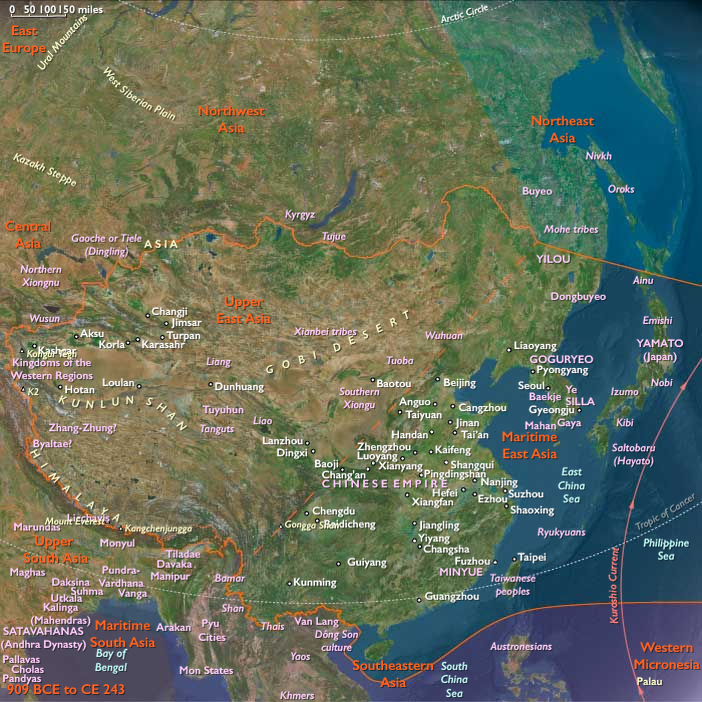
East Asia
View →Subregions

Upper East Asia
View →Related Events
No active filters.
Showing 10 events out of 61455 total
The reign of Emperor He is generally one free of major corruption, and the young emperor is himself humble and unassuming.
He also appears to genuinely care for the people.
However, he is also undistinguished as an emperor, as he appears to lack the abilities of his father and grandfather in actively doing what is good for his people.
Empress Dowager Dou dies in 97.
It is only at this time that officials reveal to Emperor He that he was born of Consort Liang.
He seeks out her brothers and honors them with powerful posts—and from this point on, the Liang clan becomes one of the most powerful in the Eastern Han aristocracy.
He also posthumously rewards her with an empress title.
However, he rejects a suggestion that Empress Dowager Dou be posthumously demoted, and he buries her with full imperial honors with his father Emperor Zhang.
(He also posthumously honors his brother Prince Qing's mother with lesser honors and awards her brothers with minor posts.)
Roman satiric poet Decimus Iunius Iuvenalis, anglicized to Juvenal, apparently grew up in Aquinum and had gone to Rome to make a living as a teacher during the reign of Domitian.
In his first Satire, Juvenal had claimed that moral indignation forced him to write, but for fear of his own safety he will speak only of the dead.
Following Domitian's murder and the accession of Nerva, Juvenal publishes a series of poems that strike out at the corruption, vices, and follies of imperial Rome, using explicit allusions to the dead emperor to mask his concern with the contemporary city.
The change of government is a relief to the Roman Senate, whose members had suffered under the terrors of Domitian's regime.
As an immediate gesture of goodwill towards his supporters, Nerva had publicly sworn that no senators will be put to death as long as he remains in office.
He has called an end to trials based on treason, released those who had been imprisoned under these charges, and granted amnesty to many who had been exiled.
All properties which had been confiscated by Domitian are returned to their respective families.
Nerva also seeks to involve the Senate in his government, but this is not entirely successful.
He continues to rely largely on friends and advisors that are known and trusted, and by maintaining friendly relations with the pro-Domitianic faction of the Senate, he incurs hostility which may have been the cause for at least one conspiracy against his life.
Having been proclaimed emperor solely on the initiative of the Senate, Nerva has had to introduce a number of measures to gain support among the Roman populace.
As is custom by this time, a change of emperor is expected to bring with it a generous payment of gifts and money to the people and the army.
Accordingly, a congiarium of 75 denarii per head is bestowed upon the citizens, while the soldiers of the Praetorian Guard receive a donativum that may have amounted to as much as five thousand denarii per person.
This is followed by a string of economic reforms intended to alleviate the burden of taxation from the most needy Romans.
To the poorest, Nerva grants allotments of land worth up to sixty million sesterces.
He exempts parents and their children from a five percent inheritance tax, and he makes loans to Italian landowners on the condition that they pay interest of five percent to their municipality to support the children of needy families; alimentary schemes which will later be expanded by Trajan, Antoninus Pius, and Marcus Aurelius.
Furthermore, numerous taxes are remitted and privileges granted to Roman provinces.
Before long, Nerva's expenses strain the economy of Rome and necessitate the formation of a special commission of economy to drastically reduce expenditures.
The most superfluous religious sacrifices, games and horse races are abolished, while new income is generated from Domitian's former possessions, including the auctioning of ships, estates, and even furniture.
Large amounts of money are obtained from Domitian's silver and gold statues, and Nerva forbids that similar images be made in his honor.
According to Suetonius, the people of Rome met the news of Domitian's death with indifference, but the army was much grieved, calling for his deification immediately after the assassination, and in several provinces rioting.
As a compensation measure, the Praetorian guard had demanded the execution of Domitian's assassins, which Nerva refused.
Instead he had merely dismissed Titus Petronius Secundus, and replaced him with a former commander, Casperius Aelianus.
Dissatisfaction with this state of affairs continues to loom over Nerva's reign, and ultimately erupts into a crisis in October 97, when members of the Praetorian guard, led by Casperius Aelianus, lay siege to the Imperial Palace and take Nerva hostage.
He is forced to submit to their demands, agreeing to hand over those responsible for Domitian's death and even giving a speech thanking the rebellious Praetorians.
Titus Petronius Secundus and Parthenius are sought out and killed.
Nerva is unharmed in this assault, but his authority is damaged beyond repair.
Shortly thereafter he announces the adoption of Trajan, who had distinguished himself early on in military and political posts, as his successor, and with this decision all but abdicates.
According to the Augustan History, it was the future Emperor Hadrian who brought word to Trajan of his adoption.
Trajan receives from the emperor the rank of caesar and a share of imperial power.
Dio Cassius referred to the Dobunni tribe as "Bodunni", probably a misspelling.
Tributary to the Catuvellauni, they had capitulated to the invading Romans when Caratacus and Togodumnus withdrew.
Unlike the Silures, their neighbors in what will later become south east Wales, they are not a warlike people and submitted to the Romans even before they reached their lands.
Afterwards they readily adopted the Romano-British lifestyle.
Even though the Dobunni in CE 43 were incorporated into the Roman Empire, txprobably not until CE 96-98 is their territory formed into Roman political units.
The tribal territory is divided into a civitas centered on Cirencester, and …
…the Colonia at Gloucester.
The Colonia was established during the reign of the emperor Nerva.
The Britons had, in about CE 48, established a market center on the site of Gloucester, in west central England on the River Severn, about thirty-five miles (fifty-six kilometers) northwest of present Bristol.
Initially, there was a Roman fort established at Kingsholm.
Twenty years later, a larger replacement fortress was built on slightly higher ground nearby, centered on Gloucester Cross, and a civilian settlement had grown around it.
The Roman Legion based here was the Legio II Augusta as they prepared to invade Roman Wales between 66 and 74 CE, later being based at Burrium (Usk) and Isca Augusta (Caerleon) in South Wales.
The whole area is designated a colonia in 97 by the Emperor Nerva.
The Romans establish Glevum (or, more formally, Colonia Nervia Glevensium) where they bridge an important crossing of the River Severn near to the Fosse Way, one of the important Roman roads in Britain.
As the residence of retired legionaries, the colonia enjoys the highest status in the Empire.
The legionaries are given farmland in the surrounding district and can be called upon as a Roman auxiliary armed force.
Guan's successor, Shi Chong, does indeed suffer major losses against Mitang.
Mitang, however, eventually surrenders in 98 after running out of allies, and Emperor He receives Mitang in an official audience in this year.
The Aesti (also Aestii or Aests) are an ancient (most probably Baltic) people first described by the Roman historian Tacitus in his treatise Germania (circa 98 CE).
Aestui, the land of the Aesti, according to Tacitus was located somewhere east of the Suiones (Swedes) and west of the Sitones (possibly the Kvens), on the Suebian (Baltic) Sea.
This and other evidence suggests that Aestui was in a region around the later East Prussia (now Kaliningrad Oblast).
Geographical and linguistic evidence suggests that the Aesti were, ethnologically, a Baltic people and possibly synonymous with the Brus/Prūsa or Old Prussians (i.e., not a Germanic people such as the modern Prussians or a Finno-Ugric people, such as the Estonians).
Tacitus almost certainly erred in implying that the Aesti were a hybrid Celtic-Germanic culture: he claimed that while the "Aestian nations" followed the "same customs and attire" as "the Suebians" (at the time a collective term for eastern Germanic peoples), their speech resembled that of the Britons (i.e., a Celtic language rather than the Germanic languages of the Suebii).
The placement of the Tacitean Aestii is based primarily on their association with amber, a popular luxury item during the life of Tacitus, with known sources at the southeastern coast of the Baltic Sea.
The ancient writers, beginning with Tacitus, who is the first Roman author to mention the Aesti in his Germania, provide very little information on them.
Although Tacitus has never traveled to Magna Germania himself and only records information he had obtained from others, the short ethnographic excursus below is the most detailed ancient account of the Aestii that we have:
Upon the right of the Suebian Sea the Aestian nations reside, who use the same customs and attire with the Suebians; their language more resembles that of Britain.
They worship the Mother of the Gods.
As the characteristic of their national superstition, they wear the images of wild boars.
This alone serves them for arms, this is the safeguard of all, and by this every worshiper of the Goddess is secured even amidst his foes.
Rare among them is the use of weapons of iron, but frequent that of clubs.
In producing of grain and the other fruits of the earth, they labor with more assiduity and patience than is suitable to the usual laziness of Germans.
Nay, they even search the deep, and of all the rest are the only people who gather amber.
They call it glesum, and find it among the shallows and upon the very shore.
But, according to the ordinary incuriosity and ignorance of Barbarians, they have neither learned, nor do they inquire, what is its nature, or from what cause it is produced.
In truth it lay long neglected among the other gross discharges of the sea; till from our luxury, it gained a name and value.
To themselves it is of no use: they gather it rough, they expose it in pieces coarse and unpolished, and for it receive a price with wonder. (Germania, chapter XLV).
Tacitus' mention of a cult of the mother of the gods among the Aesti along the eastern Baltic coast does apply to the ancient Estonian and Baltic pagan religions.
He also refers to the Fenni living next to the Aesti—the Fenni being ancestors to the Finns or the Sámi would situate them closest to the Estonians.
Ultimately, Tacitus' use of Aesti could apply equally well to either a specific people or to a grouping of ethnically diverse peoples across a wider area.
Nerva, whose public works are few because his reign is brief, instead completes projects that had been initiated under Flavian rule.
This include extensive repairs to the Roman road system and the expansion of the aqueducts.
The latter program is headed by the former consul Sextus Julius Frontinus, who helps to put an end to abuses.
Frontinus, water commissioner of Rome in 97 and consul in 98, describes, in his treatise De aquis urbis Romae (”Concerning the Waters of the City of Rome”), the city's aqueducts, enumerates the technical and administrative staff responsible for them, and discusses problems of maintenance.
Emperor He had in 96 created as empress one of his favorites, Consort Yin—who comes from the noble lineage of a brother of Emperor Guangwu's wife, Empress Yin Lihua.
She is described as beautiful but short and clumsy, and also jealous.
In particular, she becomes jealous of another of Emperor He's favorites, Consort Deng Sui, who also comes from a noble lineage, as the granddaughter of Emperor Guangwu's prime minister Deng Yu.
Consort Deng is said to have tried to alleviate this situation by acting with humility before Empress Yin, but this further draws her wrath.
Once, when Emperor He was ill, Empress Yin made the remark that if she became empress dowager, the Dengs would be slaughtered—and upon hearing that remark, Consort Deng considers committing suicide, and one of her ladies in waiting saves her by falsely telling her that the emperor had recovered.
However, the emperor did soon recover, and thus Consort Deng and her family escaped a terrible fate.
The Romans are compelled to pay large sums in tribute to the Dacians for maintaining peace, as German revolts along the Rhine are requiring augmented military force in Moesia.
This humiliating situation lasts until Trajan becomes Emperor in 98.
Immediately, he begins preparations for wars that will result in the expansion of the Roman Empire to its maximum extent.
Cappadocia had been established in CE 17 as an imperial province, meaning that its governor (legatus Augusti) is directly appointed by the emperor.
As the Empire's northeasternmost province, it retains a permanent military garrison of two legions and several Auxiliary troops.
At the end of the first century under Emperor Trajan, the province also incorporates the regions of Pontus and Armenia Minor.