
By 19 BCE, Augustus returns to Rome,…
19 BCE
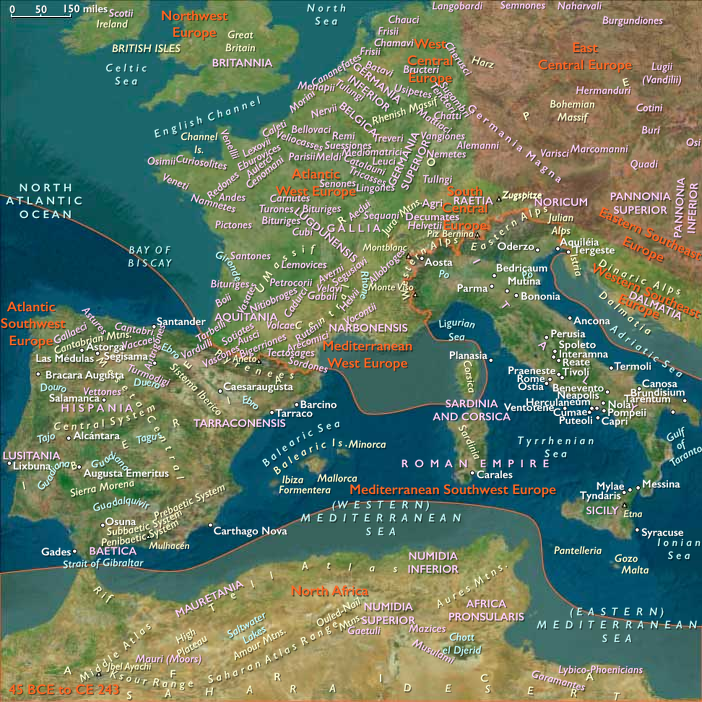
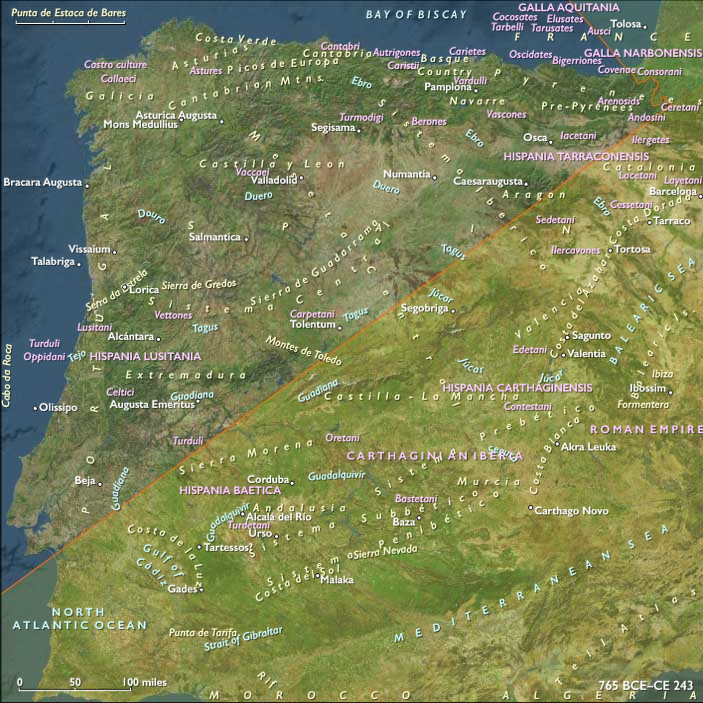
By 19 BCE, Augustus returns to Rome, having left the final pacification of Hispania in the hands of his trusted deputy, Marcus Vipsanius Agrippa. In Gaul and Spain, Agrippa successfully subdues the Cantabrians, a fiercely independent Iberian-Celtic tribe regarded as the most warlike people of the peninsula.
With their defeat, the Roman conquest of the Iberian Peninsula is effectively complete. However, while major hostilities end in 19 BCE, sporadic rebellions continue until 16 BCE.
As in other conquered territories, Rome begins imposing its administrative and social reforms. Yet, despite the heavy losses suffered by the indigenous population, local resistance remains strong, forcing the Romans to station two legions—X Gemina and IIII Macedonica—in the region for another seventy years to maintain control.
Locations
Groups
Commodities
Subjects
Regions
Southwest Europe
View →Subregions
Atlantic Southwest Europe
View →Related Events
No active filters.
Showing 10 events out of 62173 total
Octavian, now called Augustus and head of the Roman Principate, has between 31 and 20 BCE restored to King Herod the Jewish territories that Pompey had taken away, and in this enlarged kingdom he has created a sound administrative system of Hellenistic type.
Able but ruthless, feared and hated by his people, Herod promotes Hellenization among the Jews.
Herod in the eighteenth year of his reign (20–19 BCE) rebuilds the Jewish Temple.
The Temple Mount esplanade is artificially enlarged with supporting walls (including the Western Wall) to house the splendid new Temple.
The new Temple is finished in a year and a half although work on outbuildings and courts is to continue for another eighty years.
To comply with religious law, Herod has employed a thousand priests as masons and carpenters in the rebuilding.
Yuval Baruch, archaeologist with the Israeli Antiquities Authority, will on September 25, 2007, announce his discovery of a quarry compound that provided Herod with the stones to renovate the Second Temple.
Coins, pottery and iron stakes found proved the date of the quarrying to be about 19 BCE.
Archaeologist Ehud Netzer confirmed that the large outlines of the stone cuts is evidence that it was a massive public project worked on by hundreds of slaves.
Immense towers, integrated in the older Hasmonean walls, strengthen the new royal palace, whereas a new citadel defends the Temple.
An amphitheater adds to the Hellenistic character of the city.
Center of religion, goal of obligatory pilgrimage, and the seat of the ruler and of the autonomous court of the Sanhedrin, the Jewish Council of Elders, Jerusalem becomes a great metropolis of the Hellenistic world.
The Sanhedrin, which traces its origins to a council of elders established under Persian and Syrian rule, is the highest Jewish legal and religious body under Rome.
The Great Sanhedrin, located on the Temple Mount in Jerusalem, supervises smaller local Sanhedrins and is the final authority on many important religious, political, and legal issues, such as declaring war, trying a high priest, and supervising certain rituals.
Augustus has traveled in Sicily, Greece, and Asia from 22 BCE to 19 BCE, effecting important reorganizations wherever he went.
Immense satisfaction to Rome is caused by an agreement in 20 BCE with Parthia, under which the Parthians recognize Rome's protectorate over Armenia and returns the legionary standards captured from Crassus thirty-three years earlier.
In 19 BCE, there is some adjustment of Augustus’ powers to allow him to exercise them more freely in Italy.
Comprehending well the importance of ideology and propaganda, Augustus sponsors and encourages the leading writers and artists of his time, such as the historian Livy and the poets Virgil and Horace.
Horace, whose interests have returned to the discursive mode of his earlier Satires, explores the possibilities of poetic moral essays in his 20 short Epistles, published in 20 BCE.
He publishes a longer Epistle on literary matters, entitled the “Art of Poetry,” in 19 BCE.
Roman elegiac poet Albius Tibullus, who (in the two books of poetry that can definitely be attributed to him) writes mostly on the subject of love, addresses his mistresses Delia and—later—Nemesis, as well as the young man Marathus.
Writing in a simple but elegant style, Tibullus often praises the life of rural seclusion in his bucolic poems.
He dies, probably in his late twenties, in 19 BCE.
Virgil, before setting out on a voyage to Greece and Asia during which he intends to complete the Aeneid ("the story of Aeneas”), requests that the work be destroyed if anything should happen to him before the poem is complete.
Catching a fever, he dies in Brundisium on September 21, 19 BCE.
Augustus overturns the author’s request and has the epic masterpiece published.
The poem, in twelve books, deals with the founding of Roman civilization by the Trojan Aeneas, of whose adventures Naevius and Ennius had previously written.
Virgil models the characters and events of the Aeneid after their Homeric predecessors: in the first six books, Virgil successfully unifies around the figure of Aeneas the searching theme of Homer's Odyssey; in the last six books, he analogizes that of the Iliad with his account of the war and final reconciliation of the Trojans and the Latins), creating multiple correspondences between both halves.
Through the judicious use of analogy, image, and symbol, Virgil emphasizes the cost in sacrifice and loss of humanity inherent in the ideals of Augustan Rome, while outwardly glorifying these same ideals.
The Aeneid, soon made a standard school text, becomes a national epic—an explanation of Augustan Rome’s origins and heroic past—and establishes Virgil, with Homer, as one of the great epic poets.
The huge, symmetrically planned Baths of Agrippa (Thermae Agrippae), built by Agrippa, are the first of the great thermae constructed in the city.
In their first form, constructed at the same time as the Pantheon and on axis with it, as a balaneion, they are apparently a hot-air bath with a cold plunge, not unlike a sauna.
With the completion of the Aqua Virgo, the aqueduct completed by Agrippa in 19 BCE, the baths are supplied with water and become regular thermae, with a large ornamental pool (Stagnum Agrippae) attached.
Agrippa furnishes his baths with decorations that may have been executed in glazed tiles and with works of art: the Apoxyomenos of Lysippus stands outside.
Agrippa, returning to Rome in 18 BCE, receives the power of a tribune (tribunicia potestas), which Augustus also possesses.
Perhaps, too, he now receives an imperium majus (if he had not already been granted it in 23).
Glaphyra, born and raised in Cappadocia, is a royal princess of Greek, Armenian and Persian descent, whose father is the Roman ally king Archelaus of Cappadocia; her only natural sibling is her younger brother Archelaus of Cilicia.
Her paternal grandfather was the Roman ally and priest-king Archelaus of the temple state of Comana in Cappadocia, while her paternal grandmother, for whom she was named, was the hetaera Glaphyra.
The priest-kings of Comana descend from Archelaus, the favorite high-ranking general of Mithridates VI of Pontus, who may have married a daughter of that monarch.
Glaphyra's mother, the first wife of Archelaus, is an Armenian Princess whose name is unknown and who dies by 8 BCE.
She may have been a daughter of King Artavasdes II of Armenia, son of Tigranes the Great and Cleopatra of Pontus, a daughter of Mithridates VI.
If so, Glaphyra’s parents may have been distant relatives.
The Emperor Augustus in 25 BCE had given Archelaus extra territories to govern, including the new port city of Elaiussa Sebaste, located fifty-five kilometers (thirty-four miles) from present Mersin in the direction of Silifke in Cilicia on the southern coast of Anatolia, which Archelaus has renamed in honor of Augustus (Sebaste is the Greek equivalent word of the Latin "Augusta".)
The royal family has settled here, and Archelaus has built a royal residence and a palace on the island in the harbor.
Glaphyra holds the high ranking title of ‘king’s daughter’, reflecting of her descent and high birth.
She is an attractive and dynamic woman, reputed to be charming, desirable, and a force to be reckoned with.
Augustus encourages intermarriage among the families of Roman ally kings.
King Herod the Great of Judaea usually marries his children to relatives or to his subjects.
However, Herod wants his son Alexander to marry a foreign princess.
Herod negotiates a marriage alliance with Archelaus.
Glaphyra marries Alexander either in 18 BCE or 17 BCE in Herod’s court in Jerusalem.
Archelaus provides Glaphyra with a dowry, which Herod later returns to her.
The union of Alexander and Glaphyra is described as happy.
Glaphyra becomes a Jew upon her marriage and she does adopt Judaism, even though no mention of conversion is made in the account of her first marriage.
Glaphyra is to bear Alexander three children: two sons, Tigranes and Alexander and an unnamed daughter.
The names of Glaphyra and Alexander's children reflect their cultural ancestry and royal descent.
The two years following Augustus' return to Rome have witnessed social legislation attempting to encourage marriage, regulate penalties for adultery, and reduce extravagance.
Lex Julia (or: Lex Iulia, plural: Leges Juliae/Leges Iuliae) refers to a Roman law introduced by any member of the Julian family.
In the narrow sense (especially when used in the English plural form, Julian laws) they refer to a series of laws relating to marriage and morals, introduced by Augustus in 18-17 BCE.
These represent a specific attempt to force the nobles to marry and to have more children, and are more generally meant to encourage large families and increase the Roman population; adultery is establishing as a private and public crime (lex Julia de adulteriis).
In 17, there are resplendent celebrations of ancient ritual, known as the ludi saeculares (Secular Games), to purify the Roman people of their past sins and provide full religious inauguration of the new age.
Although the principate is not an office which can be automatically handed on, Augustus seems to be indicating his views regarding his ultimate successor when he adopts the two sons of his daughter Julia, boys aged three and one who are henceforward known as Gaius Caesar and Lucius Caesar.
Their father Agrippa, after participating in Augustus' celebration, returns to the East as vicegerent of the emperor.
The Bosporan kingdom has been controlled since 110 BCE by the kings of Pontus.
Asander, who had had married Pharnaces II’s daughter Dynamis before that ruler’s death, had ruled as an archon and later as king until his death in 17 BCE.
After the death of Asander, Dynamis had been compelled to marry a Roman usurper called Scribonius, who had pretends be to a relative of Dynamis, but the Romans under Marcus Vipsanius Agrippa interfere.
Agrippa orders orders Scribonius’ death and sets in his place the cultivated Polemon I, the Roman client king of Pontus, who marries Dynamis in 16 BCE.
Herod, as the Roman client king of Judea, had led a fleet to support Agrippa in the Bosporan affair, and the two now travel together along the coast of western Asia Minor.
Tiberius, after returning from the East in 19 BCE, had been married to Vipsania Agrippina, the daughter of Augustus’s close friend and greatest general, Marcus Vipsanius Agrippa, appointed praetor, and sent with his legions to assist his brother Drusus in campaigns in the west.
While Drusus focuses his forces in Gallia Narbonensis and along the German frontier, Tiberius combats the tribes in the Alps and within Transalpine Gaul, annexing Raetia, comprising Vorarlberg and Tirol states in present-day Austria, the eastern cantons of Switzerland, and parts of Bavaria and Baden-Württemberg states in Germany, and Noricum, apparently as a bloodless conquest.
Roughly comprising modern central Austria and parts of Bavaria, Germany, the kingdom had been controlled by a Celtic confederacy that dominated an earlier Illyrian population.
At its greatest extent, it includes on the east Carnuntum (about twenty miles [thirty-two kilometers] east of Vindobona [now Vienna]), …
…Savaria (Szombathely, Hungary), and Emona, together with the portion of the tribe of the Taurisci that lives near the source of the Sava River.
Many of the Roman provinces, graced with new temples, are among the beneficiaries of the Augustan building boom.
Agrippa donates to the city of Nîmes in 16 the Maison Carrée ("square house"), a hellenized Etrusco-Roman structure with six Corinthian columns under the Pediment at either end.
It is pseudoperipteral in that twenty engaged columns are embedded along the walls of the cella.
Above the columns, the architrave is divided by two recessed rows in three levels with ratios of 1:2:3.
Egg-and-dart decoration divides the architrave from the frieze.
The frieze is decorated with fine ornamental relief carvings of rosettes and acanthus leaves beneath a row of very fine dentils.
Raised on a 2.85 meter-high podium, the temple dominates the forum of the Roman city, forming a rectangle almost twice as long as it is wide, measuring 26.42 meters by 13.54 meters.
The façade is dominated by a deep portico or pronaos almost a third of the building's length.
A large door (6.87 meters high by 3.27 meters wide) leads to the surprisingly small and windowless interior, where the shrine was originally housed.
The temple owes its preservation to the fact that it was rededicated as a Christian church in the fourth century, saving it from the widespread destruction of temples that followed the adoption of Christianity as Rome's official state religion.
It subsequently became a meeting hall for the city's consuls, a canon's house, a stable for government-owned horses during the French Revolution and a storehouse for the city archives.
It became a museum after 1823.
Its French name derives from the archaic term carré long, literally meaning a "long square", or oblong—a reference to the building's shape.
The Maison Carrée is today one of the best preserved temples to be found anywhere in the territory of the former Roman Empire.
Roman elegiac poet Sextus Propertius, in his passionate poems concerning love’s vicissitudes, confesses to being, in emulation of Catullus, a slave to love.
From numerous references in his poetry it is clear he was born and raised in Umbria; modern Assisi claims for itself the honor of his birthplace.
As a boy his father died and the family lost land as part of a confiscation, probably the same one that reduced Virgil's estates when Octavian allotted lands to his veterans in 41 BCE.
Combining this with cryptic references in Ovid implying he was younger than his contemporary Tibullus, a birthdate in the early forties seems appropriate.
After his father's death, Propertius' mother had set him on course for a public career—indicating his family still had some wealth—while the abundance of obscure mythology present in his poetry indicates he received a good education.
Frequent mention of friends like Tullus—the nephew of Lucius Volcatius Tullus, consul in 33 BCE—plus the fact that he lived on Rome's Esquiline hill indicate he moved among the children of the rich and politically connected during the early part of the twenties decade.
It is during this time that he meets Cynthia, the older woman who inspires him to express his poetic genius.
Propertius publishes a first book of love elegies in 25 BCE, with Cynthia herself as the main theme; the book's complete devotion gave it the natural title Cynthia Monobiblos.
The Monobiblos must have attracted the attention of Maecenas, a patron of the arts.
who takes Propertius into his circle of court poets, which includes Horace, Virgil and Ovid.
A second, larger book of elegies is published perhaps a year later, one that includes poems addressed directly to his patron and (as expected) praises for Augustus.
The publication of a third book comes sometime after 23 BCE.
Its content shows the poet beginning to move beyond simple love themes, as some poems (e.g.
III.5) use Amor merely as a starting point for other topics.
The book also shows the poet growing tired of the demanding yet fickle Cynthia, and implies a bitter end to their torrid love affair.
Book IV, published sometime after 16 BCE, displays more of the poet's ambitious agenda, and includes several aetiological poems explaining the origin of various Roman rites and landmarks.
He spends most of his life in Rome.