Benedetto Odescalchi, born at Como in 1611…
September 1676 CE
Benedetto Odescalchi, born at Como in 1611 (either on May 16 or 19) to a Como nobleman, Livio Odescalchi, and Paola Castelli Giovanelli from Gandino, had after his father death in 1626 begun schooling in human sciences taught by the Jesuits at his local college, before transferring to Genoa.
In 1630 he narrowly survived an outbreak of plague, which killed his mother.
The Odescalchi family, although only of minor nobility, are nevertheless determined entrepreneurs.
Benedetto's brother had in 1619 founded a bank with his three uncles in Genoa; it had quickly grown into a successful money-lending business.
After completing his studies in grammar and letters, the fifteen-year old Benedetto had moved to Genoa to take part in the family business as an apprentice.
Lucrative economic transactions were established with clients in the major Italian and European cities, such as Nuremberg, Milan, Cracow, and Rome.
Benedetto had decided some time between 1632 and 1636 to move to Rome and then Naples in order to study civil law: this had led to securing the offices of protonotary apostolic, president of the apostolic chamber, commissary of the Marco di Roma, and governor of Macerata; in 1647, Pope Innocent X had made him Cardinal-Deacon with the deaconry of Santi Cosma e Damiano.
He afterwards became legate to Ferrara.
When he was sent to Ferrara in order to assist the people stricken with a severe famine, the Pope had introduced him to the people of Ferrara as the "father of the poor."
Odescalchi had in 1650 become bishop of Novara, in which capacity he had spent all the revenues of his see to relieve the poor and sick in his diocese.
With the permission of the pope, he had resigned as bishop of Novara in favor of his brother Giulio in 1656 and gone to Rome, taking a prominent part in the consultations of the various congregations of which he is a member.
Odescalchi had been a strong papal candidate after the death of Pope Clement IX in 1669, but the French government rejected him (using the now-abolished veto).
After Pope Clement X died, Louis XIV of France again intends to use his royal influence against Odescalchi's election.
Instead, believing the cardinals as well as the Roman people are of one mind in their desire to have Odescalchi as their Pope, Louis reluctantly instructs the French party cardinals to acquiesce in his candidacy.
Chosen as Clement X's successor on September 21, 1676, Odescalchi takes the name of Innocent XI.
Images

Innocent XI
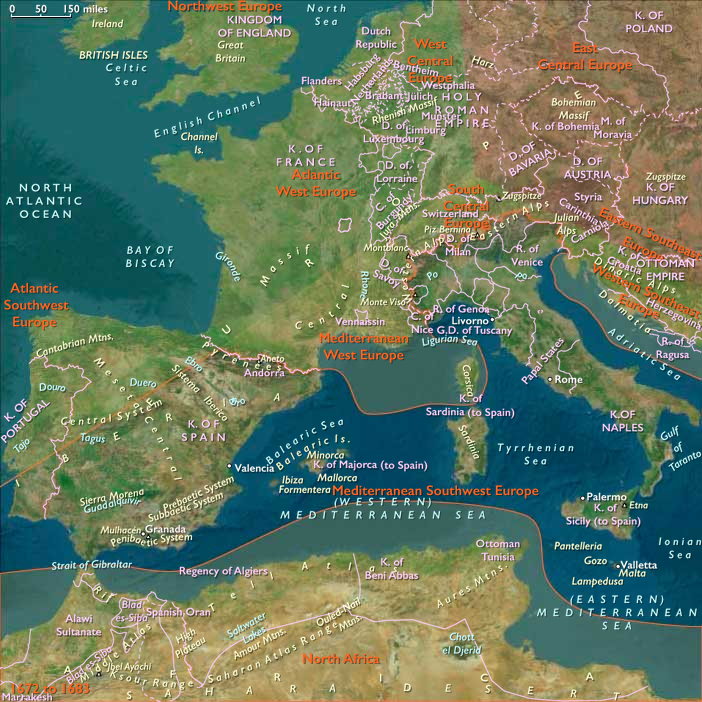
Locations
Regions
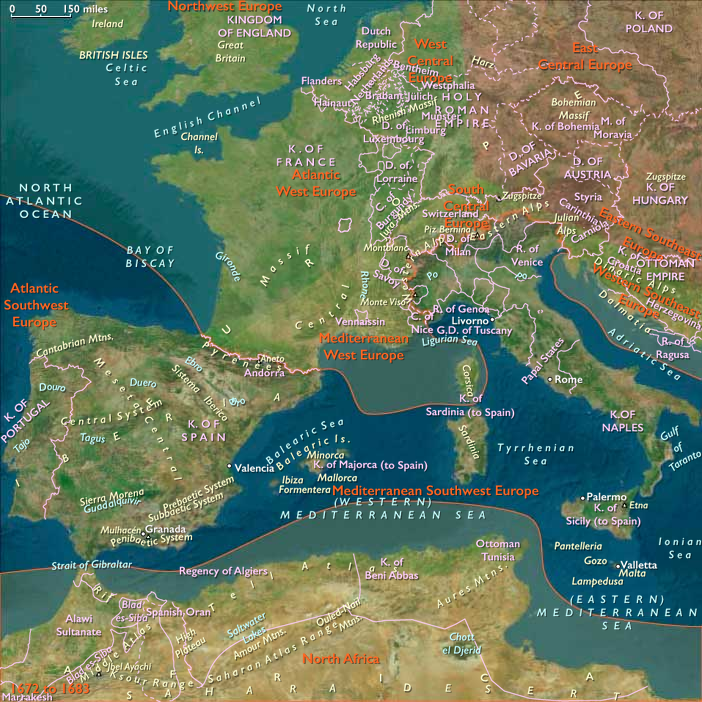
Southwest Europe
View →Subregions