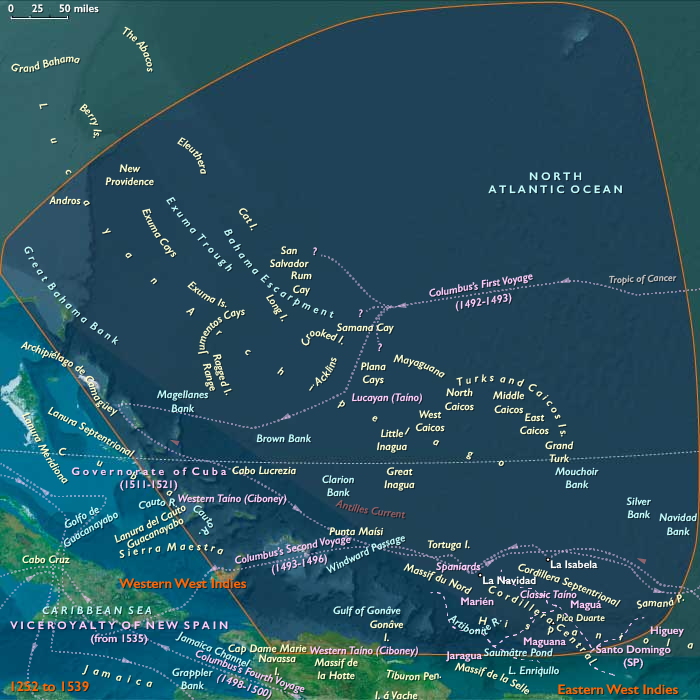
Between one hundred thousand and five million…
1492 CE to 1503 CE
Between one hundred thousand and five million Taíno and Ciboney live on the island of Hispaniola in the fifteenth century.
They base their flourishing economies on cassava farming, fishing, and inter-island trade (gold jewelry, pottery, and other goods).
The well-organized Taíno society on Quisqueya is divided between five different caciquats or kingdoms, each governed by a chief or cacique.
The cacique, who can be either male or female, plays the role of priest, healer and local legislator.
The Marien, with Guacanagaric as cacique, is situated in the north and north East Coast interior straddling the northern regions of present Haiti and Dominican Republic.
Christopher Columbus sights Quisqueya on December 6, 1492.
Anchoring near present Cap-Haïien on the north coast, he names it La Isla Española (”The Spanish Island”, anglicized as Hispaniola).
Over the next few decades, the will Spanish enslave vast numbers of the island's inhabitants to mine for gold.
European diseases, harsh reprisals and brutal working conditions devastate the indigenous population, which by the end of 1513 will have fallen to about thirty thousand.
Locations
People
Topics
Commodities
Subjects
Regions

West Indies
View →Subregions