
The creation of Simón Bolívar's Republic of …
Years: 1816 - 1827
The creation of Simón Bolívar's Republic of Colombia is the only instance in which an entire Spanish viceroyalty remains united, even briefly, after independence.
This unity results in large measure from the particular way in which independence is achieved in northern South America—by forces moving back and forth without regard to former colonial boundaries, under the supreme leadership of a single commander, Bolivar.
It also reflects the conviction of Bolívar himself that the union brings together peoples whose sense of common destiny has been heightened in the recent struggle, plus a wealth of resources—the gold of New Granada, the agricultural economy of Venezuela, and the textile workshops of highland Ecuador—that are basically complementary.
He likewise feels that only a large nation can gain respect on the world stage.
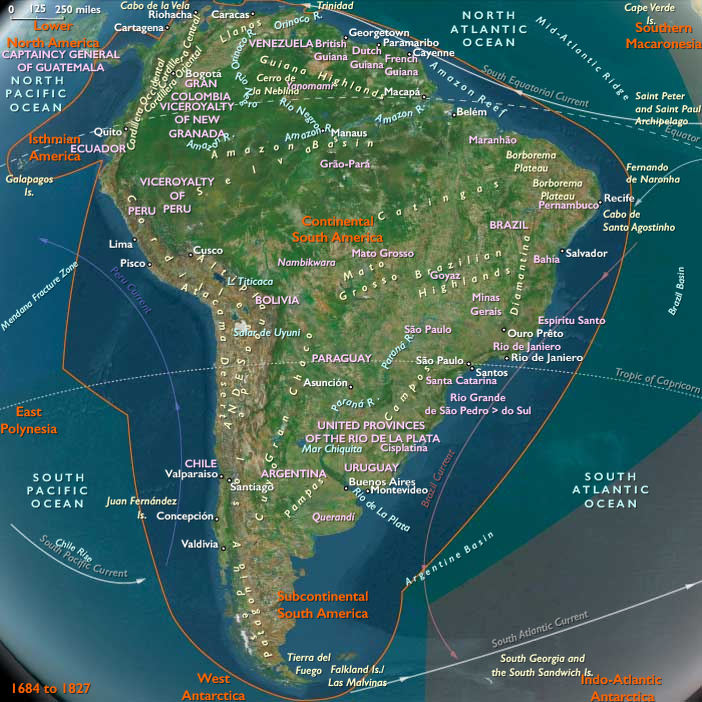
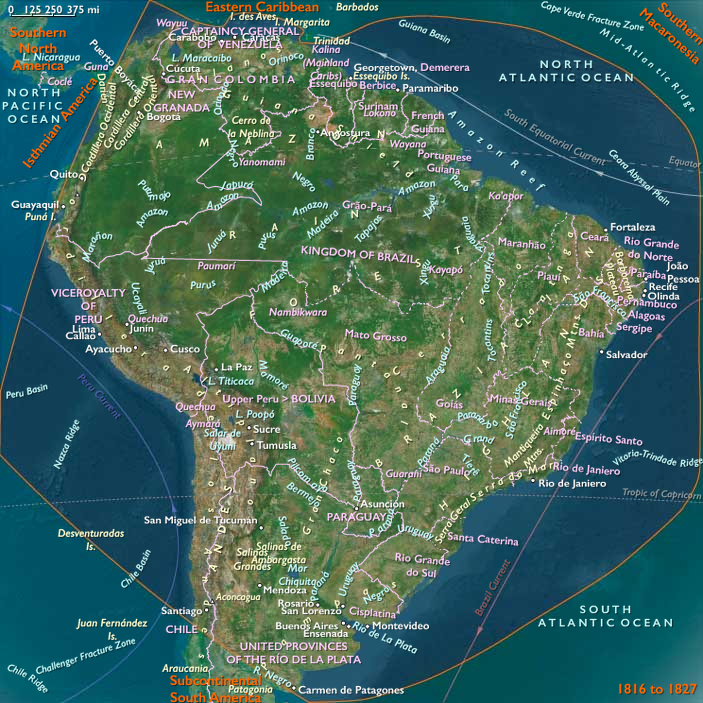
However, he does not adequately weigh certain problems, of which perhaps most obvious is the lack of an integrated transportation and communication network: it is easier to travel from Caracas to Philadelphia or from Quito to Lima than from either one to Bogota, which, by its central location, is the inevitable capital of the new nation.
Although economies may have been complementary to some extent, interests are not necessarily compatible; the insistent demand of Ecuadorian textile makers for high protective tariffs is not what suits Venezuelan agricultural exporters.
Neither does the common experience of Spanish rule and the fight against it offset the stark social and cultural differences between, for example, the lawyers of Bogota, the Quechua-speaking natives of highland Ecuador, the pardo and mestizo vaqueros of the Orinoco basin, and the planters of Andean Venezuela.
Nevertheless, in 1821 the young republic holds a constituent assembly, known as the Congress of Cúcuta, which duly reaffirms the union and goes on to adopt a highly centralized system of government, under which the entire country is divided into provinces and departments whose heads are named from Bogotá.
There are elected provincial assemblies, but with no meaningful power in local affairs.
Gran Colombia's constitution of 1821, while eschewing federalism, in some other respects reveals the clear influence of the U.S. model and is for the most part a conventionally republican document.
It provides for strict separation of powers—too strict, in Bolívar's view, despite the fact that, like other early Latin American constitutions, it authorizes sweeping "extraordinary" prerogatives for the executive to use in cases of emergency.
Socioeconomic restrictions limit the right to vote to at most ten percent of free adult males, but this is fairly standard procedure at this time.
Citizens are guaranteed a list of basic rights that do not include freedom of worship, but neither are non-Roman Catholic faiths expressly forbidden, so that the question of religious toleration is left open to be dealt with later.
At the same time, the Congress of Cúcuta itself equips the new nation with a number of enlightened reforms: slavery is not immediately abolished, but provision is made for its gradual extinction by adopting nationwide the free-birth principle enacted earlier in Antioquia; likewise, natives are relieved of the obligation to pay tribute or perform any kind of involuntary labor.
Finally, the same Congress of Cúcuta elects Bolívar president and, because he is Venezuelan, provides regional balance by making the New Granadan Santander vice president.
This unity results in large measure from the particular way in which independence is achieved in northern South America—by forces moving back and forth without regard to former colonial boundaries, under the supreme leadership of a single commander, Bolivar.
It also reflects the conviction of Bolívar himself that the union brings together peoples whose sense of common destiny has been heightened in the recent struggle, plus a wealth of resources—the gold of New Granada, the agricultural economy of Venezuela, and the textile workshops of highland Ecuador—that are basically complementary.
He likewise feels that only a large nation can gain respect on the world stage.
However, he does not adequately weigh certain problems, of which perhaps most obvious is the lack of an integrated transportation and communication network: it is easier to travel from Caracas to Philadelphia or from Quito to Lima than from either one to Bogota, which, by its central location, is the inevitable capital of the new nation.
Although economies may have been complementary to some extent, interests are not necessarily compatible; the insistent demand of Ecuadorian textile makers for high protective tariffs is not what suits Venezuelan agricultural exporters.
Neither does the common experience of Spanish rule and the fight against it offset the stark social and cultural differences between, for example, the lawyers of Bogota, the Quechua-speaking natives of highland Ecuador, the pardo and mestizo vaqueros of the Orinoco basin, and the planters of Andean Venezuela.
Nevertheless, in 1821 the young republic holds a constituent assembly, known as the Congress of Cúcuta, which duly reaffirms the union and goes on to adopt a highly centralized system of government, under which the entire country is divided into provinces and departments whose heads are named from Bogotá.
There are elected provincial assemblies, but with no meaningful power in local affairs.
Gran Colombia's constitution of 1821, while eschewing federalism, in some other respects reveals the clear influence of the U.S. model and is for the most part a conventionally republican document.
It provides for strict separation of powers—too strict, in Bolívar's view, despite the fact that, like other early Latin American constitutions, it authorizes sweeping "extraordinary" prerogatives for the executive to use in cases of emergency.
Socioeconomic restrictions limit the right to vote to at most ten percent of free adult males, but this is fairly standard procedure at this time.
Citizens are guaranteed a list of basic rights that do not include freedom of worship, but neither are non-Roman Catholic faiths expressly forbidden, so that the question of religious toleration is left open to be dealt with later.
At the same time, the Congress of Cúcuta itself equips the new nation with a number of enlightened reforms: slavery is not immediately abolished, but provision is made for its gradual extinction by adopting nationwide the free-birth principle enacted earlier in Antioquia; likewise, natives are relieved of the obligation to pay tribute or perform any kind of involuntary labor.
Finally, the same Congress of Cúcuta elects Bolívar president and, because he is Venezuelan, provides regional balance by making the New Granadan Santander vice president.
Locations
People
Groups
- Tairona
- Christians, Roman Catholic
- Muisca (Amerind tribe)
- Spaniards (Latins)
- Venezuela, Captaincy General of
- New Granada, United Provinces of
- Colombia, Republic of (Gran Colombia)
Topics
- Colonization of the Americas, Spanish
- Colombian War of Independence
- Bolivar's War
- Bolívar's campaign to liberate New Granada
Commodoties
Subjects
Regions
Subregions
Related Events
Showing 10 events out of 20863 total
Years: 1816 - 1827
Locations
People
Groups
- Tairona
- Christians, Roman Catholic
- Muisca (Amerind tribe)
- Spaniards (Latins)
- Venezuela, Captaincy General of
- New Granada, United Provinces of
- Colombia, Republic of (Gran Colombia)
Topics
- Colonization of the Americas, Spanish
- Colombian War of Independence
- Bolivar's War
- Bolívar's campaign to liberate New Granada
Commodoties
Subjects
Regions
Subregions