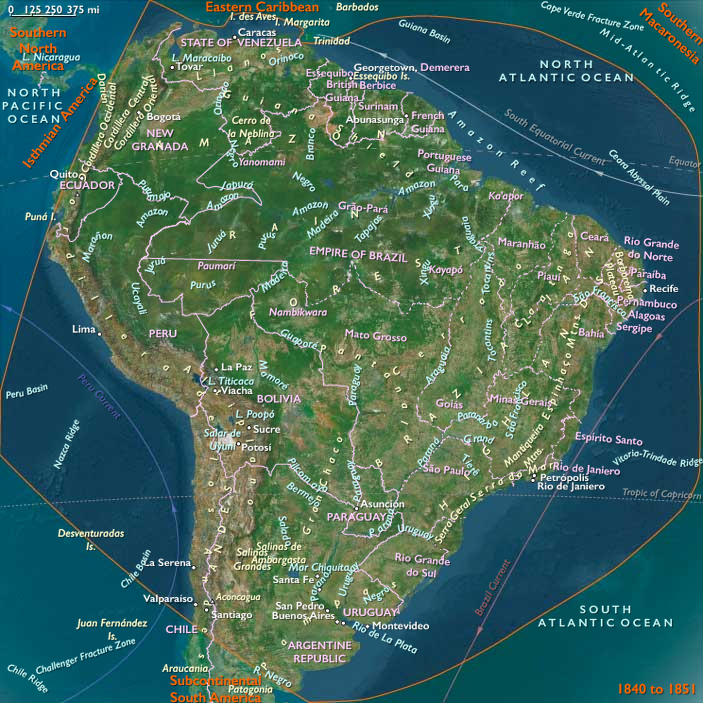
The city of Petrópolis is founded by…
March 1843 CE
Until the eighteenth century, the region was inhabited by the índios coroados (crowned indians), which had earned it the Portuguese name of "Sertão dos Índios Coroados".
It was only with the discovery of gold in Minas Gerais and the consequent opening of the new way of the mines that passed through Petrópolis in that century that the region began to be occupied by non-indigenous people.
The town's origins can be traced to Bernardo Soares de Proença, who between 1722 and 1725 opened an alternative route between Rio de Janeiro and Minas Gerais, across the Serra da Estrela called "Caminho Novo das Minas" (New Road to Mines).
Emperor Pedro I, while traveling to Minas Gerais along this route in 1822, had found the region's climate pleasant, while staying at the farm of Correia, a Catholic priest.
As the priest's sister and heiress had refused to sell his property, the Emperor bought the neighboring one, the Córrego Seco Farm, in 1830.
He had his Summer Palace built there, but never saw it finished, because he stepped down from the throne, on April 7, 1831.
Other Brazilian aristocrats eventually followed suit.
His son, Emperor Pedro II, on March 16, 1843, signs an imperial decree ordering the construction of a settlement (to be formed with the arrival of German immigrants) and the construction of the dreamy summer palace on his outlying lands, the cornerstone of which will be settled by the Emperor in May 1845, and that will be ready in 1847.
Conceived by Major Julius Friedrich Koeler, Petrópolis is considered as the second projected city of Brazil (after Recife, designed during the Dutch period), being composed of an urban nucleus—the city (now the Center), where the Imperial Palace, Public buildings, commerce and services.
From that time on, during the summer, the city will became the de facto capital of the Empire of Brazil, with the change of the whole court.
Locations
People
Groups
Subjects
Regions
South America
View →Subregions