
Breu the Elder paints “Scenes from the…
1502 CE
Breu the Elder paints “Scenes from the Life of St. Bernard” for the Monastery of Zwettl in 1502.
Locations
People
Regions
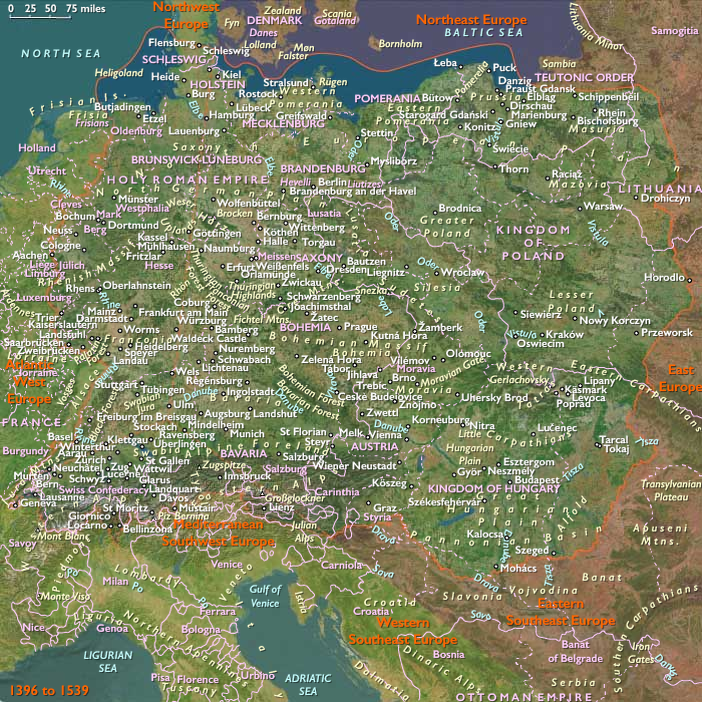
Central Europe
View →Subregions
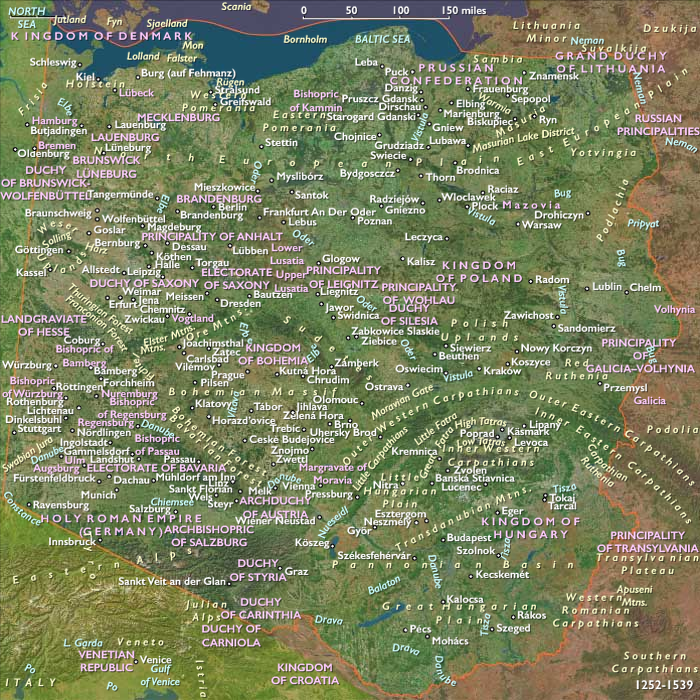
East Central Europe
View →Related Events
No active filters.
Showing 10 events out of 39831 total
Babur had tried to reclaim Fergana but lost it as well.
Escaping with a small band of followers, he wanders to the mountains of central Asia and takes refuge with hill tribes.
Thus, during the ten years since becoming the ruler of Fergana, Babur has suffered many short-lived victories and has often been without shelter and in exile, aided by friends and peasants.
He finally stays in Tashkent, which is ruled by his maternal uncle.
Babur will later write, "During my stay in Tashkent, I endured much poverty and humiliation.
No country, or hope of one!"
By 1502, Babur has resigned all hopes of recovering Fergana: left with nothing, he is forced to try his luck someplace else.
Ivan the Young, Ivan's son with Maria of Tver, had died in 1490, leaving from his marriage with Helen of Moldavia an only child, Dmitry the Grandson.
The latter had been crowned as successor by his grandfather on February 15, 1498, but Ivan later reverts his decision in favor of Sophia's elder son Vasily, who is ultimately crowned co-regent with his father on April 14, 1502).
The decision is dictated by the crisis connected with the Sect of Skhariya the Jew, as well as by the imperial prestige of Sophia's descendants.
Dmitry the Grandson is put into prison, where he will die, unmarried and childless, in 1509, already under the rule of his uncle.
The Grand Duke is increasingly aloof from his boyars, who are no longer consulted on affairs of state.
The old patriarchal systems of government have vanished.
The sovereign has become sacrosanct, while the boyars are reduced to dependency on the will of the sovereign.
The boyars naturally resent this revolution and struggle against it.
Norway allies with Sweden in 1502 in the escalating Danish-Swedish War, but the cruel treatment of captured Norwegian rebels by King John’s son Christian frightens the country into submission.
Leading the Danes into Sweden, Christian seizes two fortresses in Västergötland and slaughters their defenders.
Frederick III of Wettin, a member of the Ernestine branch of the family, born in Torgau, had succeeded his father Ernst in 1486 as Elector of Saxony.
Called "the Wise" because of his reputation for good advice among the German princes, Frederick is among the princes who have pressed the need of reform upon Holy Roman Emperor Maximilian I, and in 1500 he becomes president of the newly formed council of regency (Reichsregiment).
He founds Wittenburg University in 1502.
Dürer had made watercolor sketches as he traveled over the Alps.
Some have survived and others may be deduced from accurate landscapes of real places in his later work, for example his engraving Nemesis.
South German landscape painter Jörg Breu the Elder had journeyed in 1500 from his native Augsburg to Austria and has created several multi-panel altarpieces here such as the Melk Altar in 1502.
Ismail, having started with just the possession of Azerbaijan, Shirvan, southern Dagestan (with its important city of Derbent), and Armenia in 1501, takes the title of "Shah of Iran" after defeating a Aq Qoyunlu army in 1502.
In the same year, he gains possession of Erzincan and …
…Erzurum.
Asher Lämmlein, a German born Jew who appears in Istria, near Venice, in 1502 and, encouraged by the works of Isaac Abrabanel, proclaims himself a forerunner of the Jewish Messiah, declares that if the Jews show great repentance and charity, the Messiah will not fail to appear in six months.
He gains a troop of adherents who spread his prophesies though Italy and Germany, and his message meets with such acceptance that the year becomse known as the "year of penance."
Existing institutions are willfully destroyed in the belief of coming redemption and a return to Jerusalem.
However, Lämmlein dies or suddenly disappears and the extravagant hopes of his followers come to an end.
Venice, by the time Aldus Manutius settled here in 1490, was not only a major printing center but it also had a large library of Greek manuscripts from Constantinople and a population of Greeks who could assist with their translation.
He soon afterward printed editions of Hero and Leander by Musaeus Grammaticus, the Galeomyomachia, and the Greek Psalter.
He calls these "Precursors of the Greek Library."
He began gathering Greek scholars and compositors around him, employing as many as thirty Greeks in his print shop and speaking Greek at home.
Instructions to typesetters and binders are given in Greek.
The prefaces to his editions are written in Greek.
Greeks from Crete collate manuscripts, read proofs, and give samples of calligraphy for casts of Greek type.
Manutius had issued the first volume of his edition of Aristotle in 1495; four more volumes completed the work in 1497–1498.
Nine comedies of Aristophanes appeared in 1498.
Thucydides, Sophocles, and Herodotus follow in 1502.
In addition to editing Greek classics from manuscripts, Manutius reprints editions of classics that had originally been published in Florence, Rome, and Milan, at times correcting and improving the texts.
His Aldine Press becomes noted for its anchor and dolphin signature, or colophon, which first appears in 1502.
In order to promote Greek studies, Manutius founds an academy of Hellenists in 1502 called the "New Academy."
Its rules are written in Greek, its members are obliged to speak Greek, their names are Hellenized, and their official titles are Greek.
Members of the "New Academy" include Desiderius Erasmus and the Englishman Thomas Linacre.
It is possible that during this period, in his printing works, Hieromonk Makarije was educated, who will later found the Obod printing works of Cetinje and print the first books in Serbian and Romanian.
Forty-two-year-old physician and philosopher Judah Abravanel, with his father Isaac a resident of Naples and now Venice during the decade since the expulsion of Jews from Spain, writes Dialoghi d'Amore (“Dialogues of Love”) by 1502.
Taking, as his central theme, love as the major creative force in the universe, he professes that love of God is the ultimate goal of the human soul.
A circle of love therefore leads from God's creation in love to man's return to God through love.
Abravanel is also a minor poet.