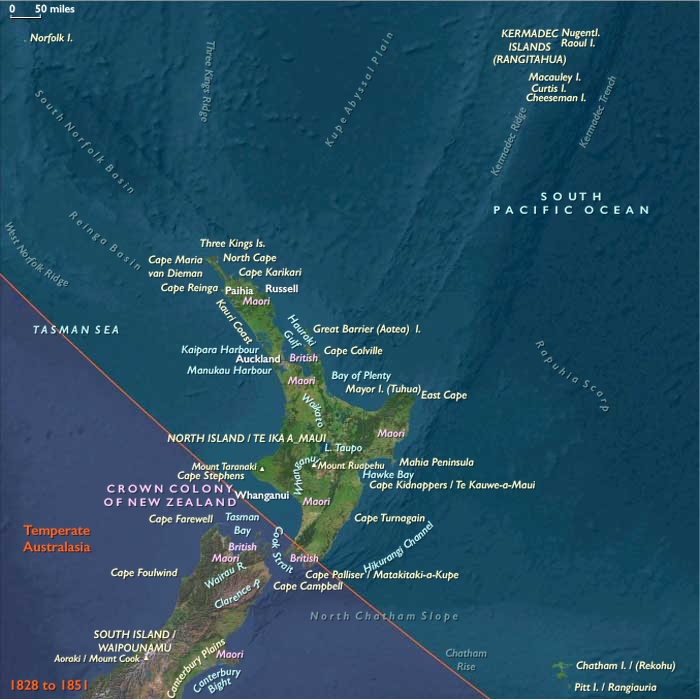
British naval commander William Hobson, offered the…
August 1839 CE
British naval commander William Hobson, offered the position of Superintendent of the Bombay Marine at a salary of two thousand pounds a year, had taken a liking to Australia and had been a candidate for the governorship of Port Phillip, although the salary was not expected to be more than eight hundred pounds a year.
In 1837, he had sailed to the Bay of Islands, New Zealand, in response to a request for help from James Busby, the British Resident, who felt threatened by wars between Maori tribes.
He had arrived on May 26, 1837 and helped to reduce the tensions.
On his return to England in 1838, he had submitted a report on New Zealand to propose a trading system and a treaty with the Maori to obtain land.
At this time, the British government recognizes the sovereignty of the Maori people, as represented in the Declaration of the Independence of New Zealand of October 1835, which Busby had organized.
Concerned over Wakefield’s dispatch of a survey party to purchase Maori lands and by suspicious French activity on South Island, the British government appoints Hobson Lieutenant Governor under the Governor of New South Wales, Sir George Gipps (ratified on July 30, 1839) and British consul to New Zealand (confirmed on August 13, 1839).
Lord Norman issues him with detailed instructions on August 14, 1839, giving reasons for intervention in New Zealand and directions for the purchase of land "by fair and equal contracts."
The land will later be resold to settlers at a profit to provide for further operations.
Locations
Groups
Subjects
Regions
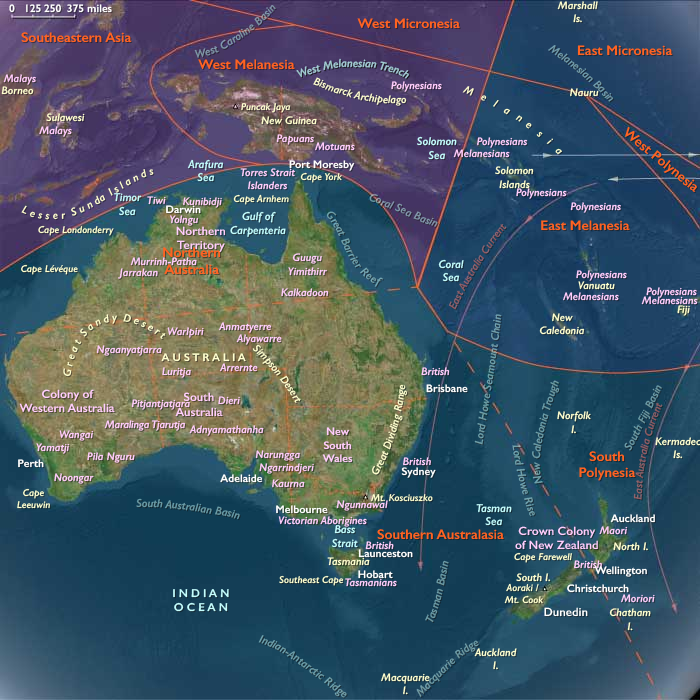
Australasia
View →Subregions