
Atlantic West Europe (45–34 BCE): From Caesar’s …
Years: 45BCE - 34BCE
Atlantic West Europe (45–34 BCE): From Caesar’s Aftermath to Augustan Stabilization
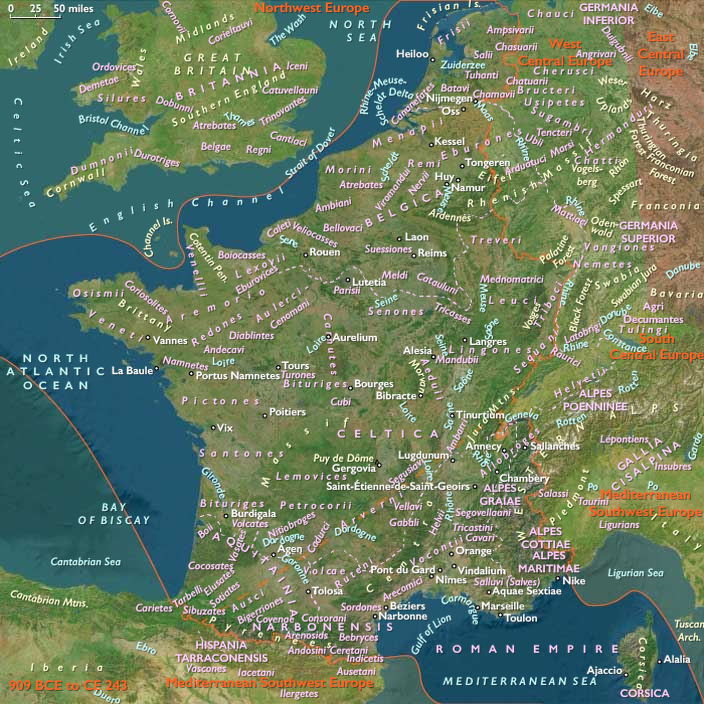
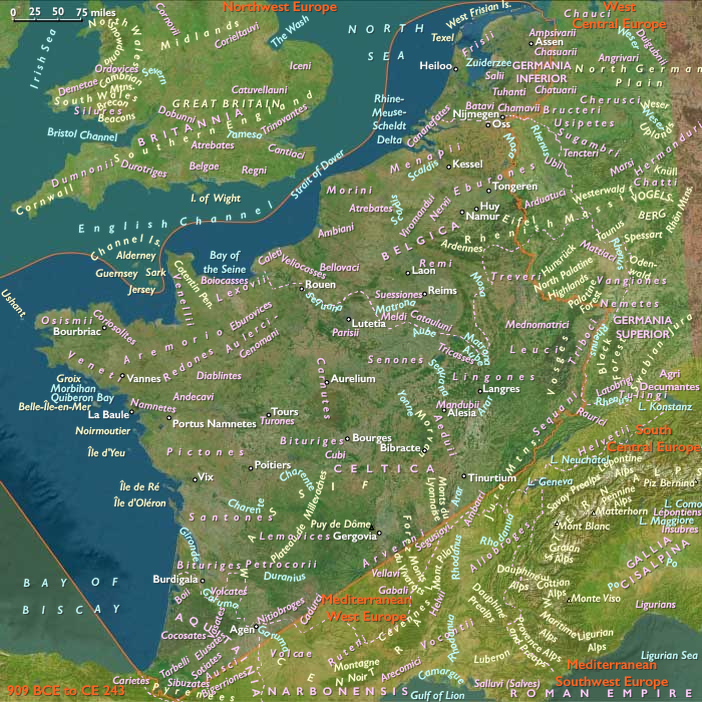
Between 45 and 34 BCE, Atlantic West Europe—including Aquitaine, the Atlantic coast, northern and central France, Alsace, and the Low Countries—underwent critical transformations, as the collapse of the Roman Republic transitioned into the early stability of Augustus’s Principate.
Political and Military Developments
Consolidation after Caesar’s Conquests
-
Following Julius Caesar's assassination (44 BCE), uncertainty briefly gripped Roman Gaul. Local tribes in Aquitaine, the Loire Valley, and Belgica sought opportunities to reassert independence or renegotiate terms with Rome.
-
Mark Antony's subordinate, Marcus Aemilius Lepidus, and Octavian swiftly reinforced Roman control in Gaul through diplomacy and military intimidation, stabilizing the region.
Regional Reorganizations under Octavian
-
Octavian began administrative reorganizations, strengthening Roman rule by establishing coloniae (Roman settlements) and military veterans’ communities, particularly along strategic points such as Narbo (Narbonne) and Burdigala (Bordeaux).
-
Local Celtic aristocrats were co-opted into Roman administration, solidifying loyalty among tribal elites.
Economic and Social Developments
Infrastructure and Urban Growth
-
Roman infrastructure projects (roads, aqueducts, early towns) accelerated, enhancing economic integration. Aquitaine's developing wine industry increasingly fed markets in Italy and elsewhere in the Roman world.
-
New trade networks emerged, bolstered by stable Roman authority, connecting Atlantic ports such as Bordeaux and Nantes to Mediterranean and northern European routes.
Cultural and Social Integration
-
Local elites began to adopt Roman customs, including Latin language and urban lifestyles, leading to an early form of Gallo-Roman cultural identity.
-
Roman colonization and settlement increased urbanization, as Roman veterans and merchants settled in strategic locations throughout the region.
Cultural and Religious Developments
Early Romanization and Religious Syncretism
-
The Roman presence fostered religious syncretism, combining Celtic and Roman deities. Roman gods like Mercury and Mars became associated with local deities in places such as Lutetia (Paris) and Avaricum (Bourges).
-
Druids maintained significant influence, but Roman political authorities viewed them as potential sources of unrest, marking the beginning of gradual suppression.
Key Figures and Events
-
Octavian (future Augustus): Initiated policies that brought stability to the region after initial uncertainty following Caesar’s death.
-
Marcus Agrippa: Conducted infrastructure improvements and pacification efforts, particularly around strategic Atlantic centers.
Long-Term Significance
By 34 BCE, Atlantic West Europe was firmly on the path toward full integration into the Roman Empire:
-
Roman rule and administrative reforms created stability after initial turmoil.
-
Roman cultural influence took root among local elites, paving the way for deeper Romanization.
-
Economic developments, especially in Aquitaine and along the Atlantic coast, laid the groundwork for long-term prosperity under imperial rule.
This era thus marked the pivotal transition from Republican instability to the establishment of enduring Roman control and cultural integration in Atlantic West Europe.
People
Groups
Topics
- Roman colonization
- Roman Age Optimum
- Roman Republic, Crisis of the
- Roman Civil War, Great, or Caesar's Civil War
- Roman Civil War of 44-31 BCE
Commodoties
Subjects
Regions
Subregions
Related Events
Showing 10 events out of 62463 total
Years: 45BCE - 34BCE
People
Groups
Topics
- Roman colonization
- Roman Age Optimum
- Roman Republic, Crisis of the
- Roman Civil War, Great, or Caesar's Civil War
- Roman Civil War of 44-31 BCE
Commodoties
Subjects
Regions
Subregions