
Bubonic plague, which appears in Constantinople in…
745 CE
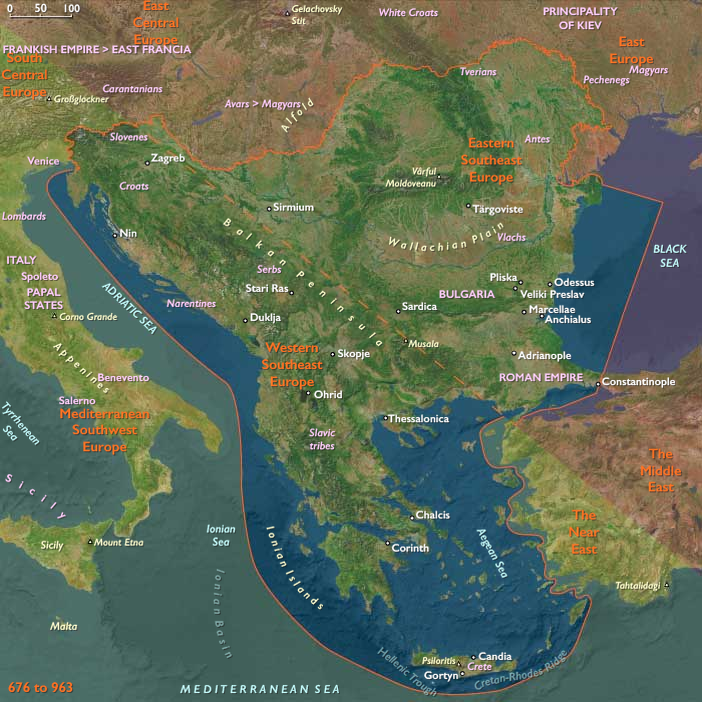
Bubonic plague, which appears in Constantinople in 745, will subsequently sweep through Europe.
Locations
Subjects
Regions
Southeast Europe
View →Subregions

Eastern Southeast Europe
View →Related Events
No active filters.
Showing 10 events out of 55366 total
Japanese temple foundations grow even larger during the Nara period, rivaling those of Tang China.
The huge and impressive monastery of the Todai-ji, begun in 745, reflects the primacy of the “kondo” and sees the removal of the pagodas from the sanctuary proper.
The Karluk vanguard had left the Altay region and at the beginning of the eighth century had reached the banks of the Amu Darya.
Famed for their woven carpets in the pre-Muslim era, they are considered a vassal state by the Tang Dynasty after the final conquest of the Transoxania regions by the Chinese around 744.
The Karluks rise in rebellion against the Göktürk, at this time the dominant tribal confederation in the region, in about 745, and establish a new tribal confederation with the Uyghur and Basmyl tribes.
The new caliph has succeeded in gaining control of Damascus and Syria, but elsewhere his authority ranges from theoretical to nonexistent.
In Iraq, this turmoil spills over in the form of a struggle between Yazid III's governor Abdallah ibn Umar and Marwan's appointee, al-Nadr ibn Sa'id al-Harashi.
This conflict has allowed the Kharijites, a Muslim sect which had originated in Mesopotamia, to rise up.
This revolt was initially led by Sa'id ibn Bahdal, but he died soon of the plague, and has been succeeded by Al-Dahhak ibn Qays al-Shaybani, who quickly assembles a sizable army, and manages to defeat the two rival governors, who had joined forces, in April/May 745.
In the aftermath of their defeat, al-Harashi returns to Marwan and Abdallah ibn Umar retreats to the fortress of Wasit, where he is soon besieged.
In August, however, ibn Umar gives himself up, and, in an unprecedented act for a member of the Umayyad dynasty and of the Prophet's own Quraysh tribe, does homage to Dahhak, who is neither and who has by now been declared caliph by his followers.
Marwan, after crushing the Syrian revolt in 745, forms an army of Syrian troops to send into Iraq, but they rebel on their way and accept Sulayman as their leader.
The rebel army takes Qinnasrin, but are soon after defeated by Marwan.
Although much of his army survives and withdraws to …
…Homs under the command of his brother Sa'id (where they are soon besieged by Marwan's forces), Sulayman flees from Homs to …
…Palmyra, then to …
…Kufa, where he enters the service of al-Dahhak ibn Qays al-Shaybani, the leader of the Mesopotamian Kharijites who, taking advantage of Marwan's preoccupation with the prolonged siege of Homs, has claimed the caliphate.
Kufa, now occupied by Dahhak's forces, has become his seat, while ibn Umar has been named named governor of Wasit, eastern Iraq and western Persia.
Dahhak's generosity in rewarding his followers, as well as the attractiveness of Kharijite doctrine, quickly swells his rank further, until his army is said to have reached one hundred and twenty thousand men.
The destruction of Arab forces in Anatolia in 740 has furthered the decline of the Umayyads.
Constantine reinvades Syria in 745, conquering additional territory as feuds between the Qays and the Kalb erupt into major revolts in Syria, Iraq, and Khorasan.
(The rivalry between Qais and the Banu Kalb, which has extended to the "North Arab" [Qais-led] versus "South Arab" or "Yemeni" [Kalb-led] tribal supergroups, had become firmly established after the Battle of Marj Rahit [684].)
Marwan names his two sons Ubaydallah and Abdallah heirs.
He appoints governors and proceeds to assert his authority by force.
However, anti-Umayyad feeling is very prevalent, especially in Iran and Iraq, where the Abbasids have gained much support.
As such, Marwan's reign as caliph will be almost entirely devoted to trying to keep the Umayyad empire together.
Odilo vassalizes the formerly independent Slavic princes of Carantania (roughly corresponding with the later March of Carinthia), who have asked him for protection against the invading Avars, in 745.
Tha'laba ibn Salama, according to chronicler Ibn al-Hakam, had sailed to Ifriqiya shortly after and served briefly there under Handhala ibn Safwan al-Kalbi in various military commands, then returned to the east, possibly with Handhala, around the time of the 745 coup of Abd al-Rahman ibn Habib al-Fihri.