
Buckingham Palace, its restoration completed in 1835,…
1837 CE
Buckingham Palace, its restoration completed in 1835, finally becomes the official royal palace of the British monarch on the accession of Queen Victoria of Hanover (properly, Saxe-Coburg-Gotha, after her consort, Prince Albert) upon the death of her father, Britain’s King William IV.
At this time, the United Kingdom is already an established constitutional monarchy in which the king or queen holds few political powers.
However, she still serves as a very important symbolic figure of her time.
The building which forms the core of today's palace had been a large townhouse built for the Duke of Buckingham in 1703 and acquired by George III in 1761 as a private residence, known as "The Queen's House".
It had been enlarged over the next seventy-five years, principally by architects John Nash and Edward Blore, forming three wings around a central courtyard.
The first monarch to reside at Buckingham Palace, she moves into the newly completed palace upon her accession on June 20, 1837.
While the state rooms are a riot of gilt and color, the necessities of the new palace are somewhat less luxurious.
For one thing, it is reported the chimneys smoke so much that the fires have to be allowed to die down, and consequently the court shivers in icy magnificence.
Ventilation is so bad that the interior smells, and when a decision is taken to install gas lamps there is a serious worry about the buildup of gas on the lower floors.
It is also said that the staff are lax and lazy and the palace is dirty.
Images

The palace c. 1837, depicting the Marble Arch, which served as the ceremonial entrance to the Palace precincts. It was moved to make way for the east wing, built in 1847, which enclosed the quadrangle.
Locations
Subjects
Regions
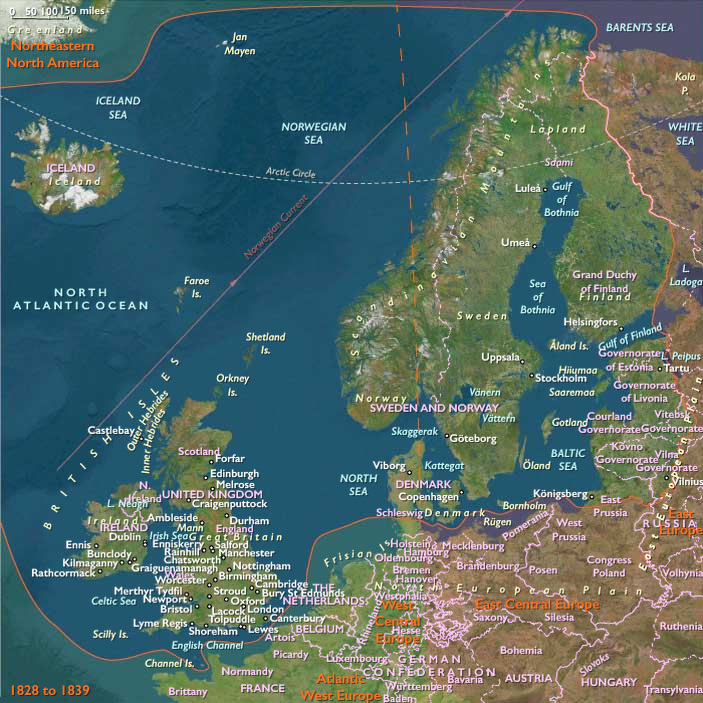
North Europe
View →Subregions
