Burgundian poet Pontus de Tyard, seigneur (lord)…
1587 CE
Burgundian poet Pontus de Tyard, seigneur (lord) of Bissy-sur-Fley and an associate of the Lyonese poets, especially Maurice Scève, had in 1551 translated León Hebreo's Dialoghi di amore (“Dialogues of Love”), the breviary of sixteenth-century philosophic lovers.
His poetry collection Erreurs amoureuses (1549; “Mistakes in Love”), which includes one of the first French sonnet sequences, had also revived the sestina in France.
The Erreurs has been augmented in successive editions, as has his important prose work, Discours philosophiques (“Philosophical Discourses”), a Neoplatonic encyclopaedia finally completed in 1587.
Its first treatise, the Solitaire premier (1552), complements Joachim du Bellay's Défense et illustration de la langue française (1549), which expounded the theories on poetic diction and language reform of La Pléiade.
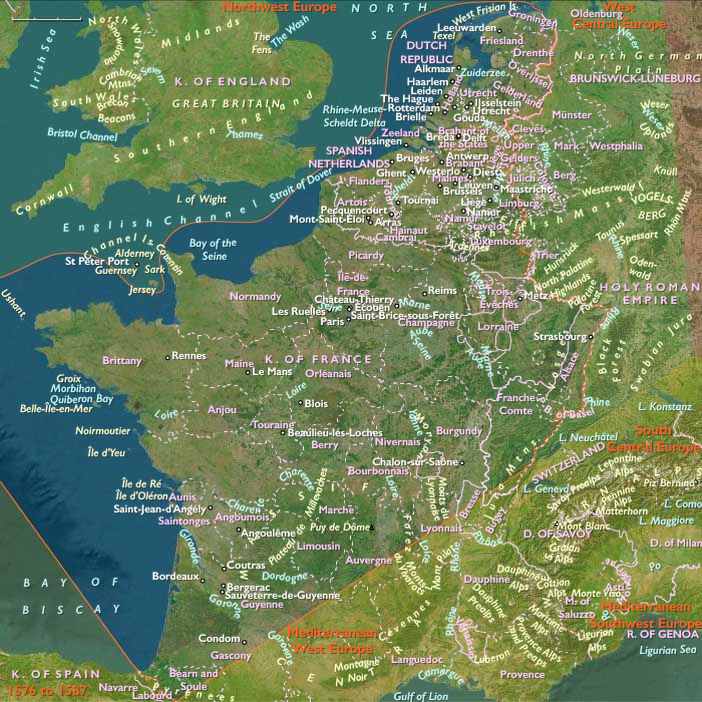
Tyard had in 1578 been given the bishopric of Chalon-sur-Saône.
A member of the literary circle known as La Pléiade as well as a forthright theorist and a popularizer of Renaissance learning for the elite, Tyard, in his enthusiasm for enriching the French language and adapting classical imagery and genre, shares the contempt for the masses felt by his associates.
In the Solitaire premier he had praised those poets who decorated their verse so richly with the ornaments of antiquity that the ignorant could not comprehend them.
He had remarked that the purpose of the poet is not to be understood by nor to lower himself to accommodate a popular audience still fond of medieval genres.
It was this hauteur and this sense of mission without contact beyond the protective society of the court that caused La Pléiade to shine so briefly and to become within a generation as dead as the Greek poets from whom they took their name.
Locations
Groups
Subjects
Regions
West Europe
View →Subregions