
Cabral's instructions are several-fold. The priority …
Years: 1500 - 1500
March
Cabral's instructions are several-fold.
The priority is to secure a treaty with Zamorin's Calicut, the principal commercial entrepôt of the Kerala spice trade and dominant feudal city-state on the Malabar coast of India.
Calicut had been visited by Vasco da Gama's first armada in 1498, but failed to impress the elderly ruling Manivikraman Raja Zamorin ('Samoothiri Raja') of Calicut, and no agreements had been signed.
Cabral's instructions are precisely to succeed where Gama had failed, and to this end is entrusted with magnificent gifts to present to the Zamorin.
Cabral is under orders to establish a factory in Calicut, to be placed under Aires Correia, the designated factor for Calicut.
The second priority, assigned to the brothers Bartolomeu Dias and Diogo Dias, is to search out the East African port of Sofala, near the mouth of the Zambezi river.
Sofala had been secretly visited and described by the explorer Pêro da Covilhã during his overland expedition a little over a decade earlier, and he had identified it as the end-point of the Monomatapa gold trade.
The Portuguese crown is eager to tap into this gold source, but Gama's armada had failed to find it.
The Dias brothers are instructed to find and establish a factory at Sofala under designated factor Afonso Furtado.
To this end, instructions are probably also given to secure the consent of Kilwa (Quíloa), the dominant city-state of the East African coast and putative overlord of Sofala.
Like Sofala, Kilwa had been visited by Covilhã, but overlooked by Gama.
A minor objective includes the delivery of a group of Franciscan missionaries to India.
It is said that Vasco da Gama had misinterpreted the Hinduism he saw practiced in India as a form of 'primitive' Christianity.
He believed its peculiar characteristics were a result of centuries of separation from the mainstream church in Europe.
Gama recommended that missionaries be sent to India to help bring the practices of the 'Hindu church' up to date with Roman Catholic orthodoxy.
To this end, a group of Franciscan friars, led by Fr. Henrique Soares of Coimbra, has joined the expedition.
Finally, the Second Armada is also a commercial spice run.
The crown and private merchants who have outfitted the ships expect full cargoes of spices to return to Lisbon.
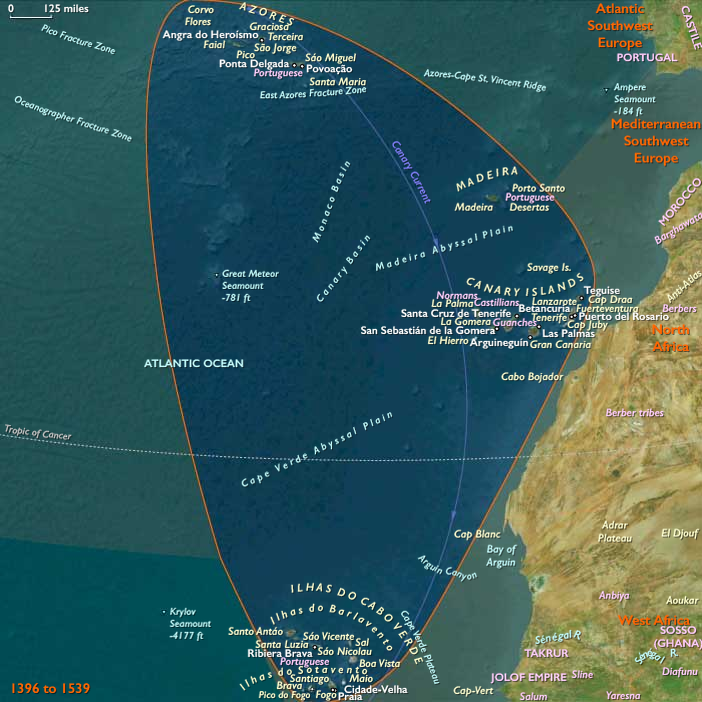
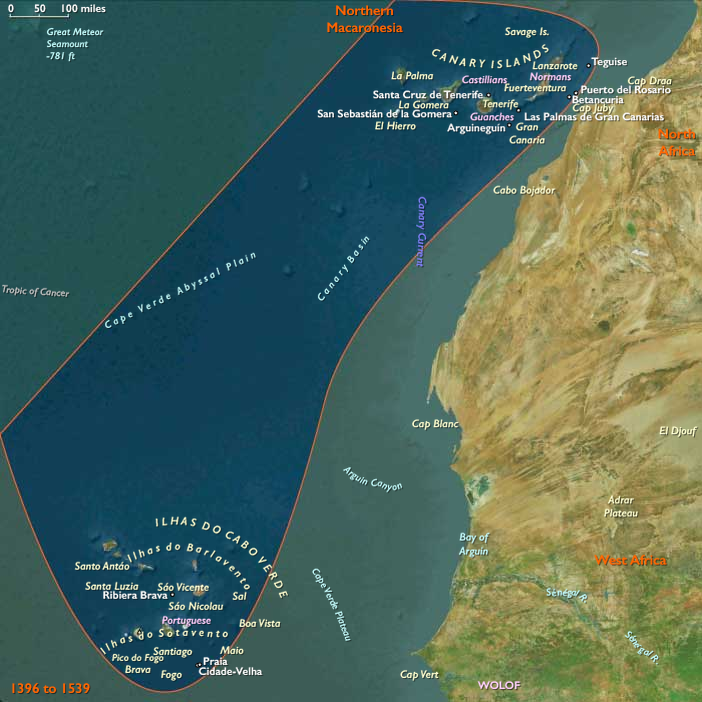
Cabral's fleet of thirteen ships had set out from the Tagus on March 9, 1500, reaching the Cape Verde island of São Nicolau on the 22nd in the middle of a storm. (One of the ships, either the privately outfitted ship of Luís Pires or the crown ship of Vasco de Ataide was either too damaged by the tempest to continue, and returned to Lisbon, or was lost around Cape Verde, respectively.)
From Cape Verde, Cabral strikes southwest.
The reasons for this unusual direction have been speculated upon endlessly.
The most probable hypothesis is that Cabral was simply following the wide arc in the South Atlantic to catch a favorable wind to carry them to the Cape of Good Hope.
Locations
People
- Bartolomeu Dias
- Diogo Dias
- Manuel I of Portugal
- Nicolau Coelho
- Pedro Álvares Cabral
- Pêro Escobar
- Pêro da Covilhã
- Vasco da Gama
Groups
- Hinduism
- Arab people
- Indian people
- Nair
- Islam
- Kilwa Sultanate
- Genoa, (Most Serene) Republic of
- Christians, Roman Catholic
- Franciscans, or Order of St. Francis
- Castile, Crown of
- Portugal, Avizan (Joannine) Kingdom of
- Portuguese Empire
- Mutapa, Kingdom of
- Florence, Republic of
- Portuguese Mozambique
Topics
- India, Medieval
- Sub-Saharan Africa, Medieval
- Interaction with Subsaharan Africa, Early European
- Age of Discovery
- Colonization of the Americas, Portuguese
- Colonization of the Americas, Spanish
- Columbian Exchange
- Colonization of Asia, Portuguese
Commodoties
Subjects
Regions
Subregions
Years: 1500 - 1500
March
Locations
People
- Bartolomeu Dias
- Diogo Dias
- Manuel I of Portugal
- Nicolau Coelho
- Pedro Álvares Cabral
- Pêro Escobar
- Pêro da Covilhã
- Vasco da Gama
Groups
- Hinduism
- Arab people
- Indian people
- Nair
- Islam
- Kilwa Sultanate
- Genoa, (Most Serene) Republic of
- Christians, Roman Catholic
- Franciscans, or Order of St. Francis
- Castile, Crown of
- Portugal, Avizan (Joannine) Kingdom of
- Portuguese Empire
- Mutapa, Kingdom of
- Florence, Republic of
- Portuguese Mozambique
Topics
- India, Medieval
- Sub-Saharan Africa, Medieval
- Interaction with Subsaharan Africa, Early European
- Age of Discovery
- Colonization of the Americas, Portuguese
- Colonization of the Americas, Spanish
- Columbian Exchange
- Colonization of Asia, Portuguese
Commodoties
Subjects
Regions
Subregions