
South America Major (1540–1683 CE): Spanish Consolidation …
Years: 1540 - 1683
South America Major (1540–1683 CE): Spanish Consolidation and Indigenous Resistance
Geographic & Environmental Context
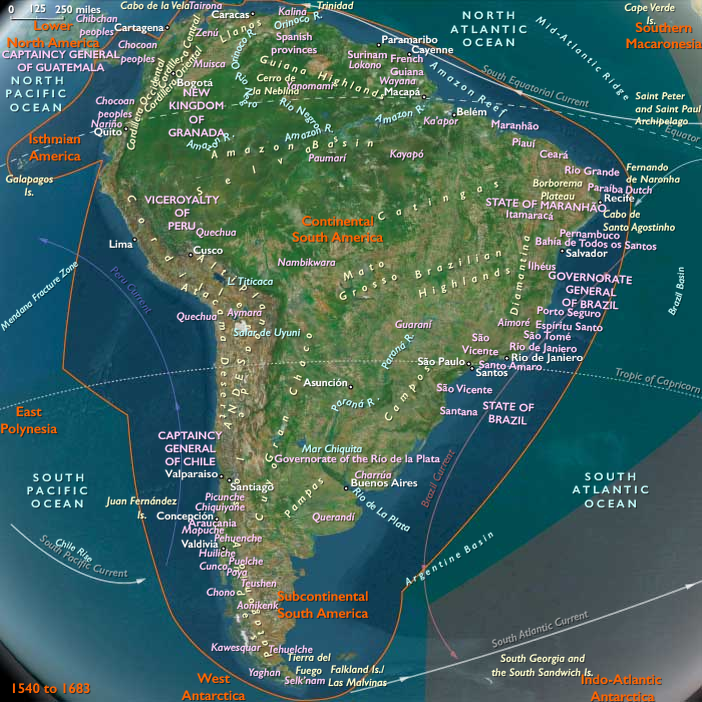
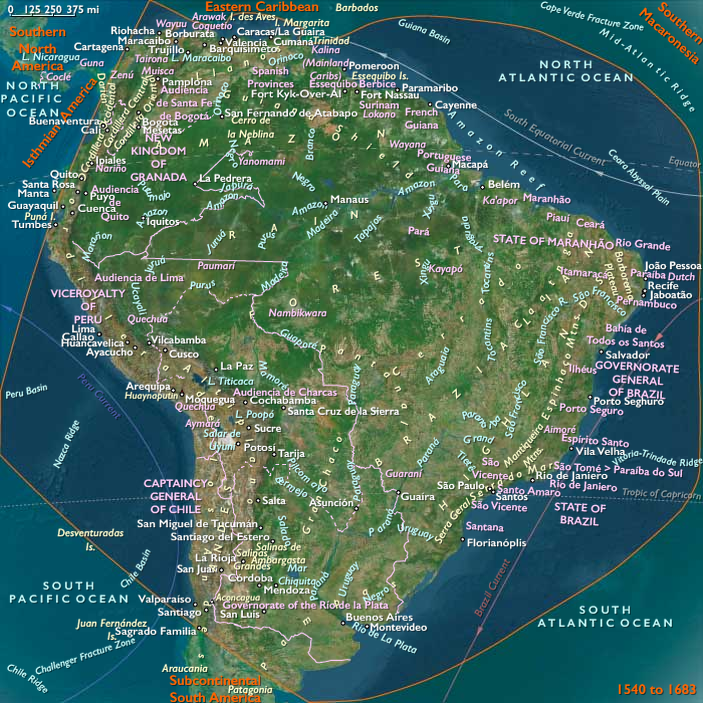
The subregion of South America Major encompasses all lands north of the Río Negro, extending across the full continental span of Brazil, Uruguay, Paraguay, northern Argentina and northern Chile, Bolivia, Peru, Ecuador (excluding the Cape lands at the Isthmian boundary), Colombia (excluding the Darién region, which belongs to Isthmian America), Venezuela, Guyana, Suriname, and French Guiana.
Anchors include the Andes cordillera and Altiplano, the Amazon basin, the Orinoco and Magdalena river systems, the Venezuelan Llanos, the Gran Chaco, the Uruguayan Pampas, and the Guiana Shield. Bounded by Isthmian America to the north and Subcontinental South America to the south, this subregion forms the continental heartland of South America—linking the Pacific and Atlantic worlds through its intertwined highlands, forests, plains, and river systems.
Two great colonial systems arose upon earlier networks—the Spanish viceroyalty of Peru, radiating from Lima, Cuzco, and Potosí; and the Portuguese State of Brazil, anchored by Bahia, Pernambuco, and later Rio de Janeiro. Between them stretched vast interior frontiers, still largely autonomous in the mid-sixteenth century.
Climate & Environmental Shifts
The Little Ice Age continued to shape continental rhythms.
-
Andean highlands: Cooler winters and increased frost shortened crop seasons; El Niño cycles triggered floods on the Pacific coast and fisheries collapse.
-
Amazon and Orinoco basins: Rainfall fluctuated, producing alternating decades of flood and drought that affected lowland horticulture and river navigation.
-
Gran Chaco and Pampas: Drought cycles alternated with torrential rains, challenging pastoralists.
-
Brazilian coast: Humid tropical climates supported sugar plantations, while intermittent droughts struck the northeastern sertão.
Despite these extremes, both Indigenous and colonial economies demonstrated remarkable environmental resilience.
Subsistence & Settlement
Spanish Andes and Pacific Worlds
Following the Inca collapse, Spaniards imposed new institutions—encomienda grants, the rotational mita labor draft, and a network of colonial cities (Lima, Cuzco, Quito, La Paz). Potosí, founded in 1545 beneath Cerro Rico, became the world’s richest silver mine. Mercury amalgamation technology transformed extraction, drawing forced labor from the Altiplano and Aymara communities.
Highland and valley farmers continued to cultivate maize, potatoes, and quinoa; terraces, irrigation canals, and qollqas(storehouses) persisted. Spaniards introduced wheat, barley, sheep, and cattle, reordering land use but relying heavily on Indigenous techniques and labor. On the Pacific coast, sugar, cotton, and vineyards expanded around haciendas, supplied by enslaved African and Indigenous workers.
Portuguese Atlantic and Interior Brazil
Along Brazil’s Atlantic rim, sugarcane plantations flourished in Pernambuco and Bahia, powered by enslaved Africans and Indigenous captives. Inland, Tupí-Guaraní horticultural villages persisted, though many were absorbed into Jesuit missions (reduções). Farther south, cattle ranches spread across Rio Grande do Sul, Paraguay, and Uruguay, forming the first gaucho frontiers.
The Amazon remained largely autonomous: Arawak, Tupí, and Carib peoples maintained shifting agriculture, fishing, and hunting; Portuguese and Spanish expeditions after 1630 probed the great rivers but could not subdue the interior.
Northern and Eastern Frontiers
The Orinoco, Guiana Shield, and Venezuelan Llanos sustained dispersed horticultural and fishing communities. Along the Caribbean rim, colonial towns—Caracas, Cartagena, Santa Marta, Guayaquil—emerged as export nodes for cacao, hides, and indigo. Inland, Muisca descendants and Andean villagers adapted to tribute demands while preserving local councils and irrigation systems.
Technology & Material Culture
European mining, shipbuilding, and plantation machinery met Indigenous and African technologies, creating hybrid systems:
-
Mining: Shafts, wind-powered pumps, and amalgamation mills reconfigured Andean landscapes.
-
Architecture: Cities centered on rectilinear plazas with cathedrals, cabildos, and arcades built by Indigenous artisans; adobe, stone, and timber blended styles from Cuzco to Salvador.
-
Crafts and art: Andean weavers produced fine textiles for colonial markets; Jesuit and Guaraní artisans created sculpture, furniture, and music that fused baroque forms with Indigenous motifs.
-
Lowland tools: Dugout canoes, hammocks, and feather regalia continued in the Amazon; African ironworking and drumming traditions enriched plantation and port cultures.
Movement & Interaction Corridors
-
Andean road system (Qhapaq Ñan): Reused by Spanish administrators and mule trains to link Potosí, Cuzco, Lima, and Quito.
-
Pacific & Atlantic shipping: Silver and sugar moved via Callao and Seville, and from Bahia to Lisbon.
-
Mission networks: Jesuit and Franciscan routes extended through Paraguay, Bolivia, Amazonia, and Venezuela, creating chains of reducciones.
-
Slave and trade routes: Africans arrived through Cartagena, Lima, and Bahia; caravans and coastal fleets tied mines, estates, and ports.
-
Indigenous trade: Canoe networks on the Amazon, Orinoco, and Magdalena persisted, carrying pottery, salt, and fish beyond colonial reach.
Cultural & Symbolic Expressions
Catholicism dominated public life yet merged with older spiritual frameworks.
-
In the Andes, reverence for sacred mountains (apus) and earth spirits (Pachamama) blended with devotion to saints and the Virgin, yielding syncretic cults like the Señor de Qoyllur Rit’i.
-
In Brazil, African and Indigenous beliefs fused with Catholic ritual to form enduring hybrid traditions.
-
The Guaraní expressed spirituality through music, communal dance, and mission festivals, where baroque choirs sang in Indigenous languages.
-
Across forests and plains, shamans continued ayahuasca ceremonies, negotiating survival through spirit alliances.
Art, song, and ritual remained vehicles of endurance and resistance, embedding memory in colonial space.
Environmental Adaptation & Resilience
Despite forced labor and ecological upheaval, Indigenous and African-descended communities preserved adaptive strategies:
-
Highlands: Terraces and crop rotations buffered frost; communal granaries maintained security.
-
Lowlands: Shifting cultivation and foraging sustained autonomy; flight and resettlement were frequent defenses.
-
Frontiers: Maroon settlements of escaped Africans and Indigenous allies formed along Brazil’s interior and the Andean foothills.
-
Missions: Blended European crops with native foods—manioc, maize, bananas—creating self-sufficient enclaves.
These layered adaptations allowed cultural continuity beneath the structures of empire.
Technology & Power Shifts (Conflict Dynamics)
Spanish authority consolidated through the Viceroyalty of Peru (1542), governed from Lima, while Portugal asserted control over Brazil under the Governorate General (1549). Yet power was never absolute.
-
Indigenous uprisings: Rebellions erupted from Vilcabamba (Inca remnant, 1537–1572) to Tupinambá wars on Brazil’s coast and Guaraní resistance in the missions.
-
Frontier wars: Chaco and Amazon peoples raided colonial outposts; Mapuche uprisings farther south halted Spanish expansion for generations.
-
Imperial rivalries: Dutch and French corsairs struck Brazilian ports; Portugal’s bandeirantes pushed west for slaves and gold, violating Spanish borders despite the Treaty of Tordesillas.
-
Labor regimes: The mita, repartimiento, and Atlantic slavery bound millions into extractive economies, sustaining the silver-sugar circuit that underwrote Iberian wealth.
Transition (to 1684 CE)
By 1683 CE, South America Major had become the twin heart of Iberian empire: Potosí’s silver flowed through Lima to Seville, and Brazilian sugar enriched Lisbon and Antwerp. Yet beneath the imperial façade persisted vast zones of autonomy—the Amazonian interior, the Chaco, the Llanos, and the mission frontiers.
Indigenous and African communities adapted through migration, syncretism, and rebellion; maroon republics and highland ayllus endured beside mines and plantations. The continent’s landscapes bore the marks of empire—terraces reworked as estates, forests cleared for cane, rivers turned to silver channels—but its peoples preserved older rhythms of survival.
South America in 1683 stood as both imperial core and frontier world—a continent bound to Atlantic circuits yet still resonant with the resilience of its first nations.
Groups
- Mapuche (Amerind tribe)
- Portuguese people
- Guaraní (Amerind tribe)
- Christians, Roman Catholic
- Portugal, Avizan (Joannine) Kingdom of
- Portuguese Empire
- Spanish Empire
- Brazil, Colonial
- Spaniards (Latins)
- Spain, Habsburg Kingdom of
- Jesuits, or Order of the Society of Jesus
- Charcas, Real Audiencia of (Upper Peru)
- Spain, Habsburg Kingdom of
- Quito, Real Audiencia of
- Bogotá, Audiencia de Santa Fe de (Captaincy General of New Granada)
Topics
- Age of Discovery
- Colonization of the Americas, Portuguese
- Colonization of the Americas, Spanish
- Columbian Exchange
Commodoties
Subjects
Regions
Subregions
Years: 1540 - 1683
Groups
- Mapuche (Amerind tribe)
- Portuguese people
- Guaraní (Amerind tribe)
- Christians, Roman Catholic
- Portugal, Avizan (Joannine) Kingdom of
- Portuguese Empire
- Spanish Empire
- Brazil, Colonial
- Spaniards (Latins)
- Spain, Habsburg Kingdom of
- Jesuits, or Order of the Society of Jesus
- Charcas, Real Audiencia of (Upper Peru)
- Spain, Habsburg Kingdom of
- Quito, Real Audiencia of
- Bogotá, Audiencia de Santa Fe de (Captaincy General of New Granada)
Topics
- Age of Discovery
- Colonization of the Americas, Portuguese
- Colonization of the Americas, Spanish
- Columbian Exchange
Commodoties
Subjects
Regions
Subregions