
Central Asia (333–190 BCE): Alexander’s Conquest and …
Years: 333BCE - 190BCE
Central Asia (333–190 BCE): Alexander’s Conquest and Cultural Consolidation
Between 333 and 190 BCE, Central Asia—a region comprising present-day Uzbekistan, Turkmenistan, Kazakhstan, Tajikistan, and Kyrgyzstan—experienced transformative changes marked by invasions, wars, cultural interactions, and the lasting impact of Alexander the Great and his successors.
Political and Military Developments
Wealth and Warfare in Mawarannahr
The considerable wealth of Mawarannahr (Transoxiana) continued to attract persistent invasions from both northern steppe peoples and Chinese forces seeking to control its prosperous trade routes. Frequent internal conflicts arose between the Sogdian city-states and neighboring entities across the region, complicating regional alliances. At the same time, intermittent competition between Persian powers and the emerging influence of China created persistent instability, yet also propelled cultural interactions.
Alexander’s Conquest and Legacy
In 328 BCE, Alexander the Great decisively subdued Mawarannahr and the broader region, briefly incorporating it into his sprawling Macedonian Empire. His conquest notably included the territories of Sogdiana, Bactria, and parts of modern-day Tajikistan, previously part of the Achaemenid Empire. Alexander’s rapid conquest introduced Greek culture and administrative practices, laying foundations for the vibrant and influential Greco-Bactrian Kingdom, a prominent successor state after Alexander’s empire fragmented upon his death in 323 BCE.
Formation and Cultural Identity of the Tajik People
The era witnessed the crystallization of key ethnic identities that persist today, notably the Tajiks. The term "Tajik" (or "Tadzhik") designates a predominantly Caucasoid Iranian-speaking people whose ancestral roots extend to the ancient populations of present-day Afghanistan and former Turkistan—a historical territory covering a large swath of Central Asia, bordered by Siberia in the north, Tibet and India in the south, the Gobi Desert in the east, and the Caspian Sea in the west.
Historical Roots in Bactria, Khwarezm, and Sogdiana
The Tajiks trace their ancestry to ancient Iranian peoples, primarily Eastern Iranian-speaking Bactrians, Sogdians, and Parthians, and represent the original Persian-speaking populations of Khwarezm (Khorezm) and Bactria within the wider region of Transoxiana (Sogdiana). These areas were crucial territories of successive Persian empires and later Alexander's Empire, strongly attesting to the continuous Persian cultural and linguistic presence from at least the mid-first millennium BCE.
The Oxus Basin, including the fertile Farḡāna valley (today’s Tajikistan and parts of Uzbekistan) and regions on both banks of the upper Oxus River (Amu Darya), specifically the mountainous Badakhshan region (today divided between Tajikistan’s Pamir Mountains and northeastern Afghanistan), emerged as the Tajiks' cultural heartland. As historian Richard Nelson Frye emphasizes, Persian migration and settlement patterns in Central Asia represent the foundational stage of modern Tajik nationhood, firmly establishing ethnic Persians and related Eastern Iranian groups as core ancestors of contemporary Tajik populations.
Economic and Cultural Significance
Despite ongoing warfare and invasions, the region maintained its central role in the burgeoning Silk Road trade, consolidating earlier Sogdian commercial practices. Cities such as Bukhara, Samarkand, and Marakanda maintained prominence as prosperous trade hubs, sustaining their wealth and cultural sophistication even through periods of political instability.
Simultaneously, the arrival of Greek settlers under Alexander’s successors fostered cultural synthesis, blending Persian, Greek, and local Central Asian traditions. This Hellenistic influence significantly enriched intellectual life, urban architecture, religious practices, and artistic expression, profoundly influencing subsequent historical developments in the region.
Legacy and Long-term Consequences
Between 333 and 190 BCE, Central Asia thus experienced a complex interplay of conquest, cultural diffusion, and ethno-linguistic consolidation. Alexander’s conquest introduced Hellenistic culture to the Iranian-influenced urban and rural populations, creating lasting impacts visible centuries later in the region’s architecture, language, and governance traditions. Furthermore, this period marked the definitive formation of the Tajik ethnic and linguistic identity, solidifying its centrality to the historical, cultural, and demographic makeup of Central Asia.
Ultimately, the dynamic interactions of indigenous Iranian cultures, Hellenistic settlers, and migratory peoples from the steppes and China transformed Central Asia into a uniquely vibrant and influential historical region, laying essential foundations for future Silk Road prosperity and cross-cultural interactions.
People
Groups
- Tajik people
- Iranian peoples
- Tocharians
- Persian people
- Scythians, or Sakas
- Zoroastrians
- Achaemenid Empire
- Sogdia
- Margiana
- Greco-Bactrian Kingdom
Topics
Commodoties
- Weapons
- Hides and feathers
- Domestic animals
- Grains and produce
- Textiles
- Ceramics
- Strategic metals
- Manufactured goods
- Spices
Subjects
Regions
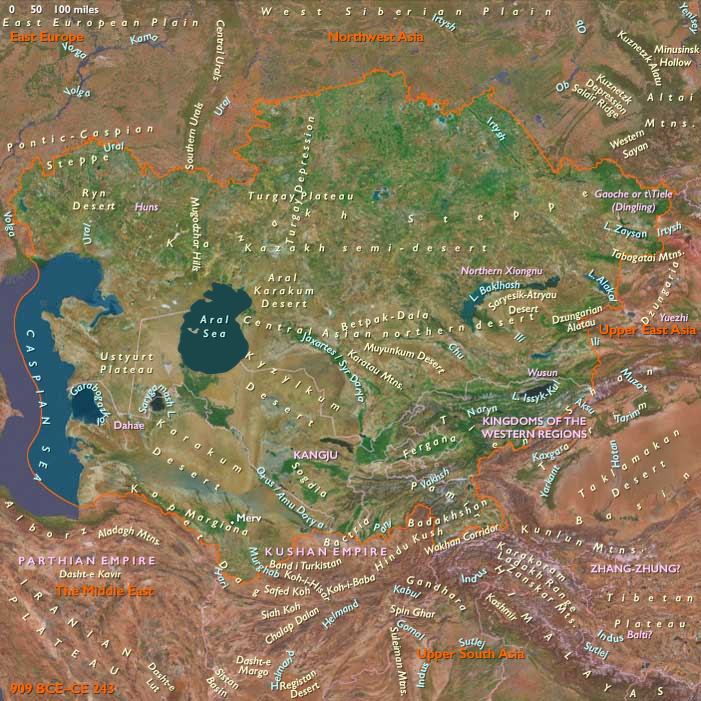
Subregions
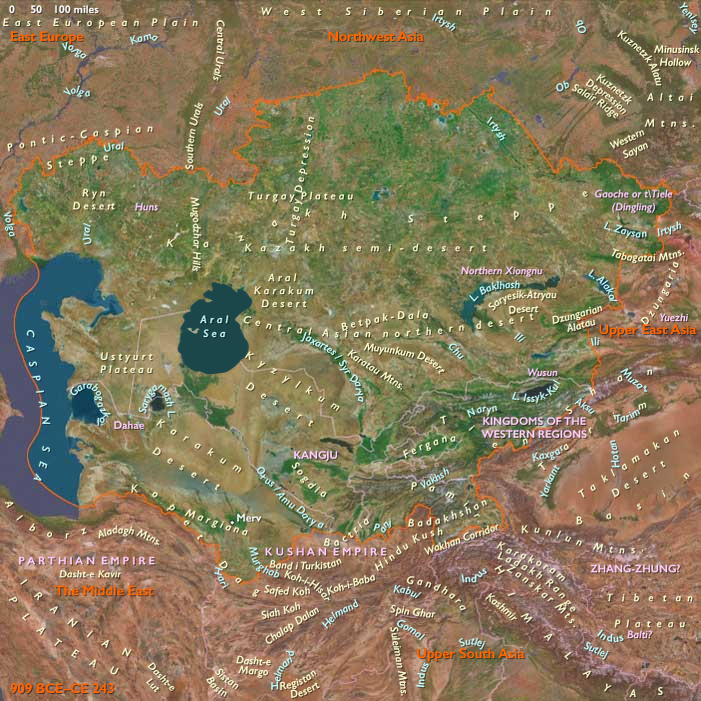
Years: 333BCE - 190BCE
People
Groups
- Tajik people
- Iranian peoples
- Tocharians
- Persian people
- Scythians, or Sakas
- Zoroastrians
- Achaemenid Empire
- Sogdia
- Margiana
- Greco-Bactrian Kingdom
Topics
Commodoties
- Weapons
- Hides and feathers
- Domestic animals
- Grains and produce
- Textiles
- Ceramics
- Strategic metals
- Manufactured goods
- Spices
Subjects
Regions
Subregions