
Cerami, a hilltop town, is the location …
Years: 1063 - 1063
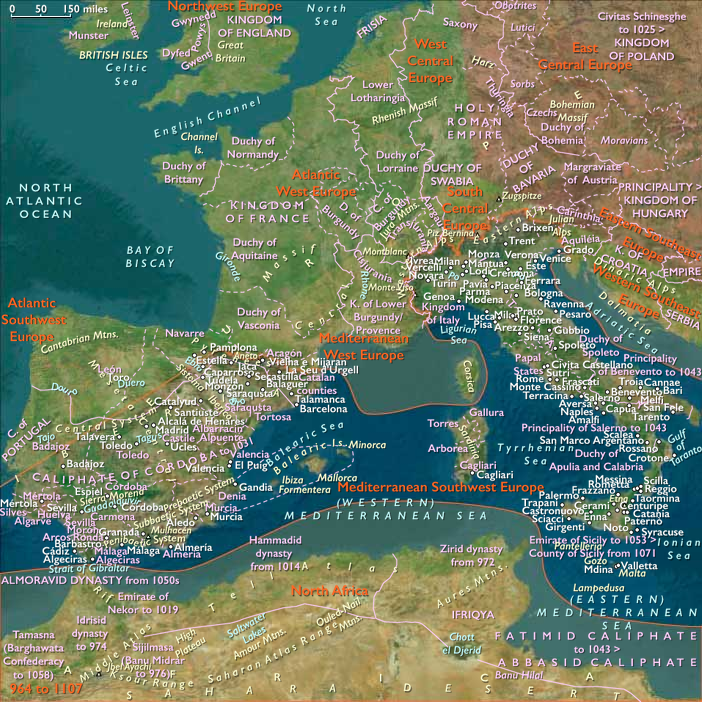
Cerami, a hilltop town, is the location of a major battle between Normans and Muslims in 1063, during the Norman conquest of the Island by Roger of Hauteville.
According to Benedictine monk and historian Goffredo Malaterra, after being besieged in the neighboring town of Troina for four months, Roger and one hundred and thirty-six ferocious Norman knights took to the field of Cerami and faced approximately fifty thousand Muslim soldiers.
The apparition of St. George was said to have materialized on a white horse carrying the sign of the cross on his lance and charging into the enemy where their array was the most dense.
Malaterra claims the Normans slaughtered thirty-five thousand of the enemy.
According to English historian Edward Gibbon, even accounting for five or six men at arms accompanying each Norman knight into battle, and even accounting for the Normans' superior martial training, the victory was either miraculous or fabulous.
Nevertheless, the Normans will eventually to capture the island.
Malaterra's work, probably finished his history around 1098, is one of the three surviving contemporaneous histories of the Norman conquest of Italy, the others being those of William of Apulia and Amatus of Montecassino.
Malaterra's is significant because it is the only history to significantly cover the conquest of Sicily.
It seems likely that Goffredo was writing at the behest of Roger, who was an old man by that time and may have been looking to legitimize the claims of his heirs.
Unlike other medieval historians, such as Dudo of Saint-Quentin, Malaterra does not directly identify his sources, and alludes briefly to a number of informants, or relatoribus.
These may have included Roger I of Sicily, himself.
Locations
People
Groups
Topics
Commodoties
Subjects
Regions

Subregions
Related Events
Showing 10 events out of 50962 total
Years: 1063 - 1063
Locations
People
Groups
Topics
Commodoties
Subjects
Regions
Subregions