
Charles, believing that the Scots are intriguing …
Years: 1640 - 1640
April
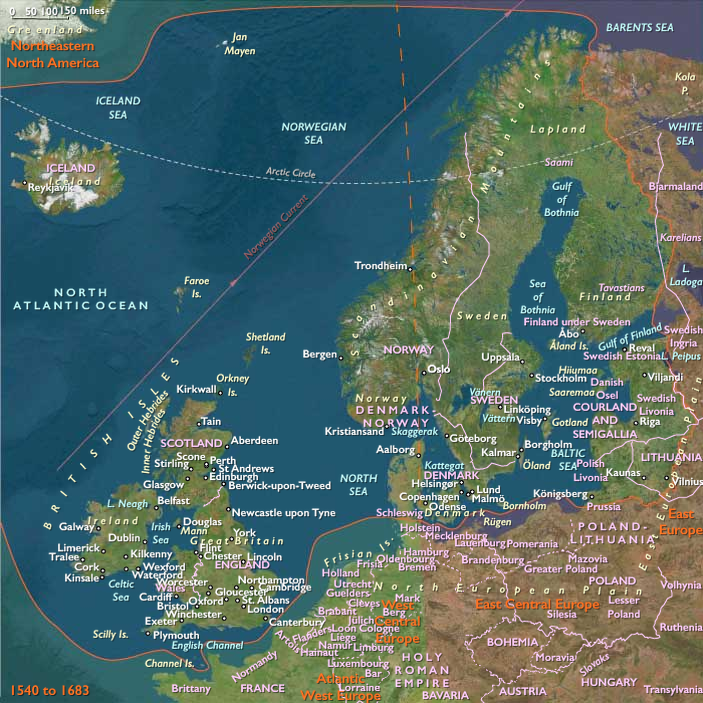
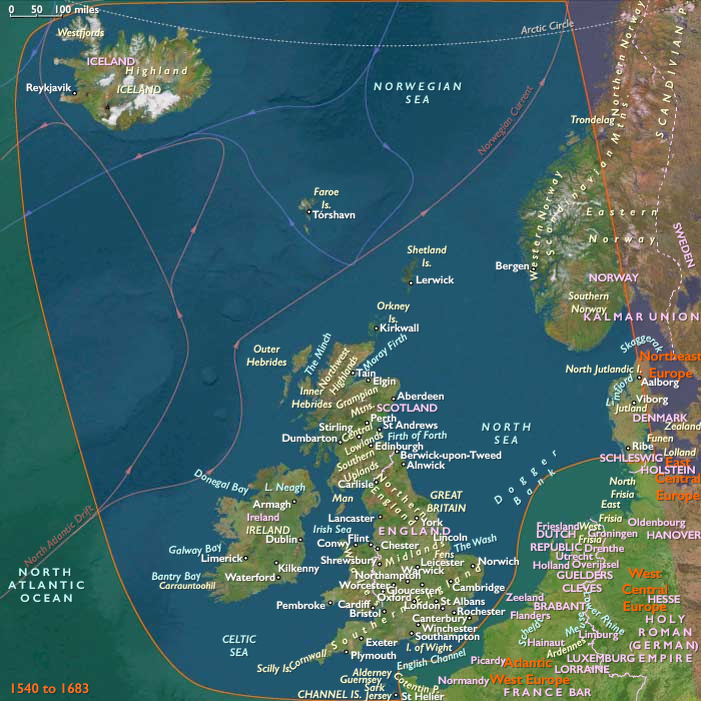
Charles, believing that the Scots are intriguing with France, fancies that England, in hatred of its ancient foe, will now be ready to rally to his standard.
After having ruled alone in England for eleven years, the king in April 1640 once more calls an English parliament.
The so-called Short Parliament demands redress of grievances, the abandonment of the royal claim to levy ship money, and a complete change in the ecclesiastical system.
Charles thinks that it will not be worthwhile agreeing such terms even to conquer Scotland, and dissolves parliament.
A fresh war with Scotland follows.
Thomas Wentworth, now earl of Strafford, becomes the leading adviser of the King.
He throws himself into Charles’s plans with great energy and leaves no stone unturned to furnish the new military expedition with supplies and money.
But no skillfulness of a commander can avail when soldiers are determined not to fight.
Locations
People
Groups
- Christians, Roman Catholic
- Scotland, Kingdom of
- Anglicans (Episcopal Church of England)
- Ireland, (English) Kingdom of
- Presbyterians
- England, (Stuart) Kingdom of
Topics
Commodoties
Subjects
Regions
Subregions
Related Events
Filter results
Showing 10 events out of 20 total
Quang Trung stimulates Vietnam's war-ravaged economy by encouraging trade and crafts, ordering the recultivation of fallow lands, reducing or abolishing taxes on local products, and resettling landless peasants on communal lands in their own villages.
Quang Trung also establishes a new capital at Phu Xuan (near modern Hue), a more central location from which to administer the country.
He reorganizes the government along military lines, giving key posts to generals, with the result that military officials for the first time outrank civilian officials.
Vietnamese is substituted for Chinese as the official national language, and candidates for the bureaucracy are required to submit prose and verse compositions in chu nom rather than in classical Chinese.
Nguyen Anh adopts the reign name Gia Long in June 1802 to express the unifying of the country—Gia from Gia Dinh (Saigon) and Long from Thang Long (Hanoi).
As a symbol of this unity, Gia Long changes the name of the country from Dai Viet to Nam Viet.
For the Chinese, however, this is too reminiscent of the wayward General Trieu Da.
In conferring investiture on the new government, the Chinese invert the name to Viet Nam, the first use of this name for the country.
Acting as a typical counterrevolutionary government, the Gia Long regime harshly suppresses any forces opposing it or the interests of the bureaucracy and the landowners.
In his drive for control and order, Gia Long adopts the Chinese bureaucratic model to a greater degree than any previous Vietnamese ruler.
The new capital at Hue, two kilometers northeast of Phu Xuan, is patterned after the Chinese model in Beijing, complete with a Forbidden City, an Imperial City, and a Capital City.
Vietnamese bureaucrats are required to wear Chinese-style gowns and even adopt Chinese-style houses and sedan chairs.
Vietnamese women, in turn, are compelled to wear Chinese-style trousers.
Gia Long institutes a law code, which follows very closely the Chinese Qing dynasty (1644-1911) model.
Under the Gia Long code, severe punishment is meted out for any form of resistance to the absolute power of the government.
Buddhism, Taoism, and indigenous religions are forbidden under the Confucianist administration.
Traditional Vietnamese laws and customs, such as the provisions of the Hong Due law code protecting the rights and status of women, are swept away by the new code.
Taxes that had been reduced or abolished under the Tay Son are levied again under the restored Nguyen dynasty.
These include taxes on mining, forestry, fisheries, crafts, and on various domestic products, such as salt, honey, and incense.
Another heavy burden on the peasantry is the increased use of corvée labor to build not only roads, bridges, ports, and irrigation works but also palaces, fortresses, shipyards, and arsenals.
All but the privileged classes are required to work on such projects at least sixty days a year, with no pay but a rice ration.
The great Mandarin Road, used by couriers and scholar-officials as a link between Gia Dinh, Hue, and Thang Long, is started during this period in order to strengthen the control of the central government.
Military service is another burden on the peasantry; in some areas one out of every three men is required to serve in the Vietnamese Imperial Army.
Land reforms instituted under the Tay Son Are soon lost under the restored Nguyen dynasty, and the proportion of communal lands dwindles to less than twenty percent of the total.
Although chu nom is retained as the national script by Gia Long, his son and successor Minh Mang, who gains the throne upon his father's death in 1820, orders a return to the use of Chinese ideographs.
Quang Trung dies in 1792, without leaving a successor strong enough to assume leadership of the country, and the usual factionalism ensues.
By this time, Nguyen Anh and his supporters have won back much of the south from Nguyen Lu, the youngest and least capable of the Tay Son brothers.
When Pigneau de Behaine returns to Vietnam in 1789, Nguyen Anh is in control of Gia Dinh.
In the succeeding years, the bishop brings Nguyen Anh a steady flow of ships, arms, and European advisers, who supervise the building of forts, shipyards, cannon foundries and bomb factories, and instruct the Vietnamese in the manufacture and use of modern armaments.
Nguyen's cause is also greatly aided by divisions within the Tay Son leadership, following the death of Quang Trung, and the inability of the new leaders to deal with the problems of famine and natural disasters that wrack the war-torn country.
After a steady assault on the north, Nguyen Anh's forces take Phu Xuan in June 1801 and Thang Long a year later.
Long-standing rivalry between Vietnam’s Nguyen and Trinh families had become open warfare in 1620, with hostilities continuing intermittently until 1673.
Both families had accepted a de facto division of the Vietnamese state by that date.
Hien Vuong, a member of the Nguyen family that rules the south, has persecuted European Christian missionaries, expanded the territory under his control, and made notable agricultural reforms.
He has encouraged Vietnamese settlement into southern lands formerly occupied by the Chams and the Cambodians, having acquired these lands at the expense of these groups, but this has been done largely by Chinese refugees fleeing the collapse of the Ming dynasty in 1644.
He has improved the mandarin examination system by which civil-service posts are filled, and established a bureau of agriculture that urges the colonization and development of the newly conquered territories.
He has promulgated needed land reforms, although they failed to alter significantly the social conditions of his lower-class subjects.
Hien Vuong has sought to secure official recognition of his sovereignty from China, but the Chinese continue to uphold the legitimacy of the northern Trinh family.
...the Nguyen Lords in the south, who rule from their capital, Huế.
Both sides fight each other for control of the nation, while claiming to be loyal to the king.
Life for the peasant farmers is difficult.
Ownership of land has become more concentrated in the hands of a few landlords as time has passed.
The Mandarin bureaucracy is oppressive and often corrupt; at one point, royally sanctioned degrees are put up for sale for whoever is wealthy enough to purchase them.
In contrast to the people, the ruling lords live lavish lifestyles in huge palaces.
The decades-long war between the Trịnh and the Nguyen had ended in 1673, and life for the northern peasants is fairly peaceful.
However, the Nguyen Lords have engaged in a regular series of wars with the weak Khmer Empire, and later, the relatively strong state of Siam.
While the Nguyen usually win, and despite the fact that the new lands they conquer offer new opportunities for the landless poor, the frequent wars take a toll on their popularity.
Nguyễn Huệ is now in control of a united Vietnam, more than twice as large than before.
He takes the title of Emperor under the reign name Quang Trung.
He distributes land to poor peasants, encourages hitherto suppressed artisans, allows religious freedom, reopens Vietnam to international trade, and replaces Classical Chinese with a Vietnamese vernacular, written with Chinese characters, as the official language.
The ambitious character of Quang Trung is legendary in Vietnamese history.
He orders the melting of Vietnamese coins to make cannons, and hopes to seize the Chinese provinces of Guangxi and Guangdong.Several stories tell of his ambitious plans and indirect challenge to the Qianlong Emperor.
In an indication of his intention to claim Chinese territory, Quang Trung even proposes to marry one of Qianlong's daughters.
Quang Trung plans the final assault on the remaining base of Nguyễn Ánh around Saigon, both by sea and land, in early 1792.
While waiting for the seasonal winds to change direction into a tailwind to propel his navy, he suddenly collapses and dies of unknown causes at the age of forty.
Many Vietnamese believe that if he had ruled for another ten years, the fate of the country would have been significantly different.
After Emperor Quang Trung's death, his son Quang Toan is enthroned as Emperor Cảnh Thịnh at the age of ten.
The real power, however, is in the hands of his uncle, Bui Dac Tuyen, who enacts a massive political purge.
Many who had served under Quang Trung are executed, while others become discouraged and leave the regime, considerably weakening the Tây Sơn.
This paves the way for Nguyen Ánh to capture the entire country within ten years, with the help of French military adventurers enlisted by French bishop Pigneau de Behaine.
Nguyen Ánh occupies Quy Nhon citadel in 1800, and in 1801 occupies Phú Xuân, forcing Quang Toan to flee to Thăng Long, which Anh besieges in 1802.
Quang Toan escapes, but then is captured and executed, ending the dynasty after twenty-four years, and the Nguyen, the last imperial dynasty of Vietnam, take over the country in 1802.
French vessels entering Vietnamese harbors are ordered to be searched with extra care.
All entries are to be watched.
Minh Mạng had continued and intensified his father's isolationist and conservative Confucian policies.
His father had rebuffed a British delegation in 1804 proposing that Vietnam be opened to trade.
The delegation's gifts are not accepted and turned away.
Vietnam is under no threat of colonization, since most of Europe is engaged in the Napoleonic Wars.
Nevertheless, Napoleon had seen Vietnam as a strategically important objective in the colonial power struggle in Asia, as he felt that it would make an ideal base from which to contest the British East India Company's control of the Indian subcontinent.
With the restoration of the monarchy and the final departure of Napoleon in 1815, the military scene in Europe quieted and French interest in Vietnam was revived.
Jean-Baptiste Chaigneau, one of the volunteers of Pigneau de Behaine who had helped Gia Long in his quest for power, had become a mandarin and continued to serve Minh Mạng, upon whose ascension, Chaigneau and his colleagues were treated more distantly.
He eventually left in November 1824.
In 1825, he is appointed as French consul to Vietnam after returning to his homeland to visit his family after more than a quarter of a century in Asia.
Upon his return, Minh Mạng receives him coldly.
The policy of isolationism will soon see Vietnam fall further behind and become more vulnerable as political stability returns to continental Europe, allowing her colonial powers a free hand to once again direct their attention towards further conquests.
The influence of missionaries is perceived as the most critical issue by the court and scholar-officials.
The French Societe des Missions Etrangeres will report four hundred and fifty thousand Christian converts in Vietnam in 1841.
The Vietnamese Christians are for the most part organized into villages that include all strata of society, from peasants to landowners.
The Christian villages, with their own separate customs, schools, and hierarchy, as well as their disdain for Confucianism, are viewed by the government as breeding grounds for rebellion—and in fact they often are.
The French presence does, however, enjoy some support at high levels.
Emperor Gia Long had felt a special debt to Pigneau de Behaine and to his two chief French naval advisers, Jean-Baptiste Chaigneau and Philippe Vannier, both of whom had remained in the country until 1824.
There are also members of the Vietnamese court who urge the monarchy to undertake a certain degree of westernization and reform in order to strengthen itself in the areas of administration, education, and defense.
In the southern part of the country, Christians enjoy the protection of Viceroy Le Van Duyet until his death in 1832.
Soon thereafter the Nguyen government begins a serious attempt to rid itself of French missionaries and their influence.
A series of edicts forbids the practice of Christianity, forcing the Christian communities underground.
An estimated ninety-five priests and members of the laity will be executed by the Vietnamese during the following quarter of a century.
Peasant rebellion in Vietnam flares from time to time throughout the first half of the nineteenth century, fueled by government repression and such calamities as floods, droughts, epidemics, and famines.
Minority groups, including the Tay-Nung, Muong, and Cham, are also in revolt.
Although they are primarily peasant rebellions, some of these movements find support from, or are led by, disaffected scholars or some of the surviving pretenders to the Le throne.
Vietnam's foreign relations are also a drain on the central government during this period.
Tributary missions are sent biennially to the Qing court in Beijing, bearing the requisite six hundred pieces of silk, two hundred pieces of cotton, twelve hundred ounces of perfume, six hundred ounces of aloes wood, ninety pounds of betel nuts, four elephant tusks, and four rhinoceros horns.
Other missions to pay homage (also bearing presents) are sent every four years.
At the same time, Vietnam endeavors to enforce tributary relations with Cambodia and Laos.
In 1834, attempts to make Cambodia a Vietnamese province lead to a Cambodian revolt and to Siamese intervention, with the result that a joint Vietnamese-Siamese protectorate will be is established over Cambodia in 1847.
Other foreign adventures include Vietnamese support for a Laotian rebellion against Siamese overlord- ship in 1826-27.
Years: 1640 - 1640
April
Locations
People
Groups
- Christians, Roman Catholic
- Scotland, Kingdom of
- Anglicans (Episcopal Church of England)
- Ireland, (English) Kingdom of
- Presbyterians
- England, (Stuart) Kingdom of
