
The most serious foreign policy problem for…
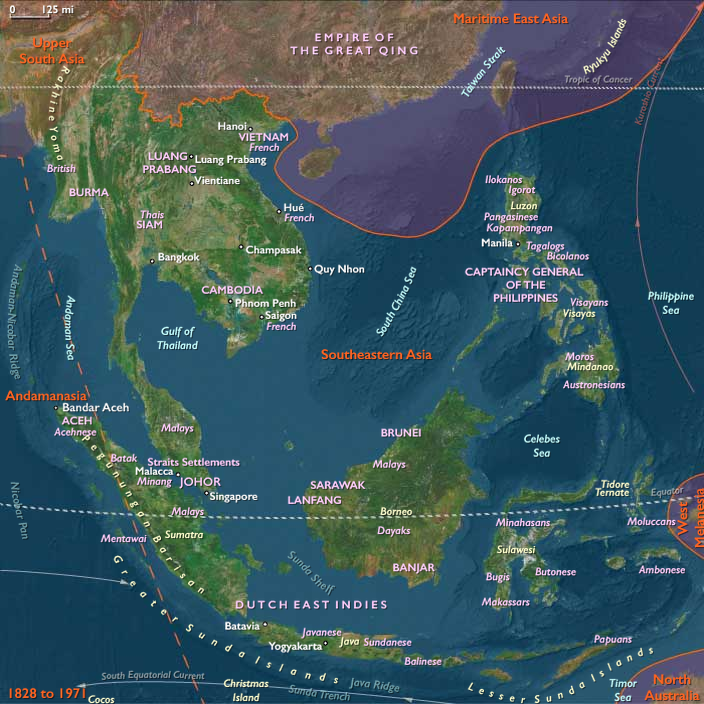
1828 CE to 1839 CE
The influence of missionaries is perceived as the most critical issue by the court and scholar-officials.
The French Societe des Missions Etrangeres will report four hundred and fifty thousand Christian converts in Vietnam in 1841.
The Vietnamese Christians are for the most part organized into villages that include all strata of society, from peasants to landowners.
The Christian villages, with their own separate customs, schools, and hierarchy, as well as their disdain for Confucianism, are viewed by the government as breeding grounds for rebellion—and in fact they often are.
The French presence does, however, enjoy some support at high levels.
Emperor Gia Long had felt a special debt to Pigneau de Behaine and to his two chief French naval advisers, Jean-Baptiste Chaigneau and Philippe Vannier, both of whom had remained in the country until 1824.
There are also members of the Vietnamese court who urge the monarchy to undertake a certain degree of westernization and reform in order to strengthen itself in the areas of administration, education, and defense.
In the southern part of the country, Christians enjoy the protection of Viceroy Le Van Duyet until his death in 1832.
Soon thereafter the Nguyen government begins a serious attempt to rid itself of French missionaries and their influence.
A series of edicts forbids the practice of Christianity, forcing the Christian communities underground.
An estimated ninety-five priests and members of the laity will be executed by the Vietnamese during the following quarter of a century.
Locations
People
Groups
Vietnamese people
View →
Tai peoples, or Thais
View →
Muong people
View →
Tày people
View →
Cham people
View →
Nùng people
View →
Christians, Roman Catholic
View →
Lao people
View →
Siam, (Rattanakosin) Kingdom of
View →
Vietnam, Kingdom of
View →
France, constitutional monarchy of
View →
Dai Nam, Empire of
View →
Topics
Regions
Southeast Asia
View →Subregions
