
Event
West Central Europe (1540–1683 CE): Confessional Territories,…
West Central Europe (1540–1683 CE): Confessional Territories, Thirty Years' War, and Rhenish Reconstruction
Geographic and Environmental Context
The Rhine corridor remained agriculturally productive but vulnerable to harvest fluctuations, flood, military requisition and epidemic disease. Vineyards and mixed farms persisted even where towns and fortifications expanded.
Societies and Political Development
The Peace of Augsburg of 1555 established a legal framework for Catholic and Lutheran imperial estates but did not initially recognize Calvinists. This mattered enormously in West Central Europe: the Electoral Palatinate moved first toward Lutheran reform and then firmly toward the Reformed confession, with the Heidelberg Catechism issued in 1563. Mainz, Cologne and Trier remained major Catholic territories.
The resulting confessional frontier became one of the political fault lines leading into the Thirty Years' War. The Electoral Palatinate's involvement in the Bohemian crisis brought war directly into the subregion; Heidelberg and surrounding territories suffered conquest, occupation and repeated military exactions.
Productive Landscape and Economy
Agriculture remained the foundation even during war. Armies consumed grain, fodder, livestock and wine, turning productive landscapes into military supply systems. Frankfurt's fairs and Rhine commerce continued when security permitted, while wartime tolls and requisitions disrupted ordinary exchange.
Movement and Interaction Corridors
The same routes that served commerce enabled armies to move rapidly through the Rhine/Main system. Soldiers, refugees, merchants and disease traveled along overlapping corridors.
Technology and Material Culture
Printing remained central to confessional polemic and administration. Gunpowder fortification expanded, although most towns still consisted largely of older masonry and timber-framed housing. Baroque rebuilding gradually appeared after wartime destruction.
Religion and Cultural Expression
Catholic reform, Jesuit institutions, Lutheran churches and Reformed communities hardened confessional identities. The Peace of Westphalia in 1648 restored and expanded the imperial religious settlement, including recognition of the Reformed confession.
Adaptation and Resilience
The Thirty Years' War caused severe local depopulation, abandoned fields and disrupted markets, but recovery varied sharply. Immigration, resettlement, river trade and reconstruction gradually restored devastated districts during the later seventeenth century.
Legacy of the Age
By 1683, West Central Europe had emerged from a century of confessional struggle as a politically fragmented but institutionally durable territorial landscape. The age's central transformation was the consolidation of confessional states, not the disappearance of local rural life.

-
{# Image navigates to the detail page; the magnifying-glass chip is the only Fancybox lightbox trigger (kept a separate sibling — anchors can't nest). #}
 The North Atlantic Lands
World
-
{# Image navigates to the detail page; the magnifying-glass chip is the only Fancybox lightbox trigger (kept a separate sibling — anchors can't nest). #}
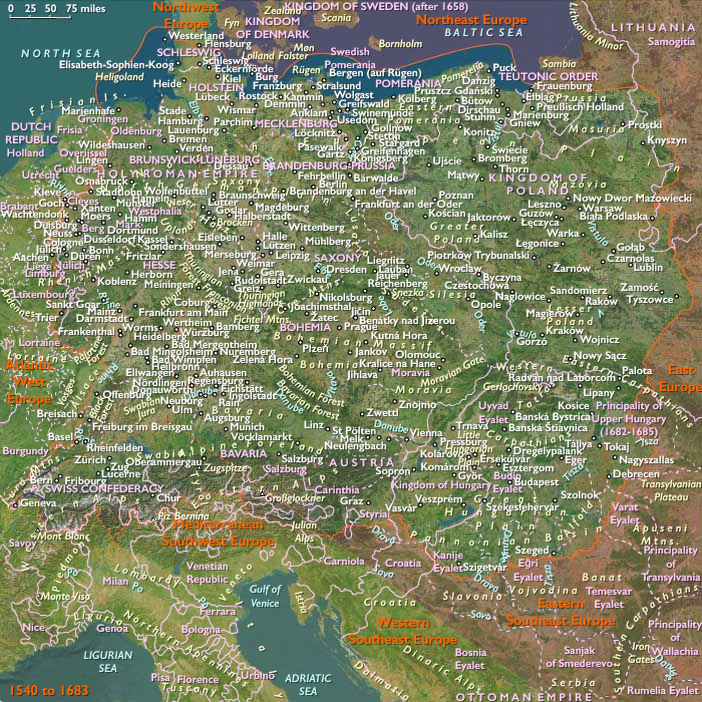 Central Europe
Region
-
{# Image navigates to the detail page; the magnifying-glass chip is the only Fancybox lightbox trigger (kept a separate sibling — anchors can't nest). #}
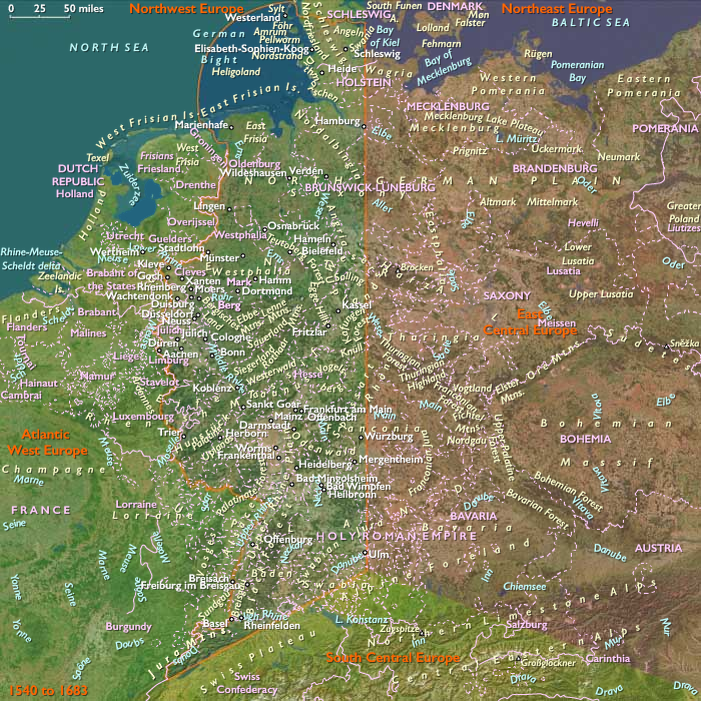 West Central Europe
Subregion
