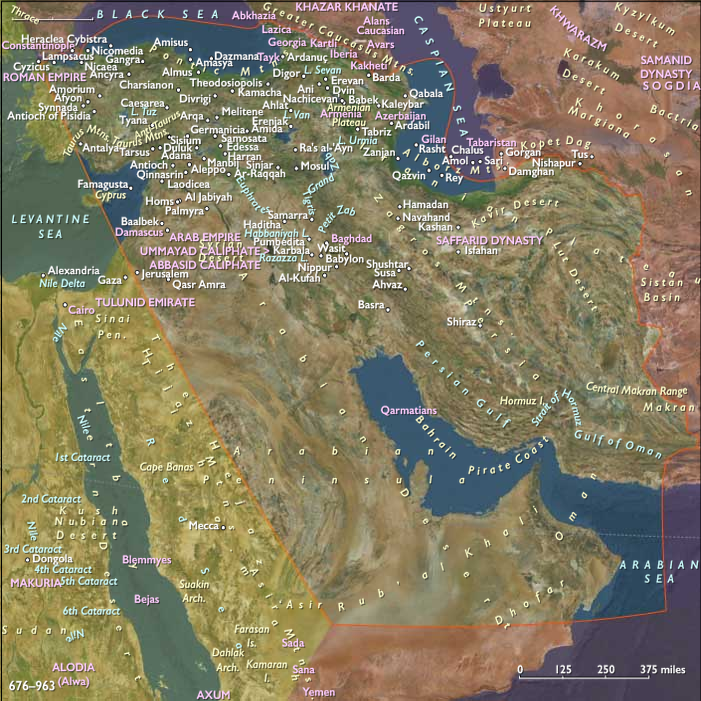
Umayyad caliph Hisham ibn Abd al-Malik, ruling…
724 CE to 735 CE
Umayyad caliph Hisham ibn Abd al-Malik, ruling from Damascus, has again encouraged arts in the empire.
He has also encouraged the growth of education by building more schools, and perhaps most importantly, by overseeing the translation of numerous literary and scientific masterpieces into Arabic.
Commodities
Related Events
No active filters.
Showing 10 events out of 55601 total
Chinese Buddhism reaches its greatest heights during the glorious and tolerant period of the Tang dynasty at its zenith, and Islam, Manichaeanism, Judaism, Zoroastrianism and Nestorian Christianity all enter China.
East Central Europe (724–735 CE): Saxon Territorial Expansion, Formation of Slavic States, and Avar Continuity
Between 724 and 735 CE, East Central Europe—encompassing Poland, Czechia, Slovakia, Hungary, and those portions of Germany and Austria lying east of 10°E and north of a line stretching from roughly 48.2°N at 10°E southeastward to the Austro-Slovenian border near 46.7°N, 15.4°E—continued its transition toward more defined medieval political structures. Saxon tribes consolidated and expanded their territories, reinforcing their status as a powerful regional force. Emerging Slavic principalities in Bohemia and Moravia strengthened their governance structures, while the Avar Khaganate maintained political stability within its Carpathian heartland. Thuringia's continued autonomy underscored ongoing Merovingian fragmentation, marking an important transitional period toward the Carolingian ascendancy.
Political and Military Developments
Saxon Eastward Expansion
-
Saxon tribes continued their territorial consolidation east of the Elbe, expanding deeper into eastern Germany and parts of western Poland. Their increased presence reshaped political alignments, trade networks, and cultural interactions with neighboring Slavic principalities and Thuringia.
Strengthening of Slavic Principalities
-
Bohemian and Moravian political structures matured significantly, transitioning from loosely organized tribal federations into clearly defined early medieval states with strengthened leadership and more stable territorial boundaries.
Thuringian Autonomy Amid Frankish Decline
-
Thuringian dukes maintained effective political independence from weakened Merovingian royal power, further exemplifying the fragmentation and localized rule characterizing this era.
Avar Stability and Diplomatic Relations
-
The Avar Khaganate remained diplomatically stable, cautiously balancing relations with expanding Saxon and Slavic powers while maintaining firm internal cohesion in the Carpathian Basin.
Economic and Technological Developments
Continued Economic Prosperity and Trade Networks
-
Active regional trade persisted across East Central Europe, connecting Saxon, Slavic, Bavarian, Thuringian, Avar, and Frankish communities. Trade included agricultural produce, metals, textiles, ceramics, livestock, and luxury goods.
Fortified Settlement Expansion
-
Communities across Saxon, Slavic, and Avar territories continued expanding their fortified settlements, reflecting greater political stability, population growth, economic prosperity, and technological sophistication.
Cultural and Artistic Developments
Diffusion of Saxon Cultural Elements
-
Saxon expansion disseminated distinct Germanic cultural traits widely across eastern Germany and neighboring regions, influencing artistic production, jewelry styles, pottery, burial customs, and weaponry.
Further Definition of Slavic Regional Identities
-
Bohemian and Moravian communities further refined their distinctive Slavic cultural identities, visible archaeologically through differentiated ceramics, jewelry, and fortified settlement designs.
Continued Influence of Avar Artistic Traditions
-
The Avars maintained their artistic influence across the region, particularly in sophisticated metalwork, jewelry, equestrian equipment, and decorative arts.
Settlement and Urban Development
Saxon Urban and Rural Growth
-
Saxon settlements expanded eastward and became increasingly fortified and economically productive, laying the groundwork for medieval urban centers in eastern Germany and adjacent areas of Poland and Czechia.
Development of Slavic Administrative Centers
-
Emerging urban and political centers within Bohemia and Moravia expanded notably, reflecting political maturity, demographic growth, and growing economic activity.
Stability and Prosperity in Thuringia and Bavaria
-
Bavarian and Thuringian settlements, particularly significant towns such as Regensburg, enjoyed sustained stability, benefiting from minimal external threats and vibrant regional trade networks.
Social and Religious Developments
Strong Saxon Tribal Leadership
-
Saxon social hierarchy remained robust under influential warrior elites, whose political and military strength facilitated territorial expansion, economic growth, and regional dominance.
Consolidation of Slavic Hierarchies
-
Slavic leadership in Bohemia and Moravia continued to centralize, fostering clearer political structures, strengthened defenses, and improved internal governance.
Stable Avar Social Structures
-
Avar society retained its structured, hierarchical organization under a strong nomadic elite leadership, ensuring continued internal stability and diplomatic efficacy.
Long-Term Consequences and Historical Significance
The era 724–735 CE marked significant steps toward the medieval political landscape of East Central Europe. Saxon territorial growth, consolidated Slavic principalities, sustained Thuringian independence, and stable Avar control collectively set the foundations for enduring political entities, cultural identities, and economic patterns influencing the region’s medieval trajectory profoundly.
Christian religious pictures and relics as objects of veneration in worship services is the defining issue of the era, as East Roman Emperor Leo III, in undertaking a set of civil reforms, begins to speak out publicly in 726 against the use of sacred pictures, and orders the destruction of the image of Christ at the Chalke palace in Constantinople.
Popular revolts against iconoclasm break out in the late 720s in the Cyclades, Naples, Venice, Rome, and elsewhere.
Many Greek theologians, including John Damascene, react to the new policy by developing an elaborate theory and defense of holy images and their place in worship.
Leo, proclaiming Iconoclasm the official policy of the empire in 730, orders the removal and destruction of sacred pictures in churches.
His policies meet particularly strong opposition from monastic circles.
Pope Gregory II also strongly rejects his efforts to impose Iconoclasm upon areas of Italy under imperial control.
The two outbreaks of Iconoclasm in the Empire during the eighth and ninth centuries are unusual in that the use of images is the main issue in the dispute, rather than a byproduct of wider concerns.
Iconoclasm in Christianity has generally been motivated by a literal interpretation of the Ten Commandments, which forbid the making and worshiping of "graven images".
As with other doctrinal issues in the Byzantine period, the controversy is by no means restricted to the clergy, or to arguments from theology.
Iconoclasm seems to have been supported by many from the East of the Empire, and refugees from the provinces taken over by the Muslims.
The continuing cultural confrontation with, and military threat from, Islam probably has a bearing on the attitudes of both sides.
It has been suggested that their strength in the army at the start of the period, and the growing influence of Balkan forces in the army (generally considered to lack strong iconoclast feelings) over the period may have been important factors in both beginning and ending imperial support for iconoclasm.
Eastern Southeast Europe (724–735 CE): Iconoclasm and Religious Controversy
Settlement and Migration Patterns
Continued Stability and Cultural Cohesion
From 724 to 735 CE, demographic stability continued within Eastern Southeast Europe, particularly among the well-established Slavic and Bulgar populations. Cultural integration remained strong, supporting regional identity despite broader religious and political upheavals.
Political and Military Developments
Arab Threat Management
The Byzantine Empire remained vigilant against intermittent Arab threats but enjoyed a brief respite following previous successful defenses. Military fortifications continued to be maintained, securing vital regions against external incursions.
Economic and Technological Developments
Economic Stability Through Defensive Strategies
Economic conditions remained stable, supported by continued strategic investment in defense infrastructure. Fortifications and defensive preparations around major urban centers safeguarded vital trade routes and agricultural productivity.
Cultural and Artistic Developments
Religious and Cultural Conflict: Iconoclasm
The defining issue of this era was the Iconoclast controversy, initiated by Emperor Leo III, who publicly condemned the veneration of religious images beginning in 726. Leo's order to destroy the image of Christ at Constantinople's Chalke palace symbolized the policy's aggressive implementation.
Artistic Resistance and Theological Defense
Popular revolts erupted throughout the Byzantine territories, including the Cyclades, Naples, Venice, and Rome, illustrating widespread opposition to iconoclasm. Prominent theologians, notably John Damascene, articulated detailed defenses of religious imagery, firmly establishing theological arguments in support of icons.
Social and Religious Developments
Institutional Division: East vs. West
Emperor Leo III formally declared Iconoclasm as imperial policy in 730, mandating the removal and destruction of sacred images in churches. His stance faced vehement opposition from monastic communities and the broader ecclesiastical establishment, intensifying the rift between imperial authority and religious practice.
Opposition from the Papacy
Pope Gregory II notably rejected Leo III's iconoclastic directives, particularly in regions of Italy under Byzantine influence, underscoring the growing ecclesiastical divide between Eastern Orthodoxy and Western Christianity. This controversy contributed significantly to long-term doctrinal and institutional divergences between East and West.
Impact of Cultural and Military Context
Iconoclasm’s support was particularly pronounced among military and administrative groups from the Empire’s eastern provinces, many influenced by cultural confrontations and threats from Islam. Conversely, Balkan military contingents, generally less supportive of iconoclasm, played a role in influencing imperial attitudes over the era.
Long-Term Consequences and Historical Significance
The era from 724 to 735 CE was deeply marked by the Iconoclast controversy, reshaping Byzantine society, theology, and politics. The religious conflicts that emerged during this period established critical ideological and ecclesiastical distinctions, profoundly influencing the historical development of Eastern Orthodoxy and its complex relationship with Western Christianity.
The Middle East: 724–735 CE
Umayyad Consolidation, Administrative Reforms, and Cultural Flourishing
Stability under Hisham ibn Abd al-Malik
The period from 724 to 735 coincides primarily with the reign of Caliph Hisham ibn Abd al-Malik (724–743), a notable figure who provides stability and efficient governance to the expansive Umayyad Empire. Hisham undertakes critical administrative reforms to better manage the vast territories stretching from the Iberian Peninsula to the edges of Central Asia.
Administrative and Economic Developments
Hisham introduces fiscal and agricultural reforms aimed at improving state revenues, which significantly enhance economic productivity across the Middle East. He expands irrigation networks, particularly in Iraq and Syria, boosting agriculture and securing food supplies. His government meticulously regulates taxation and administration, fostering economic prosperity and social stability.
Cultural and Intellectual Activity
During Hisham’s reign, the cultural life of the Islamic world continues to flourish. The caliph supports scholarly activities, notably encouraging the preservation and translation of classical texts, thus laying the foundations for the later Islamic Golden Age. Major urban centers such as Damascus, Basra, and Kufa witness significant intellectual debates, especially on theological and legal matters.
Military Challenges and Frontier Defense
Despite internal stability, the empire faces ongoing military challenges. Arab–Byzantine frontier clashes intensify, particularly in Anatolia, where frontier fortifications are expanded and strengthened. Meanwhile, Hisham’s generals, notably Maslama ibn Abd al-Malik, maintain military pressure on Byzantine defenses, although no significant territorial shifts occur during this time.
In summary, the era of 724–735 CE under Hisham ibn Abd al-Malik is characterized by effective governance, cultural advancement, and economic prosperity, setting a robust foundation for subsequent generations in the Islamic Middle East.
Mediterranean Southwest Europe (724–735 CE): Moorish Iberia, Mozarab Communities, and Cultural Exchange
The era 724–735 CE in Mediterranean Southwest Europe witnesses the ongoing consolidation of Islamic rule in Iberia, the establishment and cultural evolution of Mozarab communities, and continued Lombard stability in Italy.
Moorish Consolidation and Berber Settlement in Iberia
Following the successful conquest led by Tariq ibn Ziyad in 711, Moorish rule solidifies across much of Iberia. The Miknasa Berbers, who had initially accompanied Tariq, settle permanently north of Córdoba, leaving lasting cultural markers such as the town of Mequinenza, named after their tribe. This settlement reflects the gradual stabilization and administrative structuring of the newly conquered territories.
Mozarab Communities and Cultural Adaptation
Many Christians in Iberia convert to Islam after the Moorish conquest, but those who retain their Christian faith become known as Mozarabs. While striving to preserve their Latin-Christian traditions, Mozarabs progressively adopt elements of Moorish culture, including language and customs. Major Mozarab communities flourish in urban centers like Córdoba, Seville, and notably Toledo, fostering a distinctive hybrid culture.
Dhimmi Status and Legal Autonomy
Under the relatively tolerant Umayyad caliphate, Christians and Jews enjoy the status of dhimmi, non-Muslims allowed to practice their religion in exchange for paying the jizyah, a personal tax. Mozarabs maintain their own judicial systems, governed by their tribunals and authorities, reflecting the eroded universalism of Roman law as ethnic and religious groups begin to manage their own legal affairs. Some Mozarabs even achieve positions of prominence in Muslim courts.
Religious Tolerance and Constraints
The regime of the Umayyad caliphs and subsequent emirs of Córdoba promotes, but does not enforce, conversion to Islam, allowing substantial religious freedom. However, apostasy, defined as renouncing Islam after having embraced it or being born Muslim, remains strictly forbidden and punishable by death, setting clear boundaries to religious pluralism.
Cultural Innovations: Moorish Rug Making
The Moorish presence introduces significant artistic innovations to Iberia, notably in the craft of rug making. Spanish-Moorish rug designs become distinctive for incorporating the intricate geometric motifs characteristic of Islamic art, exemplifying the rich cultural exchange fostered by the Moorish conquest.
Lombard Continuity and Italian Stability
Meanwhile, Lombard Italy under King Liutprand (r. 712–744 CE) enjoys ongoing political stability and prosperity. Liutprand maintains effective governance, preserving Lombard dominance throughout northern and central Italy, while the Byzantine Exarchate of Ravenna continues its tenuous hold on remaining Italian territories.
Legacy of the Era
The era 724–735 CE highlights the emergence of Mozarab culture as a unique blend of Latin and Islamic influences, setting the stage for Iberia's distinctive medieval development. Concurrently, Lombard Italy experiences sustained stability, underscoring divergent historical trajectories within Mediterranean Southwest Europe during this transformative period.
The Miknasa Berbers who had accompanied Tariq ibn Ziyad in his conquest of Visigothic Spain eventually settle north of the city of Córdoba; the Spanish town of Mequinenza bears witness to their presence.
Many Christians in Visigothic Spain have converted to Islam following its conquest by the Moors in 711.
Those Spaniards who remain faithful to Christianity have come to be called Mozarabs, who, although they attempt to preserve their Latin culture, will gradually absorb much of the language and culture of their Moorish neighbors.
The strongest Mozarab communities have become centered in Córdoba, …
…Seville, and, …
…especially, Toledo.
As Christians are dhimmi, or tolerated non-Muslims living under the rule of a Muslim government, they and Jews are allowed among Muslims if they pay the jizyah, a personal tax.
As the universal nature of Roman law is eroded, most ethnic groups expects to be judged by their own judges, under their own law: Mozarabs have their own tribunals and authorities.
Some of them hold high offices in Muslim courts.
Conversion to Islam is encouraged, but not demanded under the tolerant regime of the Ummayad caliphs and, later, emirs of Córdoba.
Apostasy, however, for one who had been raised as a Muslim or had embraced Islam, is a crime punishable by death.
The Moorish invasion has introduced rug making into Spain; Spanish Moorish rug designs incorporate the geometric forms of Islamic art.