
Claudius, acceding to the imperial throne after…
41 CE
Claudius, acceding to the imperial throne after the assassination of Caligua, cautions the Alexandrians “to behave gently and kindly toward the Jews...and not to dishonor any of their customs in their worship of their god.” (Gager, John G., The Origin of Anti-Semitism: Attitudes Toward Judaism in Pagan and Christian Antiquity [New York and Oxford: Oxford University Press 1983], p. 41-53.)
Groups
Commodities
Subjects
Regions
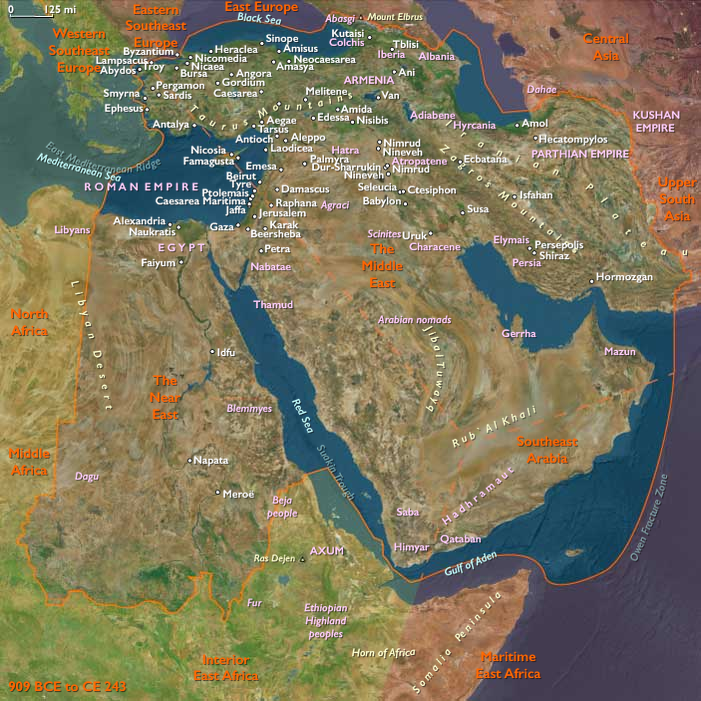
The Near and Middle East
View →Subregions
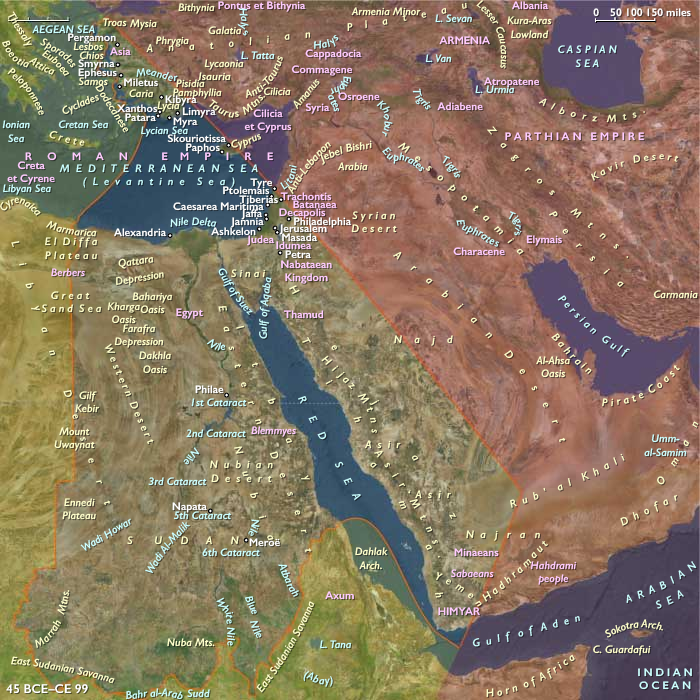
Near East
View →Related Events
No active filters.
Showing 10 events out of 61831 total
Emperor Guangwu, while still under Emperor Gengshi, had married his childhood sweetheart Yin Lihua.
Later, in 24, while he was on his expedition north of the Yellow River, he had entered into a political marriage with Guo Shengtong, the niece of a regional warlord, Liu Yang, the Prince of Zhending.
In 25, Guo had borne him a son, Liu Jiang.
The following year, Emperor Guangwu had been prepared to create an empress, and he favored his first love, Yin.
However, as Yin had not yet had a son by that point, she declined the empress position and endorsed Guo.
Emperor Guangwu therefore created Guo empress and her son Prince Jiang crown prince.
By 41, however, Empress Guo had long lost the emperor's favor.
She continuously complaind about that fact, and this angers Emperor Guangwu.
In 41, he deposes her and creates Yin empress instead.
Rather than imprisoning Guo (as is often the fate of deposed empresses), however, he creates her son Liu Fu the Prince of Zhongshan and creates her the Princess Dowager of Zhongshan.
He makes her brother Guo Kuang an important official and, perhaps as a form of alimony, rewards him with great wealth.
In 41, Emperor Guangwu sends his faithful general Ma Yuan against the Trưng sisters, who have declared an independent kingdom in the region of present northern Vietnam.
Caligula has decided to restore Agrippa to his grandfather's throne but is assassinated before he can effect this plan.
Agrippa's advice in the delicate question of the imperial succession helped to secure Claudius' accession as emperor, which he made a show of being in the interest of the senate.
Claudius grants him dominion over Judea and Samaria, while the kingdom of Chalcis in Lebanon is at his request given to his brother Herod.
Agrippa thus becomes one of the most powerful princes of the east; the territory he possesses exceeds that which was held by his grandfather Herod the Great.
A large rebellion against Claudius is undertaken shortly after the Silanus affair by the influential senator Annus Vinicianus and Lucius Arruntius Camillus Scribonianus, who is reportedly the biological son of Marcus Furius Camillus and brother to Livia Medullina, the second fiancee of Claudius.
He became the adopted son of Lucius Arruntius the Younger (consul 6 CE), and grandson of Lucius Arruntius the Elder (consul 22 BCE).
Scribonianus became consul in 32 CE with Gnaeus Domitius Ahenobarbus (biological father of Nero).
One of the people considered for the position of emperor after the death of Gaius Caligula, despite his near-relationship to Claudius, he nevertheless instigates a revolt against Claudius in 41 CE while imperial legate of Dalmatia.
Approached by Vinicianus with a plot to overthrow Claudius, he is proclaimed imperator by his troops, as Annius waits in Rome for his arrival.
The rebellion fails when Scribonianus announces his intention to restore the Republic, causing his troops to turn against him, and forcing him to flee to the island of Issa, where he commits suicide.
Imperial propaganda later declares that divine intervention prevented the standards of the legions from being pulled from the ground, causing the soldiers to turn against Scribonianus and kill him.
A son survives him and in CE 49 will be permitted to assume the post of quaestor under Claudius.
Caligula is assassinated on January 24, 41, at the Palatine Games in a broad-based conspiracy involving the Praetorian commander Cassius Chaerea and several Senators.
According to Cassius Dio, Claudius had beome very sickly and thin by the end of Caligula's reign, most likely due to stress.
A possible surviving portrait of Claudius from this period may support this.
There is no evidence that Claudius had a direct hand in the assassination, although it has been argued that he knew about the plot— particularly since he left the scene of the crime shortly before his nephew was murdered.
However, after the deaths of Caligula's wife, Caesonia, and daughter, it becomes apparent that Cassius intends to go beyond the terms of the conspiracy and wipe out the Imperial family.
In the chaos following the murder, Claudius witnesses the German guard cut down several uninvolved noblemen, including many of his friends.
He flees to the palace to hide.
According to tradition, a Praetorian named Gratus found him hiding behind a curtain and suddenly declared him princeps.
A section of the guard may have planned in advance to seek out Claudius, perhaps with his approval.
They reassure him that they are not one of the battalions looking for revenge.
He is spirited away to the Praetorian camp and put under their protection.
The Senate quickly meets and begins debating a change of government, but this eventually devolves into an argument over which of them would be the new Princeps.
When they hear of the Praetorians' claim, they demand that Claudius be delivered to them for approval, but he refuses, sensing the danger that would come with complying.
Some historians, particularly Josephus, claim that Claudius was directed in his actions by the Judean King Herod Agrippa.
However, an earlier version of events by the same ancient author downplays Agrippa's role — so it is not known how large a hand he had in things.
Eventually the Senate is forced to give in and, in return, Claudius pardons nearly all the assassins.
Claudius takes several steps to legitimize his rule against potential usurpers, most of them emphasizing his place within the Julio-Claudian family.
He adopts the name "Caesar" as a cognomen — the name still carries great weight with the populace.
In order to do so, he drops the cognomen "Nero" which he had adopted as paterfamilias of the Claudii Nerones when his brother Germanicus was adopted out.
While he had never been adopted by Augustus or his successors, he is the grandson of Octavia, and so feels he has the right.
He also adopts the name "Augustus" as the two previous emperors had done at their accessions.
He keeps the honorific "Germanicus" in order to display the connection with his heroic brother.
He deifies his paternal grandmother Livia in order to highlight her position as wife of the divine Augustus.
Claudius frequently uses the term "filius Drusi" (son of Drusus) in his titles, in order to remind the people of his legendary father and lay claim to his reputation.
Several coup attempts will be made during Claudius' reign, resulting in the deaths of many senators.
Shortly after his accession, when Appius Junius Silanus is governor of Hispania Tarraconensis, he is recalled to Rome and married to Domitia Lepida, mother of the empress Messalina.
He is treated with the greatest of distinction, but having refused the advances of Messalina herself, he is soon put to death by the emperor.
Messalina and Narcissus, one of the freedmen who forms the core of the imperial court, accuses him of plotting to assassinate Claudius, and claim that they had seen Silanus attempting to murder the emperor in their dreams.
Claudius appoints Gaius Suetonius Paulinus and Gnaeus Hosidius Geta to end the revolt in Mauretania.
During the campaign, Paulinus becomes the first Roman to cross the Atlas Mountains.
He reaches areas near the Niger river (probably actual northern Mali), where he finds black tribes.
Pliny the Elder quotes his description of the area in his Natural History: “In the year [41 AD] Suetonius Paullinus, afterwards Consul, was the first of the Romans who led an army across Mount Atlas.
At the end of a ten days' march he reached the summit,—which even in summer was covered with snow,—and from thence, after passing a desert of black sand and burnt rocks, he arrived at a river called Gerj...he then penetrated into the country of the Canarii and Perorsi, the former of whom inhabited a woody region abounding in elephants and serpents, and the latter were Ethiopians, not far distant from the Pharusii and the river Daras [modern river Senegal].” Gaius Suetonius with his expedition is thus one of the first European explorers of Saharan Africa.
Tingis, modern Tangier, is partially destroyed during the battles between the Berbers and the Romans.
Lu Fang, after initially submitting to Emperor Guangwu of the Eastern Han dynasty and made the Prince of Dai (as Emperor Guangwu maintains the fiction that Lu is actually from imperial lineage), eventually rebels again, but, unsuccessful in this, ultimately flees in 42 to the Xiongnu.
Claudius’ wife Messalina had soon borne him two children: Octavia, born in 30 or 40, and Tiberius Claudius Germanicus, born in 41; sharing his father's praenomen as recognition of his status as heir, he will be granted the honorific Britannnicus in 43.
Lucius Annaeus Seneca, called Seneca the Younger (because his father, Seneca the Elder, who died in CE 37, was—as his son will one day be—a noted literary figure and rhetorician) was born in Corduba (modern-day Córdoba) in Hispania and had gone as a boy to Rome, where he was trained in rhetoric and was introduced to Hellenistic Stoic philosophy by Attalus and Sotion.
His older brother, Gallio, becomes proconsul in the new Roman province of Achaea.
The son of his younger brother Annaeus Mela is Marcus Annaeus Lucanus, better known in English as Lucan.
Seneca's own writings describe his poor health.
At some stage he was nursed by his aunt; as she was in Egypt from 16 to 31 CE, he must have at least visited and perhaps lived there for a period.
He and his aunt returned to Rome in 31, and she had helped him in his campaign for his first magistracy.
There was a severe conflict between Caligula and Seneca; the emperor is said to have spared his life only because he expected Seneca's natural life to be near its end.
Claudius, at the behest of his third wife Valeria Messalina, banishes Seneca to Corsica on a charge of adultery with Caligula's sister Julia Livilla.
Because he had been proclaimed Emperor on the initiative of the Praetorian Guard instead of the Senate— the first Emperor thus proclaimed — Claudius' repute suffers at the hands of commentators (such as Seneca).
Moreover, he is the first Emperor who resorts to bribery as a means to secure army loyalty.
Tiberius and Augustus had both left gifts to the army and guard in their wills, and upon Caligula's death the same would have been expected, even if no will existed.
Claudius remains grateful to the guard, however, issuing coins with tributes to the Praetorians in the early part of his reign.
Claudius’ discovery of an actual plot against his life sends him into semiretirement in 42; he invests Messalina with much of the responsibilities of imperial governance.
Following her elevation to the unofficial role of coemperor, Messalina embarks on a career of wild promiscuity, manipulating her husband into executing several men who scorn her advances or otherwise incur her wrath.
The Trung sisters’ poorly trained troops, unsupported by the peasantry, are overwhelmed in 43 by invading Chinese forces under General Ma Yuan.
Routed near present Hanoi, the sisters withdraw to Hat Mon (Son Tay), where General Ma decisively defeats them.
Disgraced, the Trung sisters drown themselves at the confluence of the Red and Day Rivers, and the Chinese regain control of the area.
Emperor Guangwu, not having the heart to depose both mother and son, had initially left Guo's son, Crown Prince Jiang, as crown prince.
Crown Prince Jiang, however, realizing that his position is precarious, has repeatedly offered to step down.
In 43, Emperor Guangwu agrees and created Liu Yang, the oldest son of Empress Yin, crown prince instead.
Former Crown Prince Jiang is created the Prince of Donghai.
He also changes Prince Yang's name to Zhuang.
Emperor Guangwu had in 49 once again commissioned Ma Yuan to go on an expedition—against the indigenous people of the Wulin prefecture (modern northwestern Hunan and eastern Guizhou), who had rebelled.
While Ma is on the expedition, however, a number of Ma's political enemies made false accusations against him.
Emperor Guangwu, believing these accusations, begins investigating Ma, who happens to die of illness while on the campaign.
With Ma dead and unable to defend himself, Emperor Guangwu strips Ma of his marquess title and denounces him posthumously.
(Ma's good reputation will not restored until his daughter later becomes empress to Emperor Guangwu's son Emperor Ming.)