
Claudius pays special attention to transportation, building …
Years: 47 - 47
Claudius pays special attention to transportation, building roads and canals throughout Italy and the provinces.
Among these is a large canal leading from the Rhine to the sea, as well as a road from Italy to Germany—both begun by his father, Drusus.
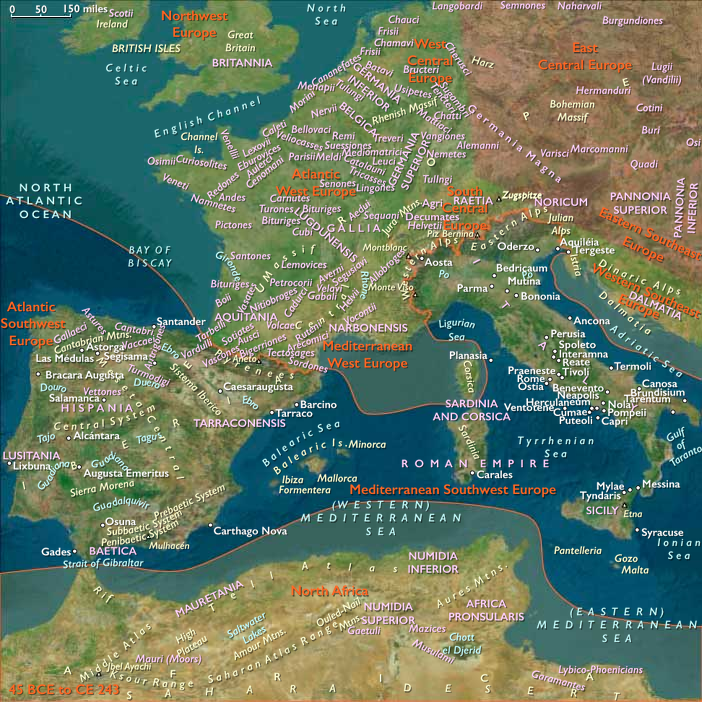
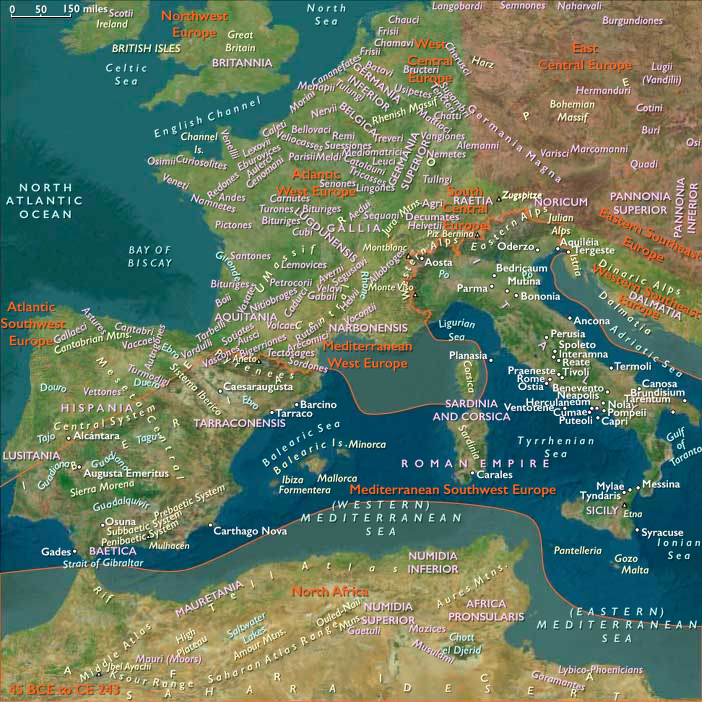
Closer to Rome, he builds a navigable canal on the Tiber, leading to Portus, his new port just four kilometers (two and a half miles) north of Ostia, Rome's original harbor.
The port at Ostia is part of Claudius' solution to the constant grain shortages that occur in winter, after the Roman shipping season.
The other part of his solution is to insure the ships of grain merchants who are willing to risk traveling to Egypt in the off-season.
He also grants their sailors special privileges, including citizenship and exemption from the Lex Papia-Poppaea, a law that regulates marriage.
In addition, he repeals the taxes that Caligula had instituted on food, and further reduces taxes on communities suffering drought or famine.
The new port, enclosing an area of sixty-nine hectares (one hundred and seventy acres), is constructed in a semicircle with two long curving moles projecting into the sea, and an artificial island, bearing a lighthouse, in the center of the space between them.
The foundation of this lighthouse is provided by filling one of the massive Obelisk ships, used to transport an obelisk from Egypt to adorn the spina of Vatican Circus, built during the reign of Caligula.
The harbor thus opens directly to the sea on the northwest and communicates with the Tiber by a channel on the southeast.
The object is to obtain protection from the prevalent southwest wind, to which the river mouth is exposed.
Though Claudius, in the inscription which he caused to be erected in CE 46, boasts that he has freed the city of Rome from the danger of inundation, his work is only partially successful: in 62 CE, Tacitus speaks of a number of grain ships sinking within the harbor during a violent storm.
Within the carefully planned town are shops, offices, and warehouses, along with public baths and lavatories, a theater, and a gymnasium.
Locations
People
Groups
Topics
Commodoties
Subjects
- Commerce
- Watercraft
- Engineering
- Environment
- Labor and Service
- Conflict
- Faith
- Government
- Custom and Law
- Technology
- Economics
Regions
Subregions
Years: 47 - 47
Locations
People
Groups
Topics
Commodoties
Subjects
- Commerce
- Watercraft
- Engineering
- Environment
- Labor and Service
- Conflict
- Faith
- Government
- Custom and Law
- Technology
- Economics
Regions
Subregions