
Coloman's father Géza I had ascended the…
May 1096 CE
Coloman's father Géza I had ascended the Hungarian throne in 1074.
As Géza I's sons, Coloman and Álmos, were still minors when he died on April 25, 1077, his brother had succeeded him as Ladislaus I.
The new king had decided that Coloman should be prepared for a career in the Church.
The king's decision was unusual, because Coloman is elder than his brother, Álmos.
According to the Illuminated Chronicle, Coloman was "of mean stature, but astute and quick of apprehension", which may induced his uncle's decision.
The chronicler even states that Coloman was "shaggy and hirsute, half-blind and humpbacked, and he walked with a limp and stammered in his speech".
However, the reliability of this description is doubtful, since the chronicle was completed in the reign of kings descending from Coloman's brother.
In preparation for his clerical life, Coloman had learned to read and write and acquired a good knowledge of Latin.
His proficiency in canon law is memorialized in a letter addressed to him by Pope Urban II in 1096.
Having finished his studies, Coloman had been ordained priest and—according to Kristó, in the early 1090s—appointed bishop.
According to late medieval chronicles, he was bishop of either Eger or of Várad (Oradea, Romania).
For instance, the Illuminated Chronicle narrates that Ladislaus I wanted to appoint Coloman "bishop of Agria", but the same source also says that Coloman was "bishop of Warad".
According to the Illuminated Chronicle, both Coloman and Álmos accompanied their uncle on a military campaign against Bohemia in the spring of 1095.
Before reaching the border of his kingdom, Ladislaus I "was overcome by a grave infirmity" and decided to appoint Álmos as his heir.
However, Coloman had not wanted to respect his uncle's decision and fled to Poland, returning around July 29, 1095 when his uncle died.
According to the Illuminated Chronicle, it was his uncle who had invited him back from Poland.
The same source adds that Álmos "in the true simplicity of his heart honored his brother, Coloman, and yielded to him the crown of the kingdom", which suggests that Coloman ascended the throne without bloodshed.
On the other hand, he is only crowned king in early 1096, implying that the two brothers had been fighting for the crown before they reached an agreement.
It is also possible, as it is proposed by Márta Font, that Coloman could only be crowned after Pope Urban II had exempted him of his clerical status.
Coloman is crowned in Székesfehérvár by Archbishop Seraphin of Esztergom.
According to the Illuminated Chronicle, at the same time he "granted the dukedom with full rights" to Álmos.
This report shows that Álmos only acknowledged his brother's rule in exchange for receiving the one-time ducatus or duchy of their father and grandfather, which encompasses one-third of the kingdom.
Shortly after his coronation, Coloman has to face the problems the armies of the First Crusade cause while passing through Hungary.
The first army, which is led by Walter Sans Avoir, reaches the frontier on May 8, 1096 and proceeds through the kingdom without any disturbances.
The next arrival, who are headed by Peter the Hermit, also pass through the country without incident until they reach Zimony (Zemun, Serbia).
[Here a dispute between the crusaders and the locals causes a riot.
The crusaders besiege and take the town, where they massacre "[a]bout four thousand Hungarians", according to Albert of Aix.
They only withdraw when Coloman's troops are approaching them.
A third band of crusaders reaches Nyitra (Nitra, Slovakia) around the same time and stars to plunder the region.
They are soon routed by the locals.
A fourth army pillages the region between Moson and Székesfehérvár, but they are defeated and massacred by Coloman's troops.
Locations
People
Groups
Topics
Commodities
Subjects
Regions
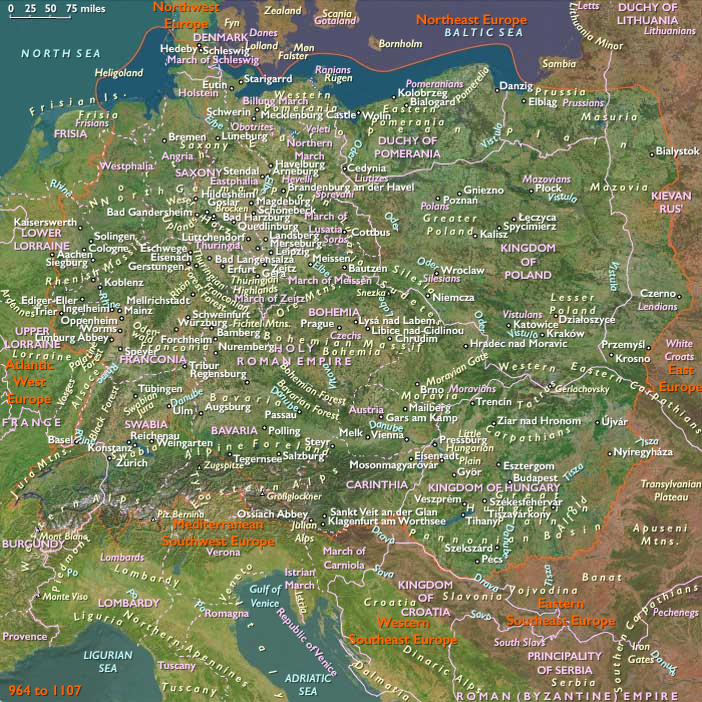
Central Europe
View →Subregions
