
Construction of the Romanesque Church of Saint-Benoît-sur-Loire…
1065 CE
Construction of the Romanesque Church of Saint-Benoît-sur-Loire Begins (1065)
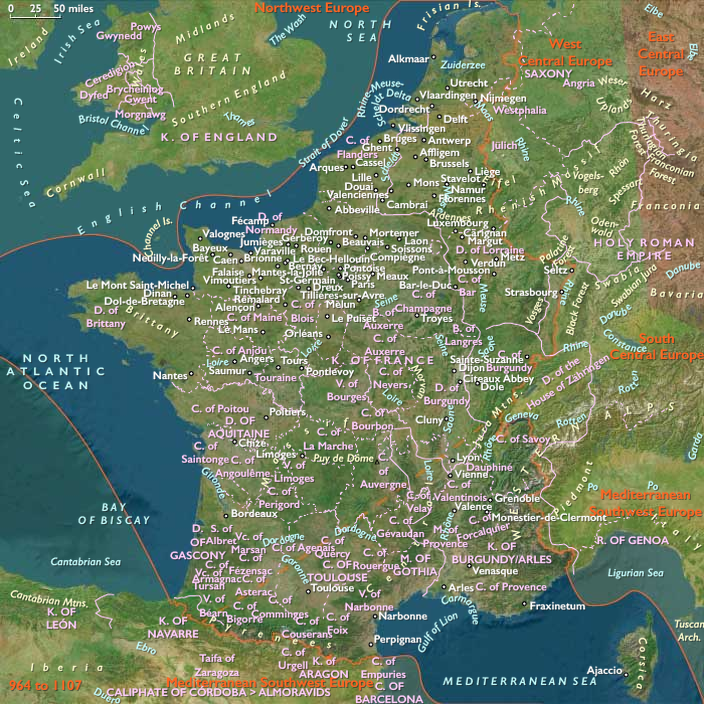
In 1065, construction began on the Romanesque-style monastic church of Saint-Benoît-sur-Loire, an important Benedictine abbey in central France. The abbey had long been a center of monastic life and learning, and its new church project reflected both the growing wealth of the monastery and the increasing influence of the Cluniac-inspired architectural movement.
Historical and Religious Importance of Saint-Benoît-sur-Loire
- The abbey was founded in the 7th century and was famous for housing the relics of Saint Benedict of Nursia, the founder of Western monasticism.
- Over time, the monastery became one of the most influential in France, attracting pilgrims and scholars alike.
- By the mid-11th century, the monastery’s growing prominence necessitated a larger, grander church, leading to the construction of the new Romanesque basilica in 1065.
Architectural Features of the New Romanesque Church
- The new church followed the Romanesque style, characterized by:
- Thick stone walls and rounded arches.
- A large nave and a semi-circular apse.
- Columned arcades and intricate sculptural decoration.
- Its design incorporated Cluniac influences, which emphasized monumental scale and richly adorned interiors.
- The church was built to accommodate increasing numbers of pilgrims, as Saint Benedict’s relics continued to attract visitors from across Christendom.
Significance and Influence
- The construction of Saint-Benoît-sur-Loire reinforced the growing power of monastic institutions in 11th-century France.
- Its Romanesque design set a precedent for later abbey churches, influencing structures throughout France and beyond.
- The abbey remained an important intellectual center, contributing to medieval theological and literary traditions.
The 1065 construction of Saint-Benoît-sur-Loire marked a significant moment in medieval architecture, showcasing the evolving artistic and spiritual ambitions of the Benedictine monastic order.
Groups
Regions
West Europe
View →Subregions

Atlantic West Europe
View →Related Events
No active filters.
Showing 10 events out of 50938 total
Vselav, the son of Bryachislav Izyaslavich, Prince of Polotsk and Vitebsk, and thus the great-grandson of Vladimir I of Kiev and Rogneda of Polotsk, was born between about 1030 to 1039 in Polotsk (with Vasilii as his baptismal name) and had married around 1060.
He had taken the throne of Polotsk in 1044 upon his father's death, and although he is the senior member of the Rurik Dynasty for his generation, since his father had not been prince in Kiev, Vseslav is excluded (izgoi) from the grand princely succession.
He is the only major prince in Rus not descended from Yaroslav.
Unable to secure the capital, which is held by Yaroslav's three sons, Vseslav starts pillaging the northern areas of Kievan Rus.
Vseslav lays siege to Pskov in 1065, but is thrown back.
Harald travels throughout his realm in the winter of 1065 and accuses the farmers of withholding taxes from him.
He responds with brutality, having peopled maimed and killed as a warning to those who disobey him.
Harald maintains control of his nation through the use of his hird, a private standing army maintained by Norwegian lords.
His contribution to the strengthening of Norway's monarchy is the enforcement of a policy that only the king can retain a hird, thus centralizing power away from local warlords.
The area of present Tartu had been first recorded in 1030 by chroniclers of Kievan Rus.
Yaroslav I the Wise, Prince of Kiev, built his own fort here, and named it Yuryev (literally "Yury's" – Yury (a Russified form of George) being Yaroslav's Christian name).
Kievan rulers had then collected tribute from the surrounding ancient Estonian county of Ugaunia, possibly until 1061, when, according to chronicles, Yuryev is burned down by another tribe of Chudes (Sosols), a term historically applied in the early Russian annals to several Finnic peoples in the area of what is now Estonia, Karelia and northwestern Russia.
Boleslaw II, as the eldest son of Casimir, had in 1058 inherited Greater and Lesser Poland as well as the Mazovian, Pomeranian, and Silesian lands.
His younger brothers Wladyslaw Herman and Mieszko had become governors of the remaining provinces.
However Mieszko dies relatively early, in 1065, at which point his lands come under the authority of Boleslaw II.
His father had left him a stable country; Boleslaw II continues his foreign policy of surrounding his realm with allied kingdoms in order to prevail against the extensive Holy Roman Empire in the west; he aims to have Poland eventually bordering only allied countries.
The accession of Constantine X Ducas in 1059 had been a triumph for the civil aristocracy.
Unfortunately, he has proven to be an incapable emperor, having reduced the army and neglected the frontier defenses at a time when the Seljuq Turks are pressing into the eastern provinces.
He had suffered invasions by Alp Arslan in Asia Minor in 1064, resulting in the loss of the Armenian capital, and by the Oghuz Turks in the Balkans in 1065, while Belgrade has been lost to the Hungarians.
A succession dispute after Thimal's death that had raged between Mahmud and Thimal's brother 'Atiyya ibn Salih led to a split in the Mirdasid domains.
Mahmud controls the western half, while 'Atiyya controls the east.
In order to gain an edge over Mahmud, 'Atiyya had recruited a band of Turks, but they later defect to Mahmud, forcing 'Atiyya to give up Aleppo in 1065.
French Christian warriors, en route to Spain in 1065 to drive out the Muslims, stop in a number of towns along the way and kill any Jews they find.
The Moors, in a counterattack in 1065, easily retake Barbastro and undo all the crusaders' work, massacring the small garrison.
Ermengol III dies on April 17, 1065, while defending the city from Moorish reprisals.
Thibaut, the Burgundian leader, dies also, possibly of wounds received on campaign, while returning to France after the loss of the city.
Fernando I of Leon had in 1063 sent his son, the infante Sancho, to the aid of his vassal, Ahmad al-Muqtadir, king of the Taifa of Zaragoza when his city of Graus was being besieged by the forces of Ramiro I of Aragon.
Consequently, Ramiro, who was Fernando's brother, had been defeated and killed.
There had ensued a mass slaughter of Christians in the aftermath of that battle.
To appease public support, Ahmad al-Muqtadir has stopped paying his vassal tribute to the Kingdom of Leon.
King Fernando responds in 1065 by launching an expedition into the valley of the Ebro River, devastating the land and defeating al-Muqtadir, once again forcing him into a vassal state.
The expedition continues on towards Valencia, governed by Abd al-Malik ben Abd al-Aziz al-Mansur, with the intent on also turning that city into a vassal state.