
Construction begins in 1562 on the Escorial,…
1562 CE
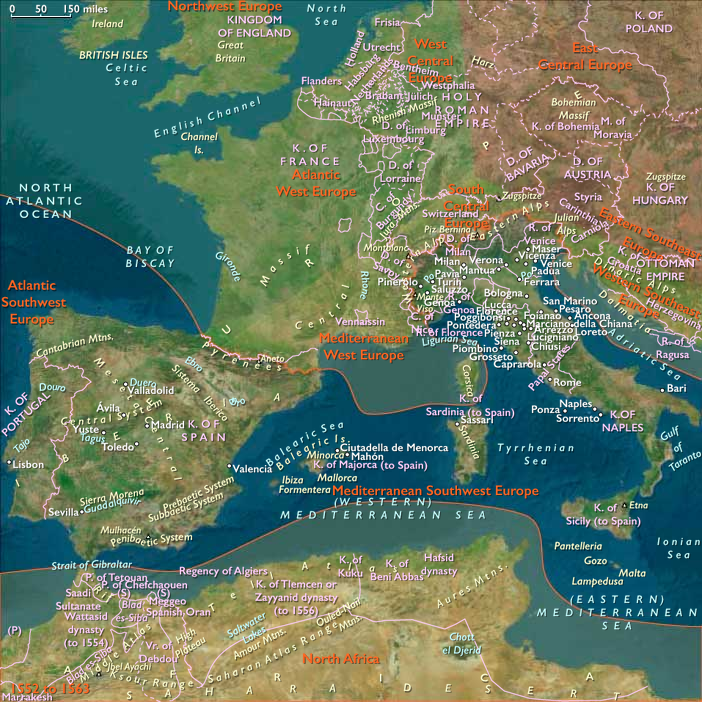
Construction begins in 1562 on the Escorial, a vast building complex in New Castile, near Madrid, in central Spain.
The project is conceived by King Philip II, who has ordained the building of a grand edifice here to commemorate the 1557 Spanish victory at the Battle of St. Quentin in Picardy against Henry II, king of France.
He also intends the complex to serve as a necropolis for the interment of the remains of his parents, Charles I and Isabella of Portugal, himself, and his descendants.
In addition, Philip envisions El Escorial as a center for studies in aid of the Counter-Reformation cause.
The architect, Juan Bautista de Toledo, designs the ground plan on a gridiron scheme, recalling the grill on which St. Lawrence, patron of the building, was martyred.
St. Lawrence’s feast day is August 10, the same date as the Battle of St. Quentin.
However, the origin of the building's layout is in fact controversial.
The grill-like shape, which did not fully emerge until Juan de Herrera, under whom the building will be completed in 1584, eliminates from the original conception the six interior towers of the facade, is not unique to El Escorial.
Other buildings had been constructed with interior courtyards fronting on churches or chapels; King's College, Cambridge, dating from 1441, is one such example; the old Ospedale Maggiore, Milan's first hospital, begun in 1456 by Antonio Filarete, is another grid-like building with interior courtyards.
In fact, palaces of this approximate design were commonplace in the Byzantine and Arab world.
Strikingly similar to El Escorial is the layout of the Alcázar of Seville and the design of the Alhambra at Granada where, as at El Escorial, two courtyards in succession separate the main portal of the complex from a fully enclosed place of worship.
The most persuasive theory for the origin of the floor plan is that it is based on descriptions of the Temple of Solomon by the Judeo-Roman historian, Flavius Josephus: a portico followed by a courtyard open to the sky, followed by a second portico and a second courtyard, all flanked by arcades and enclosed passageways, leading to the "holy of holies".
Statues of David and Solomon on either side of the entrance to the basilica of El Escorial lend further weight to the theory that this is the true origin of the design.
The Temple-of-Solomon design, if it is indeed the basis for El Escorial, is extensively modified to accommodate the additional functions and purposes Philip II intends the building to serve.
Beyond being a monastery, El Escorial is also a pantheon, a basilica, a convent, a school, a library, and a royal palace.
All these functional demands will result in a doubling of the building's size from the time of its original conception.
Images

El Escorial: floor plan, based on the floor plan of Solomon's Temple.
Locations
Subjects
Regions
Southwest Europe
View →Subregions
