Construction of the Arsenal, a complex of …
Years: 1104 - 1104
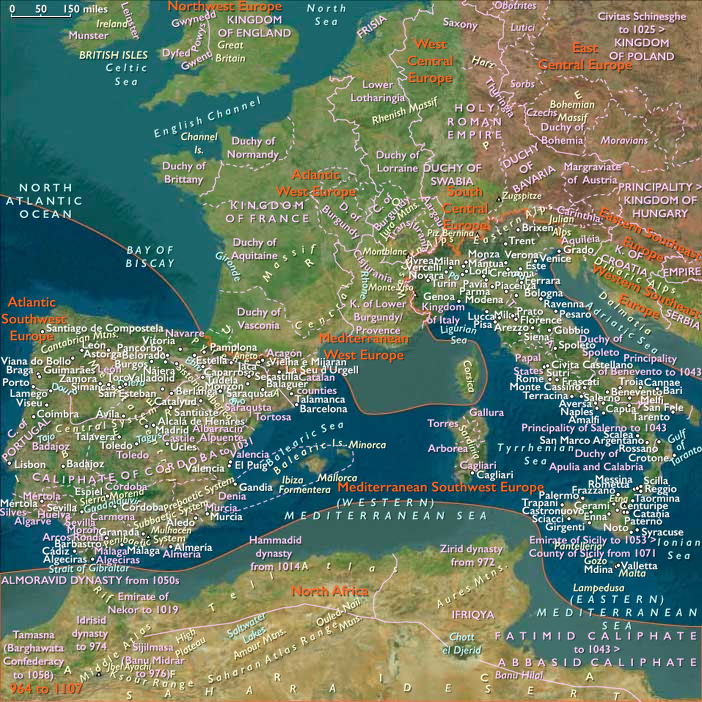
Construction of the Arsenal, a complex of state-owned shipyards and armories clustered together in Venice, begins during Venice's republican era.
While the establishment may have existed as early as the eighth century, the present structure is usually said to have been begun in 1104 during the reign of Ordelafo Faliero, although there is no evidence for such a precise date.
Initially, the state dockyard works merely to maintain privately built naval ships.
Locations
People
Groups
Commodoties
Subjects
Regions
Subregions
Related Events
Filter results
Showing 10 events out of 49956 total
Harald Kresja has acted as regent for his father in 1103-1104 while he was on pilgrimage to Jerusalem alongside Archbishop Asser of Lund.
As regent, he is courageous but violent, cruel and debauched.
Harald plunders far and wide from his stronghold Haraldsborg at Roskilde.
This behavior greatly contributes to the reasons that he had not been elected king after news of his father’s death on crusade in 1103 reached Denmark.
Instead, his uncle Niels, a son of King Sweyn II Estridson and a concubine, is in 1104 elected king.
David IV of Georgia, despite his young age at his accession to the throne, had long been actively involved in Georgia’s political life.
Backed by his tutor and an influential churchman named George of Chqondidi, David IV has pursued a purposeful policy, taking no unconsidered step.
He is determined to bring order to the land, bridle the unsubmissive secular and ecclesiastic feudal lords, centralize the state administration, form a new type of army that will stand up better to the Seljuq Turkish military organization, then go over to a methodical offensive with the aim of expelling the Seljuqs first from Georgia and then from the whole Caucasus.
Between 1089–1100, King David had organized small detachments of his loyal troops to restore order and destroy isolated enemy troops.
He has begun the resettlement of devastated regions and helped to revive major cities.
Encouraged by his success, but more importantly the beginning of the Crusades in Palestine, he had ceased payment of the annual contribution to the Seljuqs and put an end to their seasonal migration to Georgia.
In 1101, King David had captured the fortress of Zedazeni, a strategic point in his struggle for Kakheti and Hereti, and within the past three years has liberated most of eastern Georgia.
In 1093, he had arrested the powerful feudal lord Liparit Baghvashi, a longtime enemy of the Georgian crown, and expelled him from Georgia the following year.
After the death of Liparit’s son Rati, David had abolished their duchy of Kldekari in 1103.
In 1104, David’s supporters in the eastern Georgian province of Kakheti capture the local king Aghsartan II (1102–1104), a loyal tributary of the Seljuq Sultan, and reunite the area with the rest of Georgia.

Kilij Arslan in 1104 resumes once more his war with the Danishmends, who are now weakened after the death of Malik Gazi, demanding half the ransom gained for Bohemond.
As a result Bohemond allies with the Danishmends against Rüm and Constantinople.
Toghtekin, acting as regent and de facto ruler after Duqaq dies in 1104, has the former's junior son Tutush II proclaimed emir, while he marries Duqaq's widow and reserves for himself the title of atabeg.
After deposing Tutush II, he has another son of Duqaq, Baqtash, named emir, but soon afterward he has him exiled.
Baqtash, with the support of Aitekin, the sahib of Bosra, tries to reconquer Damascus, but is pushed back by Toghtekin and forced to find help at the court of King Baldwin I of Jerusalem.
Baldwin is assisted in 1104 by a Genoese fleet; Acre is captured and renamed St. Jean d'Acre.
Peter grants a fuero to all the infanzones of his realm in 1104, retaining his right to require three-day field service.
Peter's only children, Isabella and Peter (born around 1086), both from his first marriage, had died young in 1103 and on February 1, 1104, respectively.
The boy, Peter, had been wed to María Rodríguez, a daughter of El Cid, in 1098, a marriage celebrated in the Cantar de mio Cid and subsequent literature.
Both Isabella and Peter are on August 18, 1104, interred in San Juan de la Peña.
When Peter dies at the end of September 1104 n the Val d'Aran, his kingdoms pass to his younger half-brother, Alfonso the Battler.
Peter is buried in San Juan de la Peña alongside his children.
The construction of Durham Cathedral is the best-known legacy of the late William de St. Calais, Bishop of Durham, although the nave will not be not finished until 1130.
The cathedral displays such characteristically Norman architectural features as high vaults atop windowed clerestories.
The construction technique of combining a pointed arch with another rib allows a six-pointed vault, which enables the building to attain a greater height than earlier churches.
This permits larger celestory windows, and lets more light into the building.
The technique of the six-pointed vault will spread to Saint-Etienne in Caen from which it will influence the development of early Gothic architecture near Paris.
The system of rib vaulting in the choir, completed in 1104, is the earliest consistent use of this technique in Europe.
Hekla is an active volcano in southwestern Iceland, located in an agricultural area seventy miles (one hundred and thirteen kilometers) east of Reykjavik.
Known as Cloak Mountain, Icelandic folklore holds it to be one of the gates to purgatory, guarded by witches.
Hekla in Icelandic is the word for a short hooded cloak which may relate to the frequent cloud cover on the summit.
An early Latin source refers to the mountain as Mons Casule.
Hekla had been dormant for at least two hundred and fifty years when it erupts explosively in 1104 (probably in the autumn), covering over half of Iceland (fifty-five thousand square miles) with 1.2 square kilometers / 2.5 square kilometers of rhyodacitic tephra.
This is the second largest tephra eruption in the country in historical times with a VEI of 5 like H3.
Farms upwind of the volcano in Þjórsárdalur valley (fifteen kilometers distant), Hrunamannaafréttur (fifty kilometers distant) and Lake Hvítárvatn (seventy kilometers distant) are abandoned due to the damage.
The eruption causes Hekla to become famous throughout Europe.
Stories, probably spread deliberately through Europe by Cistercian monks, told that Hekla was the gateway to Hell.
Matilda proves an effective queen for Henry, acting as a regent in England on occasion, addressing and presiding over councils, and extensively supporting the arts.
The couple soon had two children, Matilda, born in 1102, and William Adelin, born in 1103; it is possible that they also had a second son, Richard, who died young.
Following the birth of these children, Matilda prefers to remain based in Westminster while Henry travels across England and Normandy, either for religious reasons or because she enjoys being involved in the machinery of royal governance.
Henry has a considerable sexual appetite and enjoys a substantial number of sexual partners, resulting in a large number of illegitimate children, at least nine sons and thirteen daughters, many of whom he appears to have recognized and supported.
It was normal for unmarried Anglo-Norman noblemen to have sexual relations with prostitutes and local women, and kings are also expected to have mistresses.
Some of these relationships occurred before Henry was married, but many others take place after his marriage to Matilda.
Henry has a wide range of mistresses from a range of backgrounds, and the relationships appear to have been conducted relatively openly.
He may have chosen some of his noble mistresses for political purposes, but the evidence to support this theory is limited.
Duke Robert has continued to fight Robert of Bellême, but the Duke's position has worsened, until by 1104, he has to ally himself formally with Bellême to survive.
Arguing that Duke Robert has broken the terms of their treaty, Henry crosses over the Channel to Domfront, where he meets with senior barons from across Normandy, eager to ally themselves with the King.
Henry confronts his brother and accuses him of siding with his enemies, before returning to England.