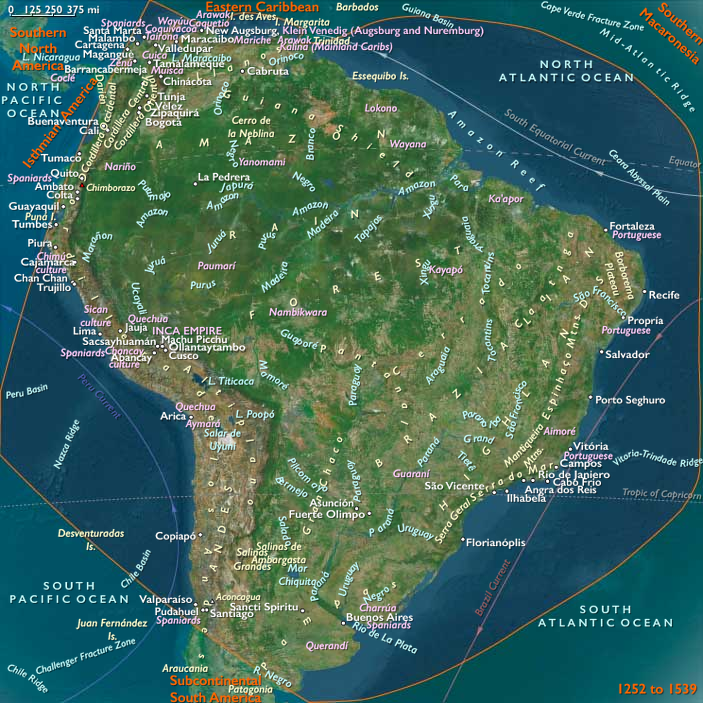
Continental South America (1492–1503 CE): Huayna Capac’s…
1492 CE to 1503 CE
Continental South America (1492–1503 CE): Huayna Capac’s Imperial Apex, Cultural Flourishing, and First European Contacts
Between 1492 and 1503 CE, Continental South America—including Peru, Bolivia, Paraguay, Uruguay, Brazil, northern Argentina, northern and central Chile, central and eastern Colombia, most of Ecuador, Venezuela, Suriname, Guyana, and French Guiana—experienced profound developments during the early rule of Huayna Capac. This era marked the zenith of Inca imperial organization and cultural integration, alongside significant regional prosperity, innovation, and the earliest European contacts along the continent’s northern coasts.
Political Developments
Huayna Capac’s Full Consolidation of Power
Huayna Capac firmly established his authority over the extensive territories of the Inca Empire, successfully reinforcing centralized governance and administrative efficiency throughout Peru, Ecuador, northern Chile, Argentina, and western Bolivia. His rule marked political stability, strategic diplomacy, and effective provincial integration.
First European Contacts on the Northern and Eastern Coasts
During this era, European explorers—most notably Christopher Columbus (arriving near the continent’s northern coasts in 1498) and subsequent Spanish and Portuguese expeditions—initiated contact with the peripheral regions of Venezuela, Brazil, and the Guianas, signaling the beginning of major transformations ahead.
Regional Dynamics and Imperial Responses
Regional societies, including the Chachapoyas in northern Peru, Guaraní communities in Paraguay and southern Brazil, and chiefdoms in Colombia, Ecuador, and Venezuela, navigated imperial integration with diverse strategies. Many maintained cautious alliances, selective autonomy, or complex diplomatic relationships with the expanding empire.
Economic Developments
Peak Agricultural Productivity and Infrastructure
Under Huayna Capac, agricultural infrastructure reached exceptional sophistication, including advanced terracing, extensive irrigation, and widespread storage systems (qollqas). This ensured surplus food supplies, stabilized imperial economies, and effectively supported imperial populations and public construction projects.
Flourishing Trade and Communication Networks
Enhanced trade and communication infrastructure, notably the extensive Inca road system (Qhapaq Ñan), facilitated efficient transportation and commerce. Textiles, ceramics, precious metals, obsidian, agricultural products, and ceremonial goods circulated widely, integrating diverse regions economically and culturally.
Cultural and Technological Developments
Monumental Imperial Construction
Architectural projects flourished under Huayna Capac, notably in Cuzco, Quito, and strategic sites throughout the empire. Monumental structures, administrative centers, temples, palaces, and fortifications showcased exceptional stone masonry, sophisticated engineering, and urban planning reflective of imperial cohesion and authority.
Artistic Refinement and Imperial Aesthetics
Artistic traditions reached new heights of sophistication, with artisans producing finely crafted textiles, elaborate ceramics, intricate metalwork, and ceremonial jewelry. These works blended imperial motifs with local symbolism, reflecting cultural integration and regional distinctiveness.
Social and Religious Developments
Intensified Religious Centralization
Imperial religious practices continued to strengthen, emphasizing elaborate rituals dedicated to Inti (the sun god), ancestor worship, and state-sponsored ceremonies. Such rituals reinforced imperial legitimacy, social cohesion, and cultural unity across diverse populations.
Clearly Defined Social Stratification
Social hierarchies were firmly established, featuring clearly delineated Inca nobility, provincial elites, religious authorities, artisans, merchants, and commoners. Hierarchical distinctions were reinforced by specialized ceremonial practices, regulated dress codes, distinctive burial rituals, and residential patterns.
Long-Term Consequences and Historical Significance
The era from 1492 to 1503 CE represented a pivotal period in Continental South America’s history, highlighting the peak of Inca imperial power, cultural flourishing, and the initial contacts with Europeans. Huayna Capac’s stable rule solidified imperial administration and cultural cohesion, setting the stage for future political and social transformations. The early European explorations initiated processes that would eventually alter the continent profoundly, laying crucial groundwork for the forthcoming historical shifts of the early colonial era.
Groups
Topics
Commodities
Subjects
Regions
South America
View →Subregions