
South America Major (1756–1767 CE): Jesuit Expulsion,…
1756 CE to 1767 CE
South America Major (1756–1767 CE): Jesuit Expulsion, Economic Prosperity, and Rising Colonial Tensions
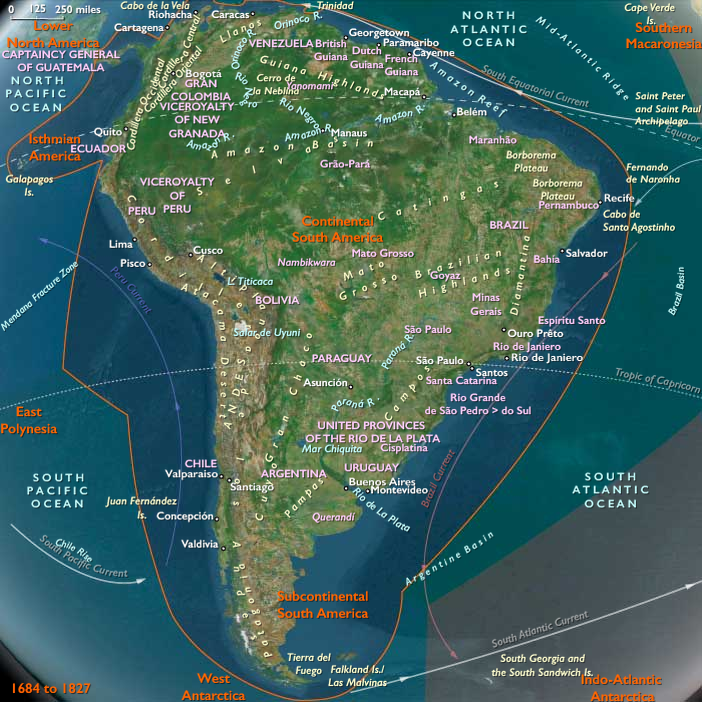
Between 1756 and 1767 CE, South America Major—encompassing all lands north of the Río Negro, extending across the full continental span of Brazil, Uruguay, Paraguay, northern Argentina and northern Chile, Bolivia, Peru, Ecuador (excluding the Cape lands at the Isthmian boundary), Colombia (excluding the Darién region, which belongs to Isthmian America), Venezuela, Guyana, Suriname, and French Guiana—witnessed a dramatic turning point with the expulsion of the Jesuits from Portuguese (1759) and subsequently Spanish territories (1767). This period continued to enjoy robust economic prosperity, but colonial societies faced escalating internal tensions, intensified indigenous resistance, and significant political and social realignments resulting from the Jesuit expulsions.
Political Developments
Jesuit Expulsion from Portuguese and Spanish Territories
The Jesuit order was expelled by Portugal from Brazil (1759) under Marquis of Pombal’s administration, and subsequently by Spain from its colonial possessions (1767). The expulsions were driven by colonial authorities' suspicion of Jesuit autonomy, wealth, and influence. Jesuit missions, particularly among the Guaraní, were dismantled, significantly altering colonial governance structures.
Spanish Colonial Governance and Reform Initiatives
Spanish administrative authorities, notably within the Viceroyalty of Peru, implemented further centralizing reforms aimed at increasing crown control and reducing the autonomy of religious orders and regional elites, as part of broader Bourbon reforms.
Continued Portuguese Expansion and Control
Portuguese authorities tightened their economic and political oversight in Brazil, driven by mining wealth, plantation agriculture, and administrative centralization under Pombal’s reforms, reshaping territorial governance.
Economic Developments
Continued Mining and Economic Strength
Gold extraction in Brazilian mining regions (Minas Gerais) continued robustly, contributing significantly to colonial wealth and global trade. Silver mining at Potosí also remained economically crucial to Spanish South America.
Plantation Economies and Enslaved Labor Systems
Plantation agriculture in Brazil continued its economic prominence, maintaining heavy reliance on enslaved African labor, reinforcing Brazil’s position within Atlantic commerce and significantly shaping social demographics.
Ranching Economies and Rural Stability
Livestock ranching flourished further in Argentina, Uruguay, Paraguay, and southern Brazil, supporting stable rural economies and influencing long-term settlement patterns and regional identities.
Cultural and Technological Developments
Disruption and Legacy of Jesuit Missions
The dismantling of Jesuit missions profoundly disrupted indigenous communities, particularly the Guaraní reductions in Paraguay, Brazil, Uruguay, and northern Argentina. The cultural, educational, and social achievements fostered by the Jesuits faced dramatic upheaval, yet their legacy of literacy, music, art, agriculture, and cultural synthesis persisted beyond their expulsion.
Continued Urban and Architectural Prosperity
Major urban centers—Lima, Quito, Bogotá, Salvador, Rio de Janeiro, and Brazilian mining towns—continued to flourish, reflecting sustained economic prosperity and cultural dynamism through significant architectural developments and vibrant urban culture.
Social and Religious Developments
Profound Impact of Jesuit Expulsion
The expulsion of Jesuits disrupted social stability and educational structures profoundly. Indigenous communities formerly under Jesuit protection experienced dislocation, vulnerability to exploitation, and social fragmentation, altering colonial social relations substantially.
Deepening Colonial Social Stratification
Racial and class-based hierarchies remained firmly entrenched and became increasingly complex, with European elites dominating, indigenous communities marginalized further post-Jesuit expulsion, and enslaved Africans and mixed-race populations continuing to navigate profound inequalities.
Indigenous Resistance and Frontier Tensions
Indigenous resistance, notably among the Mapuche in Chile, frontier populations in the Andes and Amazon, and Guaraní communities affected by mission disruptions, remained persistent. Indigenous struggles influenced colonial policies, frontier settlement, and defensive strategies.
Long-Term Consequences and Historical Significance
The era from 1756 to 1767 CE was pivotal in reshaping the political, social, and cultural landscapes of South America Major. The expulsion of the Jesuits represented a significant turning point, profoundly impacting indigenous communities and destabilizing previously thriving mission economies and cultures. Continued indigenous resistance and economic prosperity coexisted with rising tensions and shifts in colonial governance, laying essential foundations for broader transformations in the late eighteenth century, ultimately influencing the continent’s historical trajectory toward independence movements and social reconfiguration.
Groups
Topics
Commodities
Regions
South America
View →Subregions
