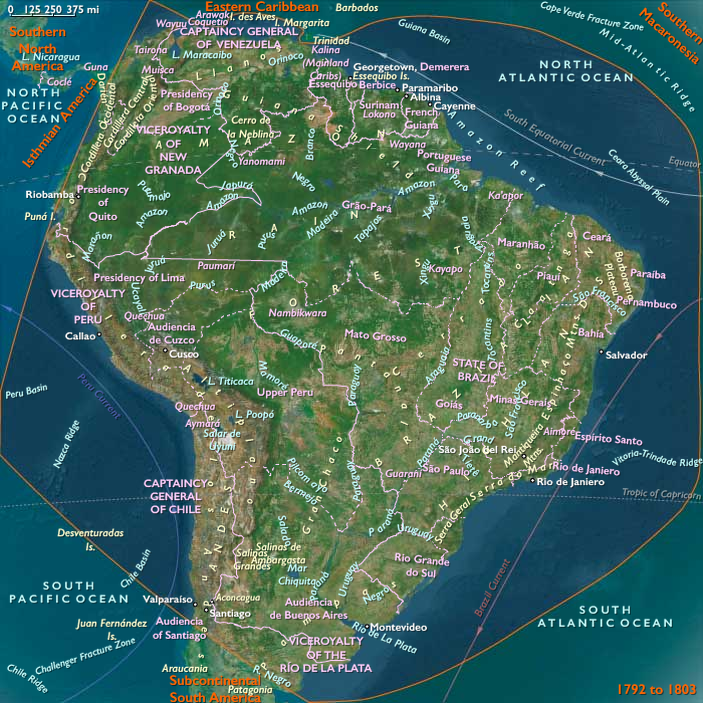
South America Major (1792–1803 CE): Revolutionary Ideals,…
1792 CE to 1803 CE
South America Major (1792–1803 CE): Revolutionary Ideals, Colonial Unrest, and Prelude to Independence
Between 1792 and 1803 CE, South America Major—encompassing Peru, Bolivia, Paraguay, Uruguay, Brazil, northern Argentina, northern and central Chile, Ecuador, central and eastern Colombia, Venezuela, Suriname, Guyana, and French Guiana—experienced escalating tensions within colonial governance and society. Deepening economic strains, increased exposure to revolutionary ideals from abroad (notably the French and Haitian revolutions), and sustained indigenous and lower-class unrest collectively set the stage for imminent independence movements.
Political Developments
Revolutionary Ideas and Increased Surveillance
The revolutionary ideals of liberty, equality, and republican governance from Europe (particularly the French Revolution of 1789–1799) and the Haitian Revolution (1791–1804) reached South America, profoundly influencing colonial intellectuals and elites. Spanish and Portuguese authorities significantly tightened censorship, surveillance, and administrative control to suppress spreading revolutionary sentiments.
Early Independence Attempts and Conspiracies
This period witnessed early conspiracies and attempts at independence, most notably in Brazil (Minas Gerais Conspiracy or Inconfidência Mineira, 1789–1792) and Colombia (Revolt of the Comuneros, 1781, influencing subsequent thought). Though largely unsuccessful, these movements foreshadowed broader revolutionary currents.
Continued Centralization and Authoritarianism
Spanish Bourbon authorities intensified administrative centralization and authoritarian measures, provoking increased resistance from local elites, merchants, and intellectuals discontented with economic restrictions and colonial exploitation.
Economic Developments
Economic Strains and Resource Depletion
Mining operations—Brazilian gold in Minas Gerais and silver extraction at Bolivia’s Potosí—continued, but with diminishing returns as major veins began depleting. Economic strains from declining mineral yields intensified social unrest and dissatisfaction with colonial taxation.
Plantation Economies and Enslavement Intensification
Brazilian plantations remained economically significant, deeply dependent on enslaved African labor, exacerbating social inequalities and fueling increasing discontent and potential unrest among enslaved populations and abolitionist advocates.
Continued Emerald Mining and Labor Exploitation
Emerald mining in Colombia’s Muzo and Chivor regions continued under exploitative conditions. Forced indigenous labor and strict Spanish controls highlighted ongoing colonial oppression and contributed to local tensions.
Cultural and Technological Developments
Enlightenment Ideas and Intellectual Exchanges
Urban centers—Lima, Quito, Bogotá, Rio de Janeiro—became vibrant sites of intellectual debate and cultural exchange, influenced by European Enlightenment thinkers. Revolutionary concepts of liberty and equality circulated, significantly shaping political thought among colonial intellectuals and elites.
Urban Development and Cultural Flourishing
Major colonial cities continued growing culturally and architecturally, reflecting sustained colonial prosperity but also becoming centers of social and political ferment. Public buildings, universities, salons, and theaters supported active intellectual and artistic communities.
Social and Religious Developments
Rising Social Tensions and Calls for Reform
Social tensions escalated notably among lower-class mestizos, indigenous peoples, and enslaved Africans, who increasingly challenged oppressive colonial systems. Calls for reform from creoles and mixed-race populations gained momentum, reflecting widespread dissatisfaction.
The Catholic Church Amid Revolutionary Challenges
The Catholic Church faced significant challenges adjusting to revolutionary ideas. Seeking to reinforce traditional authority post-Jesuit expulsion, the Church became increasingly involved in suppressing revolutionary and reformist ideas, complicating its position among diverse social groups.
Paraguay saw rising political consciousness and tensions linked to revolutionary ideals circulating from Buenos Aires and other colonial centers. Though distant from major revolutionary hotspots, the legacy of Jesuit missions left a distinct cultural and political imprint, shaping local responses to colonial pressures and foreshadowing Paraguay’s unique approach to independence.
Indigenous Resistance and Frontier Conflict
Indigenous populations continued to resist exploitation through rebellions and frontier conflicts, notably among the Mapuche in southern Chile and various Andean and Amazonian groups. Persistent indigenous resistance influenced colonial defensive and political strategies, exacerbating existing tensions.
Long-Term Consequences and Historical Significance
The era from 1792 to 1803 CE marked a pivotal phase in the trajectory toward independence across Continental South America. Exposure to revolutionary ideals, deepening economic strains, and persistent social and indigenous unrest intensified colonial tensions. The cumulative effect of these factors firmly established conditions ripe for revolutionary upheaval, profoundly shaping the continent's imminent historical transformations and independence movements in the early nineteenth century.
Groups
Topics
Subjects
Regions

South America
View →Subregions