
Control of Valle d'Aosta passes in 1238…
1238 CE
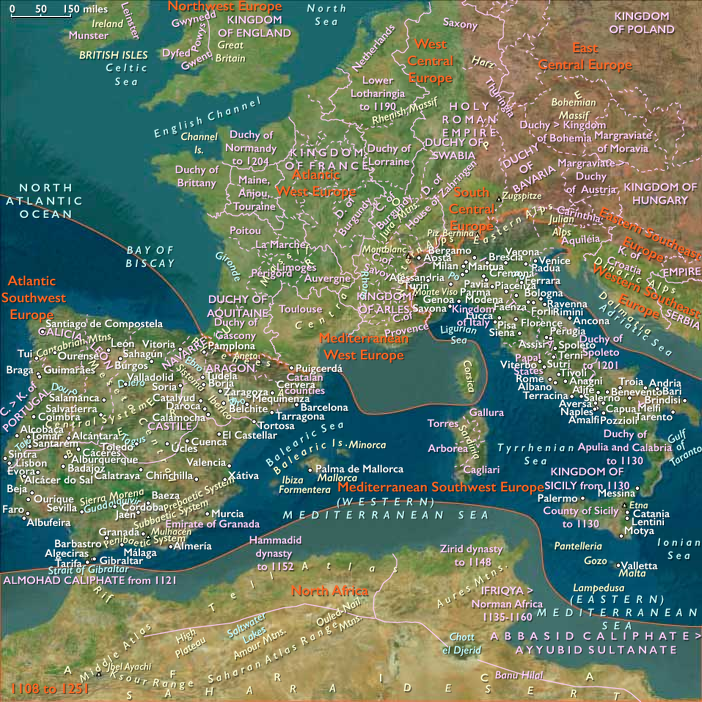
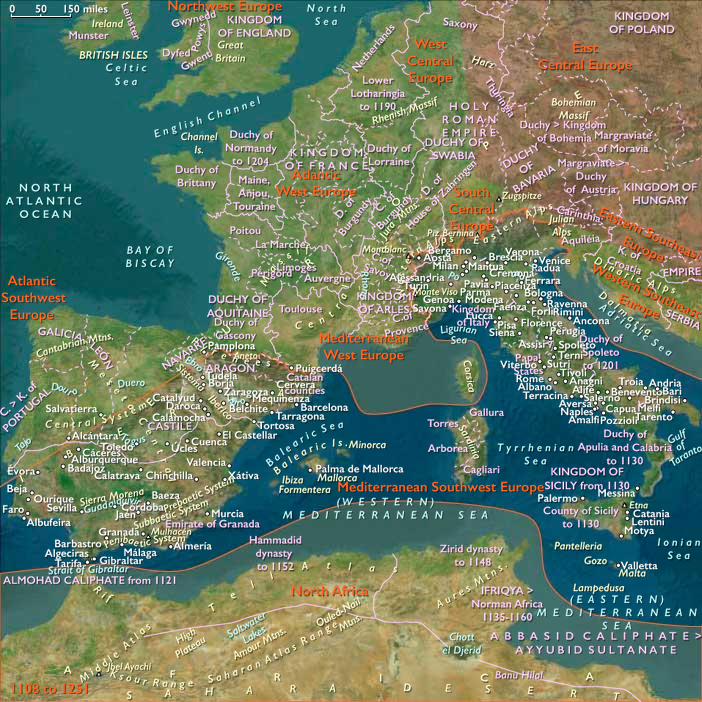
Control of Valle d'Aosta passes in 1238 from the dukes of Burgundy to the house of Savoy.
Locations
Subjects
Regions
Southwest Europe
View →Subregions
Mediterranean Southwest Europe
View →Related Events
No active filters.
Showing 10 events out of 46934 total
The Livonian Knights make an agreement in 1238 with the Danish king Valdemar II, whereby the Danes regain Estonia.
The Knights gain the Baltic coast between Vistula and Danish Estonia.
Pope Gregory IX in 1238 had formed an alliance between Genoa and Venice against the Empire, and consequently against Pisa also.
As Pola had sided with the Pisans, the city is sacked in 1243 by the Venetians.
The annexation of Moorish lands by Aragon leaves the Nasrid kingdom of Granada, founded in 1232, as all the sole remnant of the Moorish dominion in Spain.
James, in completing the conquest of the Muslim kingdom of Valencia in 1238, has brought the kingdom of Aragon—now comprising Aragon, Catalonia, Valencia, and the Balearics—to its greatest extent, and earns himself the title James the Conqueror.
Batu moves into central Russia in 1238 to subdue the Western Russian principalities.
Besieging Vladimir, he finally overruns it on February 8, 1238.
A great fire destroys thirty-two limestone buildings on the first day alone, while the family of Grand Prince Yuri II perishes in a church where they had sought refuge from the flames.
The grand prince himself manages to escape.
Yuri’, after the Mongols sack his capital, flees across the Volga northward to Yaroslavl', where he hastily musters an army.
He and his brothers then turn back toward Vladimir in hopes of relieving the city before the Mongols take it, but they are too late.
Yuri sends out a force of three thousand men under Dorozh to scout out the Mongols’ position; whereupon Dorozh returns saying that Yuri and his force are already surrounded.
As he tries to muster his forces, he is attacked by the Mongol force under Burundai and flees, but is overtaken on the Sit River and dies there along with his nephew, Prince Vsevolod of Yaroslavl'.
The battle marks the end of unified resistance to the Mongols and inaugurates two centuries of the Mongol domination of modern day-Russia, Ukraine, and Belarus.
Major cities such as Torzhok and …
…Kozel'sk are captured and burned.
Kozel'sk becomes famous when its seven-year-old prince Vasily, son of Titus, has to defend the town against the army of Batu Khan.
The latter dubs it an "evil town" because its citizens had been fighting the attackers for seven weeks in a row, killing around four thousand enemy soldiers during the siege.
The citizens of Kozel'sk are greatly outnumbered and almost all of them die in battle.
Yaroslav, following the battle death of his older brother, leaves Kiev for Vladimir, where he is crowned grand prince.
Some of the armed forces of Ryazan withdraw to unite with the Vladimir-Suzdal army and meet the forces of Batu Khan near Kolomna.