
Copernicus, shortly after receiving his doctorate from …
Years: 1514 - 1514
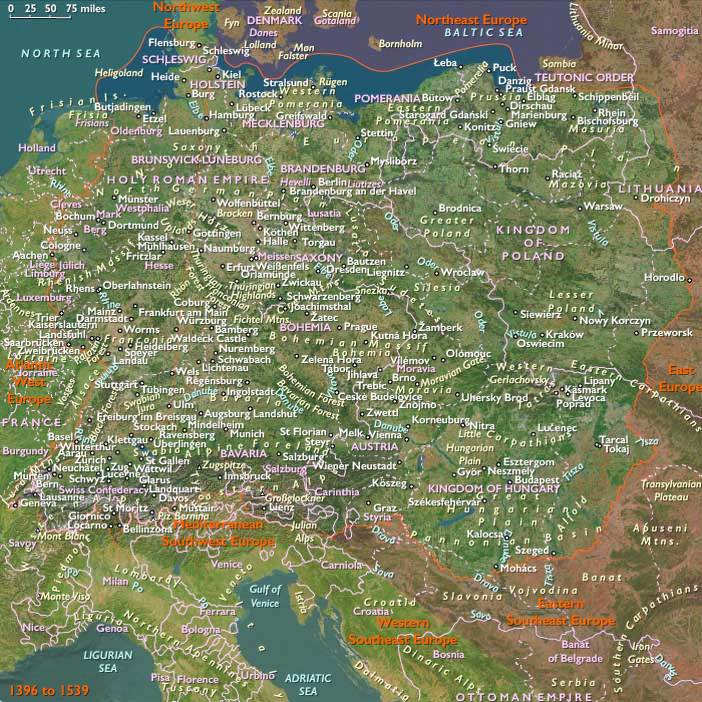
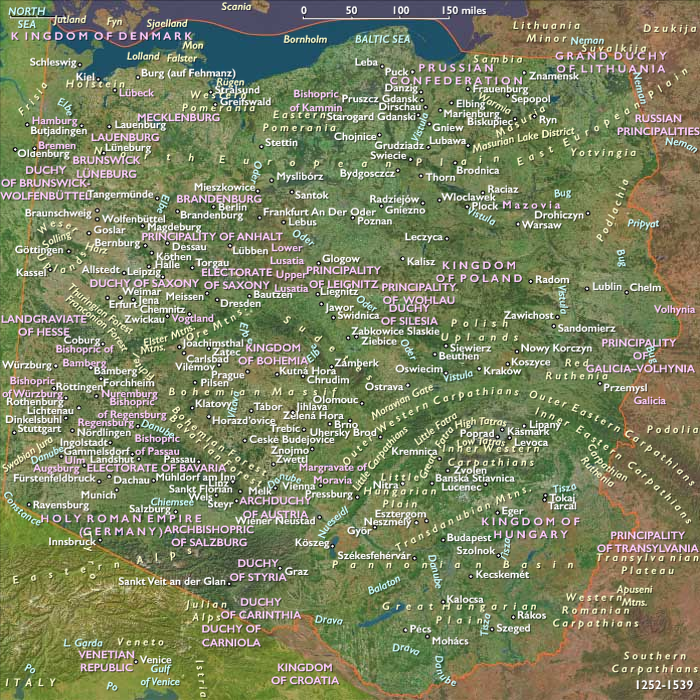
Copernicus, shortly after receiving his doctorate from Ferrara, returns from to Poland and eventually settles at the cathedral in Frauenberg, not a hundred miles (one hundred and sixty kilometers) from his birthplace in Thorn.
By May 1514, the forty-one-year-old Copernicus has written and discreetly circulated in manuscript his Commentariolus, the first outline of his challenge to the geocentric cosmology that has been accepted dogmatically since the time of Aristotle.
Locations
People
Groups
Topics
Subjects
Regions
Subregions
Related Events
Filter results
Showing 10 events out of 14 total
There are three main candidates, two of whom prove to be unacceptable to the Habsburgs, whose candidate, Alessandro Mattei, cannot secure sufficient votes.
Carlo Bellisomi also is a candidate, though not favored by Austrian cardinals; a "virtual veto" had been imposed against him in the name of Franz II and carried out by Cardinal Franziskus Herzan von Harras.
After several months of stalemate, Jean-Sifrein Maury proposes Cardinal Barnaba Chiaramonti as a compromise candidate.
Chiaramonti, like his brothers, had attended the Collegio dei Nobili in Ravenna but had decided to join the Order of Saint Benedict at the age of fourteen on October 2, 1756, as a novice at the Abbey of Santa Maria del Monte in Cesena.
Two years after this, on August 20, 1758, he became a professed member and assumed the name of Gregorio.
He taught at Benedictine colleges in Parma and Rome, and was ordained a priest on September 21, 1765.
A series of promotions resulted after his relative, Giovanni Angelo Braschi, was elected Pope Pius VI (1775–99).
A few years before this election occurred, in 1773, Chiaramonti became the personal confessor to Braschi.
Pius VI had appointed the thirty-four-year-old Dom Gregory, who had been teaching at the Monastery of Sant'Anselmo in Rome, as honorary abbot in commendam of his monastery in 1776.
This ancient practice had drawn complaints from the monks of the community, as monastic communities generally felt it was not in keeping with the Rule of St. Benedict.
The pope appointed Dom Gregory as the Bishop of Tivoli, near Rome, in December 1782.
Pius VI soon named him the Cardinal-Priest of San Callisto in February 1785 and, as the Bishop of Imola, will hold an office until 1816.
At the invasion of Italy by the French Revolutionary Army in 1797, Cardinal Chiaramonti had counseled temperance and submission to the newly created Cisalpine Republic.
Elected pope on March 14, 1800, Chiaramonti is certainly not the choice of die-hard opponents of the French Revolution, and takes as his pontifical name Pius VII in honor of his immediate predecessor.
He is crowned on March 21 in a rather unusual ceremony, wearing a papier-mâché papal tiara—the French having seized the tiaras held by the Holy See when occupying Rome and forcing Pius VI into exile.
He now leaves for Rome, sailing on a barely seaworthy Austrian ship, the Bellona, which lacks even a galley.
The twelve-day voyage will end at Pesaro, whence he will proceed to Rome.
Bonaparte has gradually extended his authority in Italy by annexing the Piedmont and by acquiring Genoa, Parma, Tuscany and Naples and added this Italian territory to his Cisalpine Gaul.
He now lays siege to the Roman state and initiates the Concordat of 1801 to control the material claims of the pope.
Bonaparte restores Catholicism in France by the 1801 concordat with Pope Pius VII, thus ending more than a decade of hostility and violence between the church and revolutionary France.
The main terms of the Concordat, signed on July 15, 1801, include: A declaration that "Catholicism is the religion of the great majority of the French" but not the official state religion, thus maintaining religious freedom, in particular with respect to Protestants.
The Papacy had the right to depose bishops, but this makes little difference, because the French government still nominates them.
The State will pay clerical salaries and the clergy swear an oath of allegiance to the State.
The Roman Catholic Church gives up all its claims to Church lands that were confiscated after 1790.
The Sabbath is reestablished as a "festival", effective Easter Sunday, April 18, 1802.
The rest of the French Republican Calendar, which had been abolished, will not be replaced by the traditional Gregorian Calendar until January 1, 1806.
Bonaparte, recognizing his error in raising the authority of the pope from that of a figurehead, produces the Articles Organiques (1802) wanting, like Charlemagne, to be the legal protector of the papacy.
To conceal his plans before their actual execution, he arouses French colonial aspirations against Britain and the memory of the 1763 Treaty of Paris, exacerbating British envy of France, whose borders now extend to the Rhine and beyond, to Hanover, Hamburg and Cuxhaven.
The Peace of Amiens (25 March 1802) with the United Kingdom, of which France's allies, Spain and the Batavian Republic, paid all the costs, has finally given the peacemaker a pretext for endowing himself with a Consulate, not for ten years but for life, as a recompense from the nation.
Bonaparte’s march to empire begins with the Constitution of the Year X.
On May 12, 1802, the French Tribunat votes unanimously, with the exception of Carnot, in favor of the Life Consulship for the leader of France.
This action is confirmed by the Corps Législatif.
A general plebiscite follows, resulting in 3,653,600 votes aye and 8,272 votes nay.
The Legion of Honor, or in full the National Order of the Legion of Honor (French: Ordre national de la Légion d'honneur) is a French order established by Bonaparte on May 19, 1802 to reward military and civil merit.
The Order is today the highest decoration in France and is divided into five degrees: Chevalier (Knight), Officier (Officer), Commandeur (Commander), Grand Officier (Grand Officer) and Grand Croix (Grand Cross).
By the Law of May 20, 1802, Bonaparte reestablishes slavery in France's colonial possessions, where it had been banned following the Revolution.
Pope Pius VII presides over the December 2 ceremony at the cathedral of Notre Dame de Paris, in which Napoleon crowns himself as the first Emperor of the French in a thousand years, then crowns Josephine empress.
Witnessing this, Simón Bolívar dedicates himself to liberating Venezuela from Spanish rule.
Ludwig van Beethoven, a longtime admirer, is disappointed at this turn towards imperialism and scratches his dedication to Napoleon from his Third Symphony.
The story that Napoleon seized the crown out of the hands of Pope Pius VII during the ceremony to avoid his subjugation to the authority of the pontiff is apocryphal; the coronation procedure had been agreed in advance.
Napoleon creates a titled court, including several ex-royalists and many of his statesman and generals.
André Masséna is made a marshal of France.
The French Revolution had proved as disastrous for the temporal territories of the Papacy as it was for the Roman Church in general.
France had annexed the Comtat Venaissin and Avignon in 1791.
The Legations (the Papal States' northern territories) were seized later, with the French invasion of Italy in 1796, and became part of the Cisalpine Republic.
The Papal States as a whole were invaded two years later by French forces, who declared a Roman Republic.
Pope Pius VI had fled to Siena, and died in exile in Valence (France) in 1799.
The Papal States had been restored in June 1800 and Pope Pius VII has taken up residency once again, but the French under Napoleon again invade in 1808.
Napoleon orders the annexation of the Papal States to the French Empire on May 17, 1809.
When he announces that the Pope's secular power has ended, the Pope excommunicates him.
French troops arrest Pope Pius VII on July 6 and take him to Liguria.
Pope Pius VII reestablishes the Society of Jesus (Jesuits) all over the world, after having approved their survival and existence in Russia, on August 7, 1814.
Pope Pius VII had resolved during his captivity in France to restore the Jesuits universally, and after his return to Rome he did so with little delay.
By the bull Sollicitudo omnium ecclesiarum, he reverses the suppression of the society, and therewith another Polish Jesuit, Thaddeus Brzozowski, who had been elected to Superior in Russia in 1805, acquires universal jurisdiction.
