
Diego Velázquez, born in Seville, Andalusia, Spain, …
Years: 1618 - 1618
Diego Velázquez, born in Seville, Andalusia, Spain, as the first child of Juan Rodríguez de Silva and Jerónima Velázquez, was baptized at the church of St. Peter in Seville on Sunday, June 6, 1599.
This christening must have followed the baby's birth by no more than a few weeks, or perhaps only a few days.
Velázquez's paternal grandparents, Diego da Silva and Maria Rodrigues, had moved to Seville from their native Porto, Portugal decades earlier.
As for Juan Rodríguez de Silva and his wife, both were born in Seville, and were married, also at the church of St. Peter, on 28 December 1597.
They came from the lesser nobility and were accorded the privileges generally enjoyed by the gentry.
Velázquez had been educated by his parents to fear God and, intended for a learned profession, had received good training in languages and philosophy.
Showing an early gift for art, he had consequently begun to study under Francisco de Herrera, a vigorous painter who disregarded the Italian influence of the early Seville school.
Velázquez had remained with him for one year; it was probably from Herrera that he had learned to use brushes with long bristles.
After leaving Herrera's studio when he was twelveyears old, Velázquez began to serve as an apprentice under Francisco Pacheco, an artist and teacher in Seville, who, although considered a generally dull, undistinguished painter, sometimes expressed a simple, direct realism in contradiction to the style of Raphael that he had been taught.
Velázquez will remain in Pacheco's school for five years, studying proportion and perspective and witnessing the trends in the literary and artistic circles of Seville.
The Old Woman Cooking Eggs, a genre painting produced by Velázquez during his Seville period (its date is not clearly defined but is considered to be around the turn of 1618, before his definitive move to Madrid in 1623), is now in the National Gallery of Scotland, in Edinburgh.
Velázquez frequently uses working-class characters in such early works, using his family as models in many cases: the old woman here also appears in his Christ in the House of Martha and Mary, painted in 1618).
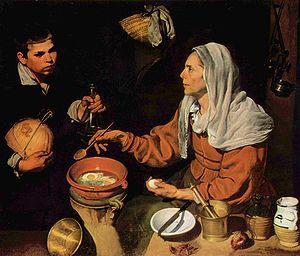
Diego Velázquez: Old Woman Cooking Eggs (1618) Oil on canvas, 99 cm × 169 cm (39 in × 67 in) National Gallery of Scotland, Edinburgh
Locations
People
Groups
Topics
Subjects
Regions
Subregions
Related Events
Showing 10 events out of 33086 total
Years: 1618 - 1618
Diego Velázquez: Old Woman Cooking Eggs (1618) Oil on canvas, 99 cm × 169 cm (39 in × 67 in) National Gallery of Scotland, Edinburgh
Locations
People
Groups
Topics
Subjects
Regions
Subregions