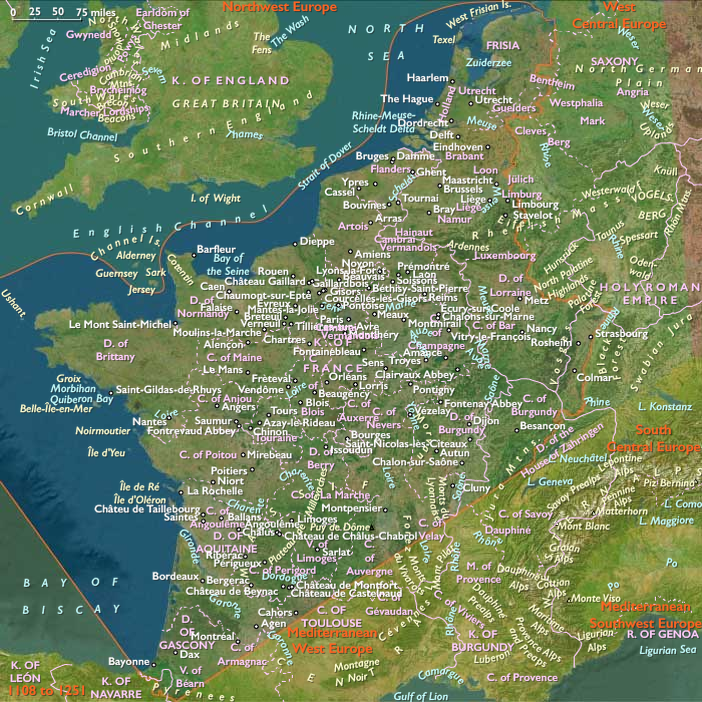
John’s Failed Loire Campaign and His Diversionary…
June 1214 CE
John’s Failed Loire Campaign and His Diversionary Attack on Poitou (1214 CE)
After his defeat at La Roche-aux-Moines, John of England was forced to abandon his advance from the Loire and retreat to his fleet. His hopes of an easy victory in reclaiming Angevin lands collapsed, as his Poitevin barons refused to support him further.
In a last-ditch effort to salvage the campaign, John launched a diversionary invasion into Poitou, hoping to draw Philip II’s forces southward and relieve pressure on his northern allies, Otto IV and Count Ferdinand of Flanders.
Louis of France Blocks John’s Advance
- Prince Louis (the future Louis VIII of France), the son of Philip II and Isabella of Hainaut, moved swiftly to counter John’s Poitevin invasion.
- Louis, who was also married to Blanche of Castile (John’s niece), led French forces to block John’s movements, preventing him from gaining any advantage in Poitou.
- John, now without support from his local vassals and unable to advance, was forced into retreat once again.
Consequences of John’s Failure in the South
- With John’s campaign in the Loire and Poitou collapsing, Philip II was free to concentrate his forces in the north.
- This allowed Philip to decisively defeat Otto IV, Count Ferdinand, and Renaud of Boulogne at the Battle of Bouvines (July 27, 1214).
- John’s defeats in France sealed the loss of Normandy, Anjou, and Poitou.
- Discredited and weakened, John’s failure contributed to rising unrest in England, leading to the baronial revolt of 1215 and the eventual signing of Magna Carta.
John’s disastrous 1214 campaign revealed his lack of strategic coordination and failure to inspire loyalty among his vassals, paving the way for Philip II’s final consolidation of Capetian power in France.
Locations
People
Groups
Topics
Commodities
Subjects
Regions
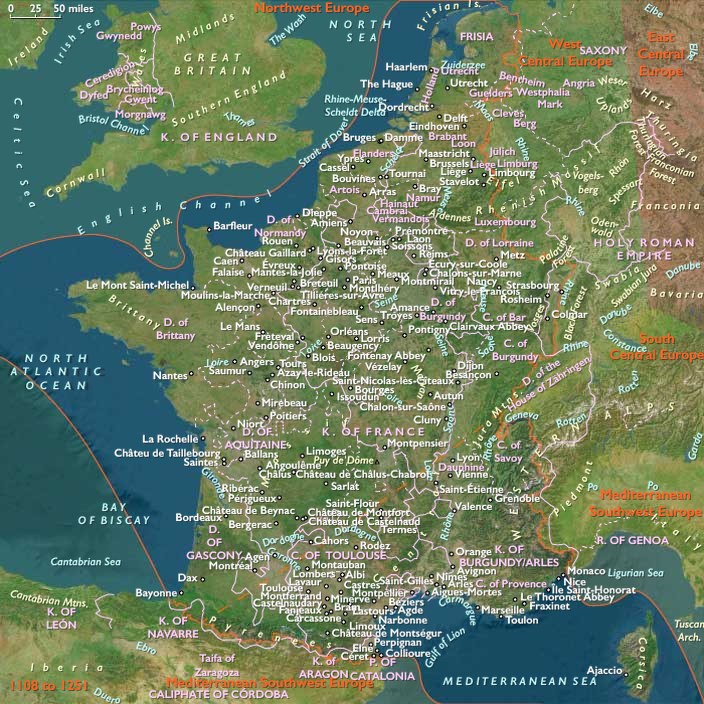
West Europe
View →Subregions