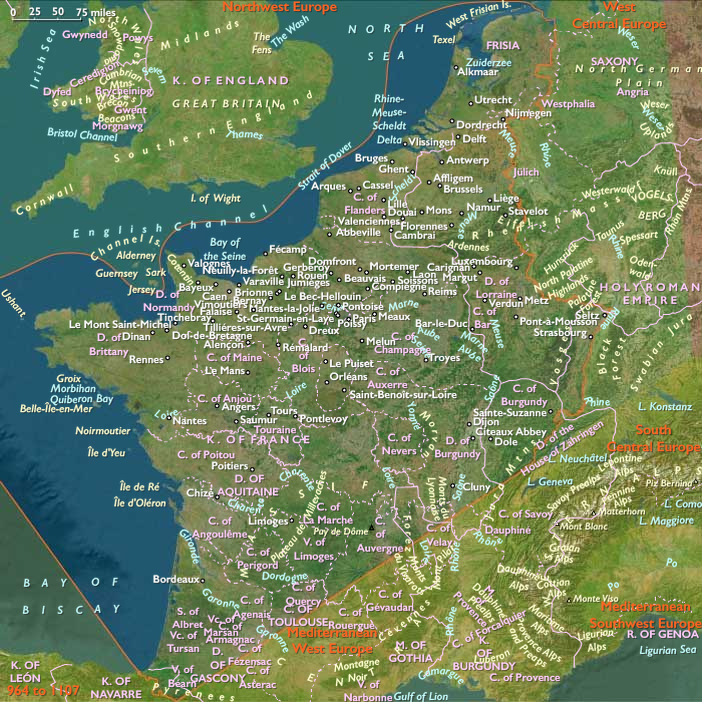
The Marriage of William of Normandy and…
1051 CE
The Marriage of William of Normandy and Matilda of Flanders (1050s)
By 1050, Duke William II of Normandy (later William the Conqueror) had begun to show interest in England, possibly encouraged by King Edward the Confessor, who had no direct heir. Meanwhile, William was also pursuing a politically advantageous marriage, setting his sights on Matilda of Flanders, daughter of Count Baldwin V and Adèle of France.
William’s Interest in England and Edward’s Alleged Promise (1051)
- William visited England in 1051, where King Edward the Confessor, who had been raised among the Normans, allegedly promised him the English throne upon his death.
- While the exact circumstances of this alleged promise remain debated, William’s ties to Edward and his growing ambitions would later drive his claim to England.
Matilda of Flanders: An Influential Bride
- Matilda of Flanders was the daughter of Count Baldwin V and Adèle of France, making her a descendant of Alfred the Great and a cousin by marriage to Edward the Confessor.
- Her marriage to William would strengthen his status, aligning him with one of the most powerful noble houses in Western Europe, which had ties to both the French royal family and the Holy Roman Empire.
The Legendary Courtship: Matilda’s Initial Rejection and William’s Reaction
- According to legend, when William’s representatives asked for Matilda’s hand in marriage, she insulted him, claiming that she was too highborn to marry a bastard.
- William’s reaction was dramatic and violent:
- One version claims that he rode from Normandy to Bruges, dragged Matilda off her horse by her braids, threw her to the ground, and rode off without a word.
- Another version states that he stormed into Matilda’s chamber in Lille, threw her down, and struck her before leaving.
- Her father, Baldwin V, was enraged and prepared for conflict, but Matilda declared that she would marry no one but William—resolving the matter.
Papal Opposition and the Marriage’s Delay (1049–1050s)
- The marriage was arranged in 1049, but Pope Leo IX forbade it at the Council of Reims (October 1049), citing consanguinity (close kinship).
- Despite this, the marriage went ahead in the early 1050s, possibly without papal sanction at first.
- A later source (not entirely reliable) claims that papal approval was only granted in 1059, but since Norman relations with Rome were strong in the 1050s, approval likely came earlier.
The Founding of Monasteries as Penance
- Papal sanction for the marriage appears to have been granted only after William and Matilda agreed to an act of penance:
- William founded the Abbaye aux Hommes (Men's Abbey) in Caen.
- Matilda founded the Abbaye aux Dames (Ladies' Abbey) in Caen.
- Lanfranc, prior of Bec Abbey, negotiated the arrangement with Rome, ensuring the marriage was recognized by the Church.
Matilda’s Alleged Love for Brihtric and Later Revenge
- Rumors suggest that Matilda had been in love with Brihtric, an English noble and ambassador to Flanders, but that he spurned her advances.
- Years later, when she acted as Regent for William in England, she allegedly confiscated Brihtric’s lands and had him thrown into prison, where he later died.
- Whether this story is true or merely legend, it reflects Matilda’s political agency and influence.
The Marriage’s Political and Personal Impact
- The marriage bolstered William’s status, as Flanders was a powerful ally, with ties to the French royal family and the Holy Roman Empire.
- Contemporary chroniclers considered the marriage a success, as it produced a large number of children, including:
- Four sons (including the future William II and Henry I of England).
- Five or six daughters, many of whom made high-status marriages in Europe.
- Matilda would later play a crucial role in William’s rule, acting as Regent of Normandy when he was in England and supporting his military campaigns.
Conclusion: A Union of Power and Influence
The marriage of William and Matilda was a union of power, ambition, and strategy, strengthening Normandy’s position in Europe and ensuring stability within William’s duchy. Despite the dramatic courtship legends, their marriage was politically vital and helped pave the way for William’s conquest of England in 1066.
Locations
Groups
Commodities
Regions
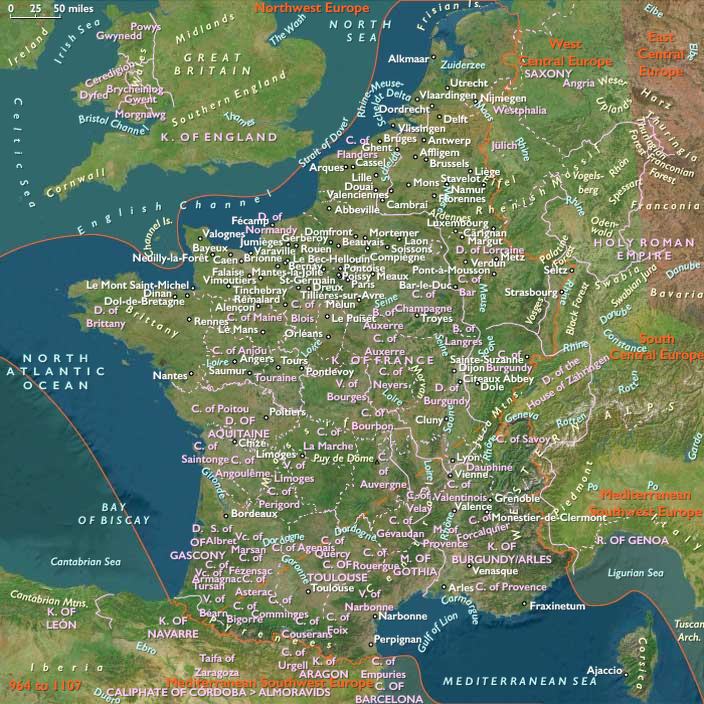
West Europe
View →Subregions