
East Central Europe (244–387 CE): Germanic Migrations, …
Years: 244 - 387
East Central Europe (244–387 CE): Germanic Migrations, Sarmatian Presence, and the Roman Frontier in Crisis
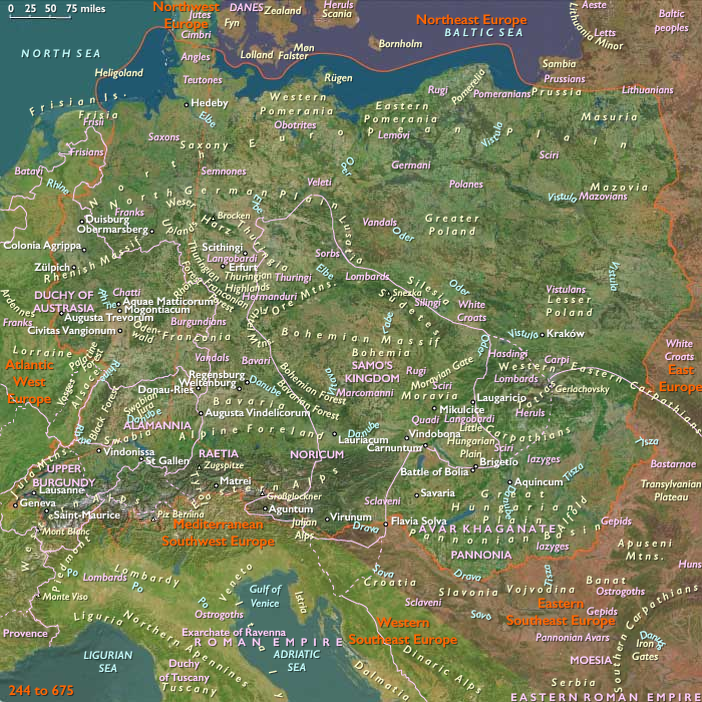
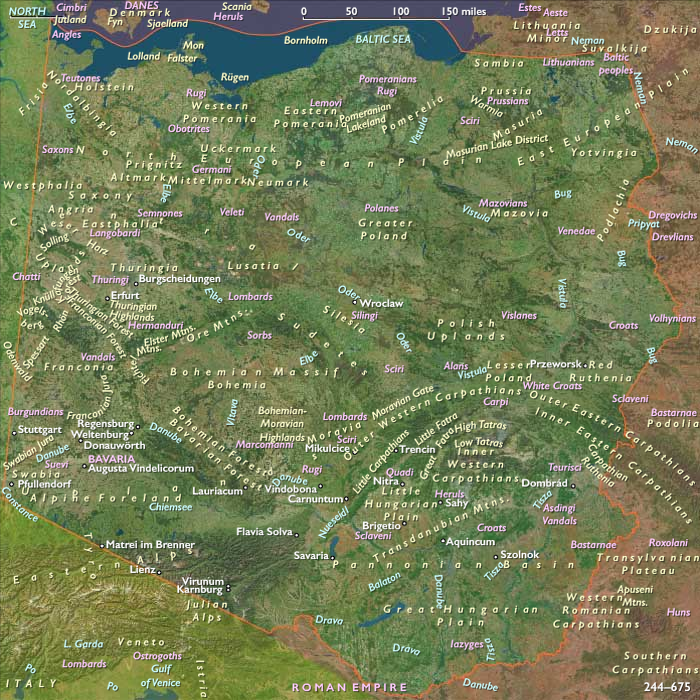
Between 244 and 387 CE, East Central Europe—encompassing modern-day Poland, Czechia, Slovakia, Hungary, and those parts of Germany and Austria lying east of 10°E and north of a line stretching southeastward from approximately 48.2°N, 10°E to the Austro-Slovenian border near 46.7°N, 15.4°E—experienced profound demographic, political, and cultural transformations. This period was characterized by major migrations of Germanic and other tribes—including the Vandals (Asdingi and Silingi), Langobardi (Lombards), Boii, Saxons, Thuringians, Hermunduri, Rugi, Alans, and early proto-Slavic groups such as the Carpi and proto-Croats. Concurrently, an influential nomadic Sarmatian presence, primarily represented by tribes like the Iazyges and Alans, significantly impacted regional dynamics, while weakening Roman frontier control along the Danube profoundly affected stability, trade networks, and cultural interactions.
Political and Military Developments
Migrations of Vandals, Langobardi, and Alans
The Vandals, divided into the Asdingi and Silingi, significantly reshaped regional demographics and political alignments. Originating from territories in present-day Poland and Czechia, they migrated southward and westward under pressure from other tribes, eventually crossing into Roman territories.
The Langobardi (Lombards), initially settled along the lower Elbe, moved steadily southward toward modern-day Austria, Slovakia, and Hungary, becoming influential in regional power struggles and alliances.
The Iranian-speaking Alans, closely allied with the Vandals and representing a major component of the broader Sarmatian tribal confederation, also migrated westward through East Central Europe. Renowned for their skilled cavalry warfare, they notably influenced local military strategies and cultural interactions.
Sarmatian Presence and Influence
The Sarmatians, particularly the Iazyges who inhabited the plains of modern-day Hungary and adjacent areas, exerted considerable political and military influence during the 3rd and early 4th centuries CE. Their powerful cavalry posed significant challenges to Roman frontier defenses, leading to conflicts and diplomatic exchanges that shaped regional political structures.
Rugian Migration and Settlement Stability in Pannonia
Around the early 4th century, the Rugii migrated southward from their homeland in Pomerania, establishing stable settlements along the upper Tisza River in Roman-controlled Pannonia (northeastern Hungary). Their presence provided regional stability amidst widespread upheaval, influencing diplomatic relations and tribal interactions.
Tribal Confederations and Regional Realignments
The Boii, previously dominant in Bohemia (from whom the region derives its name), gradually lost influence due to pressure from migrating Germanic tribes, either assimilating locally or migrating westward.
The rise of tribal confederations, notably the Thuringians and Hermunduri in modern eastern Germany, altered regional trade networks and power balances significantly.
Gothic Migrations and the Battle of Adrianople (376–378 CE)
Major Gothic migrations, driven westward by Hunnic incursions, culminated in the mass crossing of the Danube frontier in 376 CE, destabilizing Roman provinces. The catastrophic defeat of Roman forces at the Battle of Adrianople (378 CE) further eroded Roman frontier control and triggered profound geopolitical shifts.
Decline of Roman Influence in Noricum and Pannonia
Roman provincial authority weakened dramatically in frontier provinces such as Pannonia and Noricum (modern Austria) due to continual raids by Germanic and Sarmatian groups, ultimately leading to reduced military presence and administrative withdrawal.
Economic and Technological Developments
Trade Disruptions and Economic Decentralization
Persistent frontier instability severely disrupted established trade connections between the Roman Empire and East Central Europe, driving regional economies toward greater agricultural self-sufficiency and decentralized metalworking industries.
Roman Infrastructure Restoration
Despite wider disruptions, Roman emperors such as Aurelian (270–275 CE), Diocletian (284–305 CE), Constantine the Great (306–337 CE), and Valentinian I (364–375 CE) periodically strengthened frontier defenses, revitalizing certain regional economic activities and infrastructure such as roads and fortifications.
Technological Continuity and Exchange
Local Germanic, Sarmatian, and proto-Slavic populations continued refining ironworking, pottery, and agricultural techniques, selectively adopting and adapting Roman technologies to maintain productivity despite political disruptions.
Cultural and Artistic Developments
Cross-Cultural Hybridization
Interaction among diverse groups—including Germanic tribes (Vandals, Lombards, Saxons, Thuringians, Hermunduri, Rugi), Iranian-speaking Alans and Sarmatians, Celtic remnants (Boii), and early Slavic populations—resulted in dynamic cultural exchanges and hybridization visible in linguistic developments, artistic traditions, and societal customs.
Sarmatian Artistic Influence
The Sarmatian tribes introduced distinctive artistic styles, especially evident in sophisticated metalwork featuring animal motifs and elaborate cavalry equipment, influencing regional artistic traditions profoundly. Sarmatian burial practices, notably kurgan-style graves with rich grave goods, underscore their cultural impact.
Proto-Slavic Cultural Resilience
Proto-Slavic tribes, such as the Carpi and proto-Croats, began emerging prominently, maintaining stable cultural and social structures despite pressures from migrating Gothic groups. Although some proto-Slavic segments migrated northward, integrating into Finnic-speaking populations, most retained traditional territories, reinforcing local cultural continuity.
Settlement and Urban Development
Decline of Roman Frontier Settlements
Roman urban and military outposts along the Danube frontier experienced widespread decline or abandonment following Gothic incursions, internal Roman weaknesses, and the fallout of the Battle of Adrianople.
Stability of Rugian Settlements
The Rugian settlements along the upper Tisza region maintained considerable stability and economic vibrancy even as adjacent Roman towns deteriorated, demonstrating resilience amid regional disruptions.
Emergence of Germanic and Proto-Slavic Villages
Germanic tribes and early Slavic groups increasingly developed dispersed agricultural settlements characterized by village clusters, timber longhouses, and protective earthworks, replacing earlier Celtic-Roman urbanized settlements.
Social and Religious Developments
Germanic Tribal Leadership and Social Structure
Germanic societies were structured around influential warrior aristocracies, whose leadership relied on military strength, control of trade routes, and diplomatic marriages and alliances.
Sarmatian Social Impact and Equestrian Traditions
Sarmatian nomadic society significantly influenced regional social hierarchies and military organization, particularly through their celebrated equestrian traditions, cavalry tactics, and leadership structures.
Religious Practices and Syncretism
Diverse tribal populations retained traditional religious beliefs—nature worship, ancestral veneration, communal rituals—while interactions between Germanic, Iranian (Alanic and Sarmatian), and Celtic cultures encouraged significant religious syncretism.
Long-Term Consequences and Historical Significance
The period 244–387 CE transformed East Central Europe profoundly, driven by intensified Germanic migrations, influential Sarmatian presence, weakening Roman frontier authority, and the catalytic Gothic invasions culminating in the Battle of Adrianople. The resulting demographic shifts, cultural hybridization, economic decentralization, and political realignments laid essential groundwork for the emergence of early medieval societies. Significantly, the Sarmatian legacy persisted, influencing regional military practices, artistic styles, and later cultural identities—most notably in the enduring cultural mythology adopted by the Polish nobility in subsequent centuries.
People
Groups
- Slavs, Proto-
- Boii (Celtic tribe)
- Sarmatians
- Rhoxolani, or Roxolani
- Iazyges, or Iazygians
- Hasdingi
- Alans (Sarmatian tribal grouping)
- Vandals (East Germanic tribe)
- Marcomanni (Germanic tribe)
- Lombards (West Germanic tribe)
- Hermunduri (Germanic tribe)
- Rugii (East Germanic tribe )
- Silingi (East Germanic tribe)
- Quadi (Germanic tribe)
- Saxons
- Mithraic Mysteries
- Germans
- Christians, Early
- Noricum (Roman province)
- Roman Empire (Rome): Nerva-Antonine dynasty
- Carpi (people)
- Pannonia Superior (Roman province)
- Pannonia Inferior (Roman province)
- Roman Empire (Rome): Severan dynasty
- Roman Empire (Rome): Non-dynastic
- Pannonia Savia (Roman province)
- Pannonia Secunda (Roman province)
- Pannonia Valeria (Roman province)
- Pannonia Prima (Roman province)
Topics
Commodoties
Subjects
Regions
Subregions
Related Events
Showing 4 events out of 4 total
Years: 244 - 387
People
Groups
- Slavs, Proto-
- Boii (Celtic tribe)
- Sarmatians
- Rhoxolani, or Roxolani
- Iazyges, or Iazygians
- Hasdingi
- Alans (Sarmatian tribal grouping)
- Vandals (East Germanic tribe)
- Marcomanni (Germanic tribe)
- Lombards (West Germanic tribe)
- Hermunduri (Germanic tribe)
- Rugii (East Germanic tribe )
- Silingi (East Germanic tribe)
- Quadi (Germanic tribe)
- Saxons
- Mithraic Mysteries
- Germans
- Christians, Early
- Noricum (Roman province)
- Roman Empire (Rome): Nerva-Antonine dynasty
- Carpi (people)
- Pannonia Superior (Roman province)
- Pannonia Inferior (Roman province)
- Roman Empire (Rome): Severan dynasty
- Roman Empire (Rome): Non-dynastic
- Pannonia Savia (Roman province)
- Pannonia Secunda (Roman province)
- Pannonia Valeria (Roman province)
- Pannonia Prima (Roman province)
Topics
Commodoties
Subjects
Regions
Subregions