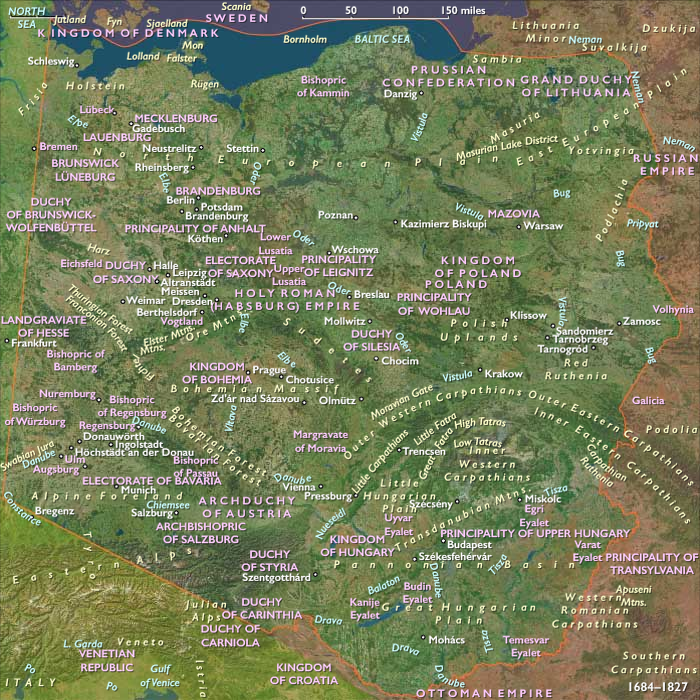
East Central Europe (1816–1827 CE): Post-Napoleonic Stabilization,…
1816 CE to 1827 CE
East Central Europe (1816–1827 CE): Post-Napoleonic Stabilization, National Revival, and Metternich’s Conservative Order
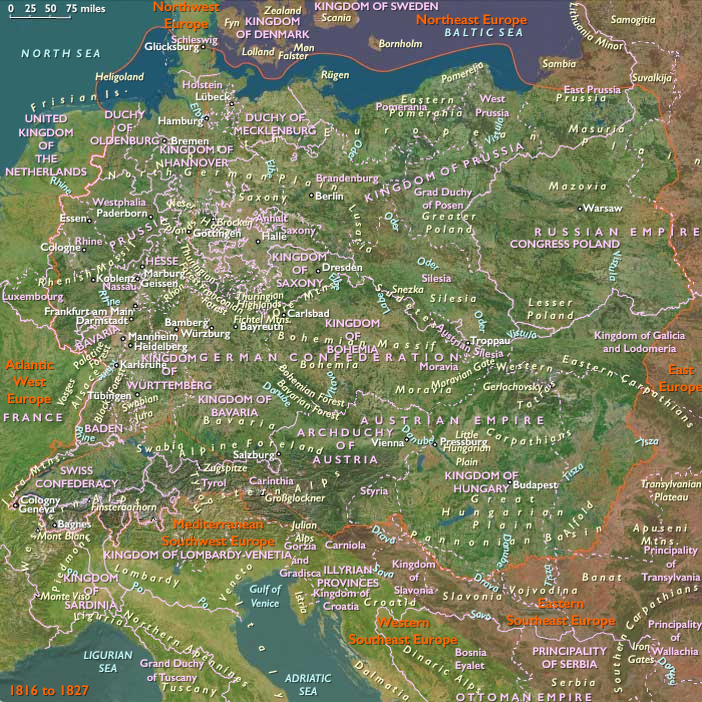
From 1816 to 1827 CE, East Central Europe—encompassing modern-day Poland, Czechia, Slovakia, Hungary, and territories within eastern Germany and Austria east of 10°E and north of the defined boundary—experienced a phase of political stabilization and conservative consolidation shaped by the post-Napoleonic settlements of the Congress of Vienna. Under the influential Austrian statesman Klemens von Metternich, the region saw significant reinforcement of conservative monarchies, suppression of nationalist and liberal movements, gradual economic recovery, and rising cultural nationalism that would profoundly influence future political developments.
Political and Military Developments
Metternich’s System and the Conservative Order
-
Austrian Chancellor Klemens von Metternich enforced a highly conservative political order across East Central Europe, emphasizing traditional monarchy, rigid social hierarchies, censorship, and opposition to liberal and nationalist ideals.
-
The Holy Alliance—established by Austria, Russia, and Prussia—enforced this conservative stability, effectively suppressing revolutionary activity, especially in Polish, Hungarian, and Czech territories.
Congress Poland and Russian Influence
-
Congress Poland, created by the Congress of Vienna under Russian dominance, initially retained some autonomy under the constitution granted by Tsar Alexander I in 1815. However, this autonomy was progressively eroded by growing Russian control and censorship, stoking dissatisfaction and rising nationalist tensions.
Habsburg Monarchy and the Kingdom of Hungary
-
Within the Austrian Empire, the Kingdom of Hungary endured tight control under Metternich’s regime. Hungarian autonomy and national aspirations were actively curtailed, with centralization efforts causing friction among Hungarian elites and contributing to rising national consciousness.
German Confederation and Saxony’s Integration
-
Saxony, Bavaria, and Thuringian states participated within the German Confederation (formed in 1815), a loose association dominated by Austria and Prussia, enforcing conservative governance while fostering economic recovery through customs and trade agreements.
Economic and Technological Developments
Economic Stabilization and Early Industrialization
-
Post-Napoleonic recovery saw gradual stabilization and revival of regional economies, notably through agricultural improvement, restoration of trade networks, and early signs of industrialization, particularly in Saxony, Silesia, and Bohemia.
-
The textile industry, mining, and metallurgy expanded significantly, stimulating employment and urban growth.
Zollverein: Initial Steps towards Economic Integration
-
German states in East Central Europe, notably Saxony, Thuringia, and parts of Bavaria, participated in early negotiations leading to the establishment of the Zollverein (Customs Union), significantly advancing regional economic integration and eliminating internal tariffs.
Cultural and Artistic Developments
Romantic Nationalism and Cultural Awakening
-
Despite conservative political suppression, cultural nationalism flourished across East Central Europe, notably through literature, music, and arts:
-
Poland: Works by Adam Mickiewicz inspired national sentiment against Russian oppression.
-
Czechia: Intellectuals like Josef Jungmann and historian František Palacký actively promoted Czech language and culture, fueling national identity.
-
Hungary: Writers and poets, including Ferenc Kölcsey (author of the Hungarian national anthem), emphasized Hungarian cultural heritage, significantly influencing emerging nationalist consciousness.
-
Education and Enlightenment Influences
-
Despite censorship, universities and scholarly institutions continued disseminating Enlightenment ideals, fostering literacy, scientific inquiry, and cultural identity—seeds of future revolutionary thought.
Settlement and Urban Development
Post-War Urban Recovery and Expansion
-
Urban centers across the region, notably Vienna, Prague, Budapest, Warsaw, and German cities such as Leipzig and Dresden, experienced renewed population growth, economic vitality, and infrastructure improvements, laying the groundwork for later industrial expansion and modernization.
Social and Religious Developments
Conservative Social Structures and Rural Conditions
-
Metternich’s regime reinforced traditional feudal hierarchies, especially in rural areas. Peasant serfdom and feudal obligations persisted, notably in Hungary and Polish territories, causing mounting social tensions and increasing rural dissatisfaction.
Religious Revival and Institutional Influence
-
The Catholic Church regained substantial institutional power and cultural influence across the region, reinforcing conservative social order and resisting liberal secularization trends, notably evident in Poland, Austria, and Bavaria.
Long-Term Consequences and Historical Significance
The era from 1816 to 1827 CE marked a pivotal period of conservative stabilization, profoundly shaping East Central Europe's political, social, and cultural landscapes. Metternich’s conservative system successfully enforced short-term political stability but fueled long-term dissatisfaction and nationalist aspirations among Poles, Hungarians, and Czechs. Emerging economic recovery and early industrialization laid critical foundations for future modernization, while cultural nationalism flourished in literature, arts, and education despite censorship and repression. Collectively, these developments set the stage for the revolutions and nationalist movements that profoundly reshaped East Central Europe in the subsequent decades of the 19th century.
People
Groups
Regions
Central Europe
View →Subregions