East Central Europe (388–399 CE): Hunnic Pressures,…
388 CE to 399 CE
East Central Europe (388–399 CE): Hunnic Pressures, Frontier Instability, and Tribal Adaptation
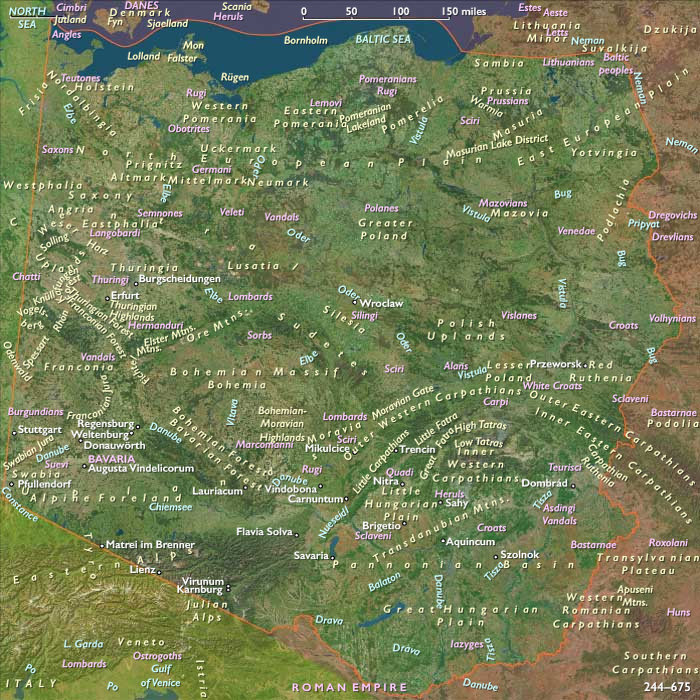
Between 388 and 399 CE, East Central Europe—encompassing Poland, Czechia, Slovakia, Hungary, and those portions of Germany and Austria lying east of 10°E and north of a line stretching from roughly 48.2°N at 10°E southeastward to the Austro-Slovenian border near 46.7°N, 15.4°E—faced new waves of regional instability driven by intensified pressure from the advancing Huns. The weakened Roman frontier along the Danube struggled under continued Gothic presence and now growing Hun threats. Amid this shifting geopolitical landscape, established communities like the Rugii continued their stability in Pannonia, while proto-Slavic peoples maintained resilience, adapting cautiously to changing regional dynamics.
Political and Military Developments
Growing Hunnic Pressure
-
Around this time, the Huns intensified their westward expansion, increasingly influencing East Central Europe. Hun pressure forced further regional realignments, prompting Roman and tribal adjustments to new political realities.
Roman Frontier Weakness and Attempts at Stabilization
-
The Roman Empire struggled to reinforce and maintain stable frontier defenses along the Danube, though intermittent efforts were made under Emperor Theodosius I (379–395 CE) and his successors. Roman authority continued to weaken, exacerbated by Hun incursions and residual Gothic influence.
Rugian Continuity and Local Stability
-
The Rugii, established near the upper Tisza River, maintained a stable political presence, managing diplomatic relations with Romans, Goths, and now increasingly with Hunnic groups, providing a localized anchor of continuity.
Economic and Technological Developments
Economic Uncertainty Amid New Threats
-
Economic activity continued cautiously amid new regional threats. Frontier trade persisted, but increasing Hun pressures caused uncertainty and disruptions, necessitating more localized, defensive economic strategies.
Frontier Infrastructure Under Pressure
-
Roman and local infrastructure investments were modest and primarily focused on immediate defensive needs. Maintenance of existing roads, bridges, and fortifications continued but under strain from frequent raids and instability.
Cultural and Artistic Developments
Cultural Adaptation and Hybridization
-
Artistic expressions reflected regional uncertainty, combining Roman traditions, Rugian elements, and Hun influences into distinctive hybrid styles. Practical and defensive motifs continued to dominate material culture.
Proto-Slavic Cultural Resilience
-
Proto-Slavic communities remained culturally stable, retaining traditional practices and gradually integrating limited external influences from surrounding Germanic and Hunnic groups.
Settlement and Urban Development
Fortified Frontier Settlements
-
Roman towns (Carnuntum, Vindobona, Aquincum) remained primarily defensive strongholds, with limited demographic growth due to frontier instability and periodic Hunnic threats.
Stable Rugian Settlements
-
Rugian settlements remained secure, acting as stable regional centers, adjusting to shifting power balances and maintaining local prosperity despite wider regional uncertainty.
Social and Religious Developments
Rugian Leadership Stability
-
Rugian leadership maintained social cohesion through adept diplomacy and internal governance, effectively navigating the complex political landscape shaped by Roman decline, Gothic presence, and Hun incursions.
Proto-Slavic Community Cohesion
-
Proto-Slavic populations continued cohesive social and religious traditions, reinforcing internal stability and cultural continuity despite external disruptions.
Long-Term Consequences and Historical Significance
The era 388–399 CE marked the beginning of significant new challenges for East Central Europe, driven largely by increasing Hun pressure. Roman authority continued to weaken, prompting tribal communities like the Rugii and proto-Slavs to adapt to new realities. These developments laid important foundations for subsequent regional transformations, setting the stage for a period characterized by major migrations, cultural blending, and shifting geopolitical alliances through the early 5th century.
People
Groups
Subjects
Regions
Central Europe
View →Subregions