Central Europe (7,821 – 6,094 BCE): Early…
7821 BCE to 6094 BCE
Central Europe (7,821 – 6,094 BCE): Early Holocene — Forest Foragers and the Dawn of Farming
Geographic & Environmental Context
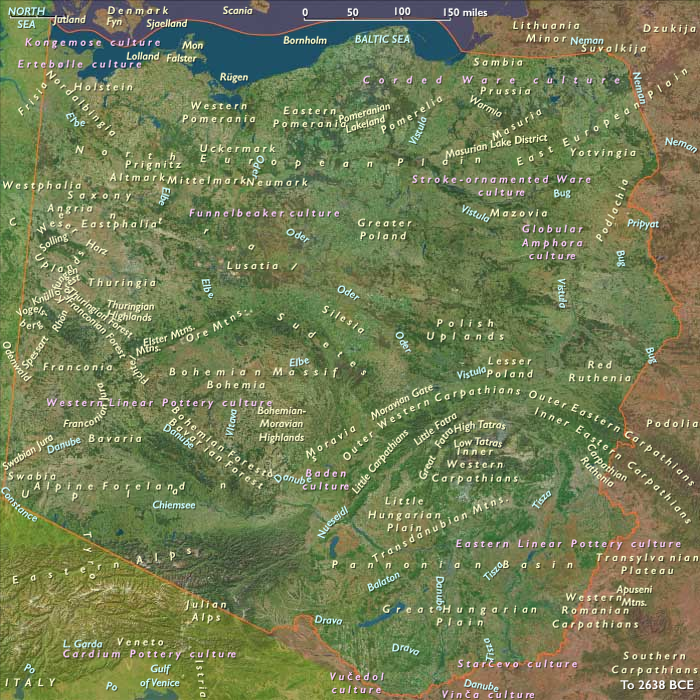
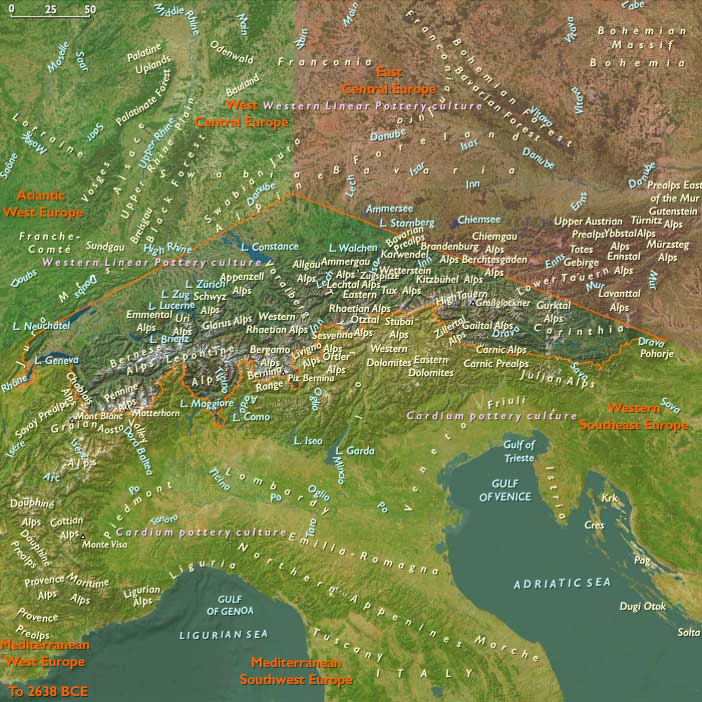
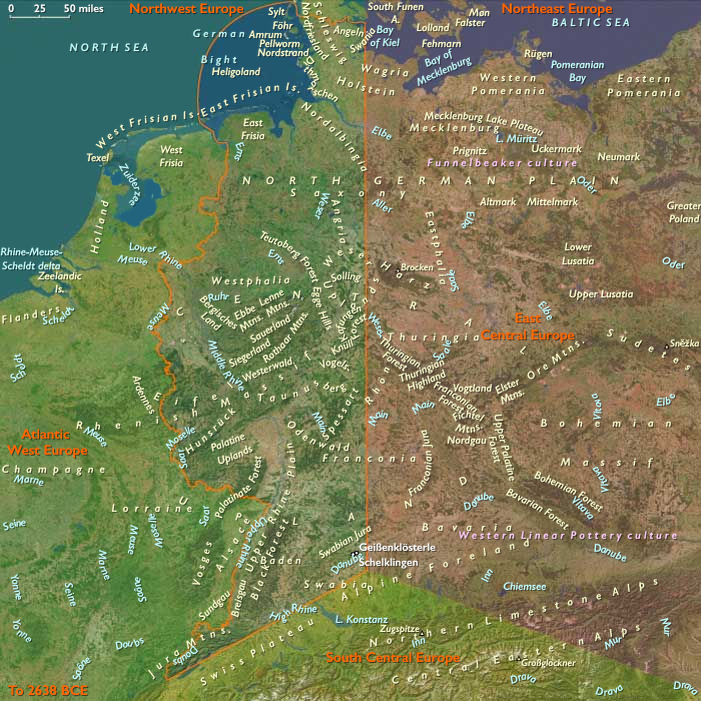
During the Early Holocene, Central Europe—extending from the Rhine and Upper Danube through the Carpathian Basin, Swiss Plateau, and Polish and Bohemian uplands—entered a long interval of climatic and ecological stability.
The retreat of the last ice sheets left behind a landscape of rivers, glacial lakes, loess plains, and closed-canopy forests.
Three broad subregions emerged within this continental mosaic:
-
East Central Europe, spanning the Danube–Tisza plains, Moravian Gate, and Polish lake districts, where riverine foragers flourished amid expanding oak–elm–lime forests.
-
South Central Europe, dominated by the Alpine forelands and Swiss Plateau, where lake-edge villages pioneered wetland adaptation.
-
West Central Europe, centered on the Rhine basin and Jura uplands, where mobile forest hunters encountered the first Neolithic pioneers moving up the Danube.
Climate & Environmental Shifts
The Holocene thermal optimum brought warmer, wetter, and more predictable conditions across Central Europe.
-
Expanding temperate forests of birch, pine, oak, elm, and linden covered the lowlands.
-
Lakes and wetlands stabilized as precipitation evened out.
-
Floodplains along the Danube, Rhine, and Vistula became nutrient-rich corridors supporting fish, game, and nut-bearing trees.
The region was a patchwork of ecological zones—forest, meadow, and marsh—each offering abundant resources and encouraging localized semi-sedentism.
Subsistence & Settlement
A broad-spectrum Mesolithic economy defined this era, balancing hunting, gathering, and fishing with early plant processing and tentative cultivation:
-
East Central Europe (Danube–Tisza–Carpathian–Polish Lakes):
Semi-sedentary foragers clustered along rivers, lakes, and terraces, living in pit-house hamlets or post-framed huts.
Diets included elk, boar, aurochs, freshwater fish and sturgeon, and rich nut and berry harvests.
Toward the close of the epoch, early pottery traditions diffused northward from the Balkans and western Ukraine, marking the first use of fired vessels in the region. -
South Central Europe (Alpine and Swiss Plateau lakes):
Lake-edge villages appeared along the Aare, Reuss, Rhône, and Inn, combining fishing, waterfowl hunting, red deer, and nut collecting with seasonal upland hunts.
Early pile-supported platforms in wetlands represent precursors to later Neolithic lake-dwelling architecture. -
West Central Europe (Rhine–Jura–Upper Danube):
Mobile forest foragers exploited deer, boar, and riverine fish; nuts, berries, and roots supplemented meat.
By the end of the epoch, Neolithic families from the southeast introduced small herds of sheep, goats, and cattle, along with domestic cereals (emmer, einkorn, barley)—transforming foraging economies into hybrid lifeways.
Across the region, settlement patterns oscillated between mobile foraging bands and semi-sedentary river or lake villages, depending on resource density and season.
Technology & Material Culture
Technological diversity reflected both continuity and innovation:
-
Ground-stone axes and adzes proliferated for woodworking and canoe construction.
-
Microlithic composite tools remained widespread in hunting contexts.
-
Fishing gear—nets, weirs, fishhooks, and harpoons—was refined for river and lake capture.
-
Dugout canoes enabled waterborne travel and trade along the Rhine and Danube.
-
Pottery, spreading from southeastern Europe, began appearing in Thracian, Carpathian, and Danubian contexts by the later centuries of the epoch.
-
Early flax processing and basketry are inferred from impressions and cord marks, showing pre-loom textile production.
Movement & Interaction Corridors
Central Europe was threaded by a web of water and mountain passes that shaped trade and cultural diffusion:
-
The Danube–Tisza–Morava system linked the Balkans and Pannonian Basin with the heart of Europe, serving as the primary artery for the first Neolithic expansions.
-
The Rhine–Main–Danube corridor facilitated east–west movement of raw materials, tools, and ideas.
-
The Vistula–Oder–Elbe routes connected Baltic amber zones with the Carpathian interior.
-
Alpine passes—Brenner, St. Gotthard, and Rhône–Rheintal—carried prestige goods like shell ornaments, ochre, and exotic stones.
These routes enabled both material exchange and the gradual migration of Neolithic technologies from the southeast into the temperate heartland.
Cultural & Symbolic Expressions
Ritual and belief reflected enduring intimacy with forest and water:
-
Cemeteries dusted with ochre, grave goods of antler tools and bone ornaments, and structured hearths within dwellings suggest a cosmology rooted in cyclical renewal and ancestral continuity.
-
Wetland offerings—antler points, carved tools, or animal remains—hint at water-centered rites of fertility or appeasement.
-
Rock art, though rare, included geometric motifs and animal depictions in sheltered valleys.
-
In the west, the first communal burials appeared, foreshadowing later Neolithic long barrows.
Symbolic life was practical, embodied, and spatially localized—focused on the house, hearth, and riverbank as anchors of identity.
Environmental Adaptation & Resilience
Resilience came from mobility, diversification, and storage:
-
Seasonal mobility between lowland rivers and upland forests balanced resource access.
-
Hazelnut and acorn storage, drying and smoking of fish and meat, and bone-fat rendering supported overwintering.
-
Watercraft mobility provided escape routes from flood or famine and linked foraging territories across wide basins.
-
As Neolithic crops and animals appeared, small-scale hybrid economies emerged—an adaptive insurance strategy against environmental uncertainty.
Long-Term Significance
By 6,094 BCE, Central Europe was a continent in transition.
Forest foragers, lake fishers, and river villagers had achieved stable coexistence within the Holocene’s gentle climate, while Neolithic pioneers from the southeast began introducing domesticated species and pottery traditions.
The cultural synthesis of this epoch—ground-stone technology, semi-sedentary wetlands, storage, and symbolic ancestorhood—formed the foundation for the Linearbandkeramik (LBK) horizon that would soon sweep across the Danubian and Rhine plains.
This was the threshold age: the forest still ruled, but the first farmers had arrived at its edge.
Topics
Commodities
Regions