
Southeast Europe (1252–1395 CE): Empires in Twilight …
Years: 1252 - 1395
Southeast Europe (1252–1395 CE): Empires in Twilight and the Ottoman Advance
From the Danube plains and Thracian valleys to the silver mines of Serbia and the Adriatic ports of Ragusa and Zadar, Southeast Europe in the Lower Late Medieval Age stood at the crossroads of empire and faith. The region’s fractured geography—mountain and river, coast and upland—made it a shifting frontier between Byzantium, the Latin West, and the rising Ottoman realm. Despite dynastic rivalries, plague, and invasion, it remained a mosaic of resilient kingdoms, fortified towns, and monastic enclaves that preserved learning and trade amid the approaching storms of the fifteenth century.
The Byzantine Empire, restored to Constantinople in 1261 after the Latin interlude, never regained its former strength. Civil wars between Andronikos II and Andronikos III in the 1320s, followed by the Kantakouzenos regency in the 1340s, drained resources and invited foreign intervention. In 1354, Ottoman troops crossed the Dardanelles, seizing Gallipoli—a foothold that opened Europe to Turkish conquest. Adrianople (Edirne) fell in 1369, becoming the new Ottoman capital. By 1395, the empire of Constantine and Justinian had shrunk to a ring around Constantinople, hemmed in by Ottoman garrisons and dependent on precarious alliances.
To the north, the Second Bulgarian Empire, which had peaked under Ivan Asen II a century earlier, disintegrated under Mongol, Tatar, and Hungarian pressure. By the late fourteenth century Bulgaria was divided between Tarnovounder Ivan Shishman and Vidin under Ivan Sratsimir, each alternating submission and defiance toward their Ottoman overlords. The Danube corridor, once a defensive line of empire, became the staging ground for Ottoman crossings and for the rise of two new principalities—Wallachia and Moldavia—that would later stand as northern bulwarks of resistance.
In Serbia, the house of Nemanjić achieved its zenith under Stefan Dušan (r. 1331–1355), whose armies swept through Macedonia, Epirus, and Thessaly. Crowned Emperor of Serbs and Greeks in 1346, Dušan codified his rule in the famous Law Code, blending Byzantine legalism with Slavic custom. Silver from the mines of Novo Brdo and Rudnik underwrote a cosmopolitan court that rivaled Constantinople. Yet after Dušan’s death, centrifugal noble rivalries—Mrnjavčević, Lazarević, and others—splintered the realm. In 1389, Prince Lazar fell at Kosovo Polje, a battle that entered legend as both tragedy and prophecy, marking Serbia’s submission to the Ottoman tide.
Farther north and east, Wallachia under Basarab I secured independence after victory over Hungary at Posada (1330), while Moldavia under Bogdan I (r. 1359–1365) consolidated between the Carpathians and the Dniester. These Danubian principalities balanced Hungarian, Tatar, and Ottoman pressures with deft diplomacy. Their fortified monasteries, tax reforms, and silver mines fostered stability, and by the end of the fourteenth century they emerged as self-conscious Christian states, heirs to the fading Byzantine and Bulgarian traditions.
In Bosnia, Ban Tvrtko I (r. 1353–1391) expanded his realm from the Drina to the Adriatic, adopting the royal crown in 1377 and reaching the peak of Bosnian power. The silver mines of Srebrenica enriched both the royal treasury and the flourishing Ragusan (Dubrovnik) merchant republic, whose fleets carried Balkan ores, wax, and hides across the Adriatic in exchange for salt, textiles, and luxury goods. Ragusa’s Statute of 1272, refined through the fourteenth century, established consuls from Alexandria to Constantinople, making it the Adriatic’s nimblest trading power.
Along the Dalmatian and Greek coasts, a patchwork of Latin and Slavic communes mediated between Venice, Hungary, and local lords. The Treaty of Zadar (1358) freed much of Dalmatia from Venetian control, allowing Ragusa to flourish under nominal Hungarian suzerainty. Venetian and Genoese ships still dominated the Black Sea and Aegean, however, maintaining the maritime arteries that fed Balkan mines and Byzantine ports. Inland, the Habsburgs extended authority over Carniola, Styria, and Slovenia, linking Central Europe to the Adriatic, while the Peloponnesian and Epirote lands of Greece remained fragmented among Latin duchies and Orthodox despots, increasingly threatened by Ottoman raids.
Agriculture across Thrace and the Danube basin adjusted to shorter growing seasons under the early Little Ice Age. Wheat, barley, and millet alternated with vineyards and transhumant herding. Serbian and Transylvanian silver mines supplied coinage that circulated with Venetian ducats and Ragusan dinars, fueling mercenary service and urban construction. Towns like Tarnovo, Skopje, Belgrade, and Novo Brdo were ringed by stone walls and towers, symbols of both wealth and insecurity. Black Death epidemics in 1348–1350 ravaged coastal cities and mining colonies but recovery was swift where silver and salt revenues flowed.
Faith and art anchored the region through political upheaval. Orthodoxy remained the unifying faith from Constantinople to Moldavia, its monastic centers—Rila, Dečani, Peć, and Mount Athos—preserving literature, fresco painting, and translation. Catholic communes in Dalmatia and Ragusa maintained Latin liturgy and notarial culture, while Bosnia’s distinctive Church of Bosnia, tinged with dualist and reformist ideas, endured despite crusading denunciations. New mosques appeared in Gallipoli and Adrianople as Ottoman garrisons settled in Thrace, introducing Islam to the European continent.
Adaptation came through networks rather than empires. When coastal trade faltered, merchants rerouted goods through inland passes; when mines flooded or armies advanced, communes and monasteries absorbed displaced labor. The Balkan economy’s redundancy—silver, salt, and livestock complemented by Adriatic and Black Sea access—allowed survival amid political collapse. Frontier diplomacy in Wallachia and Moldavia, monastic resilience in Serbia and Bulgaria, and commercial pragmatism in Ragusa and Dalmatia all testified to societies skilled at weathering change.
By 1395 CE, Southeast Europe had become a frontier of empire and a crucible of continuity. Byzantium lingered only in name, Bulgaria lay divided and vassal, Serbia had reached and lost its imperial height, and Bosnia shone briefly under Tvrtko’s crown. Yet Wallachia and Moldavia stood firm, and Ragusa’s independence proved that trade could survive where kingdoms fell. Across Thrace and Macedonia, Ottoman banners now rose above captured citadels, signaling the dawn of a new order. Even so, the monasteries of the Balkans and the communes of the Adriatic preserved the languages, laws, and faiths of an older world—ensuring that the region’s cultural continuity outlived its medieval empires.
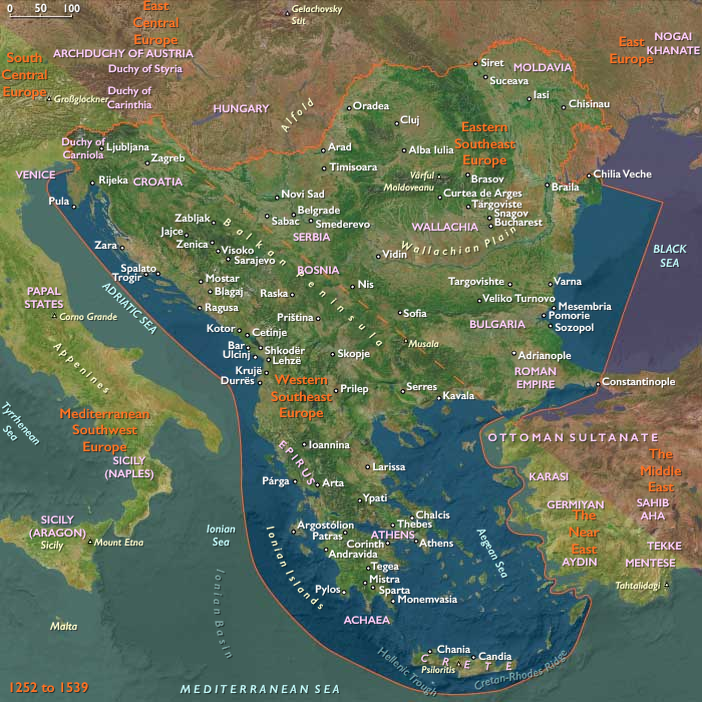
Eastern Southeast Europe (with civilization) ©2024-25 Electric Prism, Inc. All rights reserved.
People
- Andronikos II Palaiologos
- Andronikos III Palaiologos
- Basarab I
- Bogdan I of Moldavia
- Dragoș
- Ivan Shishman of Bulgaria
- Ivan Sratsimir
- Lazar of Serbia
- Murad I
- Peter I of Moldavia
- Roman I
- Stefan Uroš IV Dušan of Serbia
- Tvrtko I
Groups
- Slavonia region
- Islam
- Bulgarian Orthodox Church
- Romanians
- Genoa, (Most Serene) Republic of
- Christians, Roman Catholic
- Christians, Eastern Orthodox
- Croatia, Kingdom of
- Venice, (Most Serene) Republic of
- Bulgarian Empire (Second), or Empire of Vlachs and Bulgars
- Latin Empire of Constantinople (“Romania”)
- Nicaea, Empire of
- Serbia, Kingdom of
- Serbian Orthodox Church
- Blue Horde, Khanate of the
- Hungary, Kingdom of
- Roman Empire, Eastern: Palaiologan dynasty
- Moldavia, Hungarian province of
- Ottoman Emirate
- Ottoman Emirate
- Wallachia, Principality of
- Ottoman Empire
- Moldavia, Principality of
- Ragusa, Republic of
Topics
- Middle Subatlantic Period
- Little Ice Age, Warm Phase I
- Little Ice Age (LIA)
- Savoyard Crusade
- Kosovo, Battle of
Commodoties
Subjects
Regions
Subregions

Years: 1252 - 1395
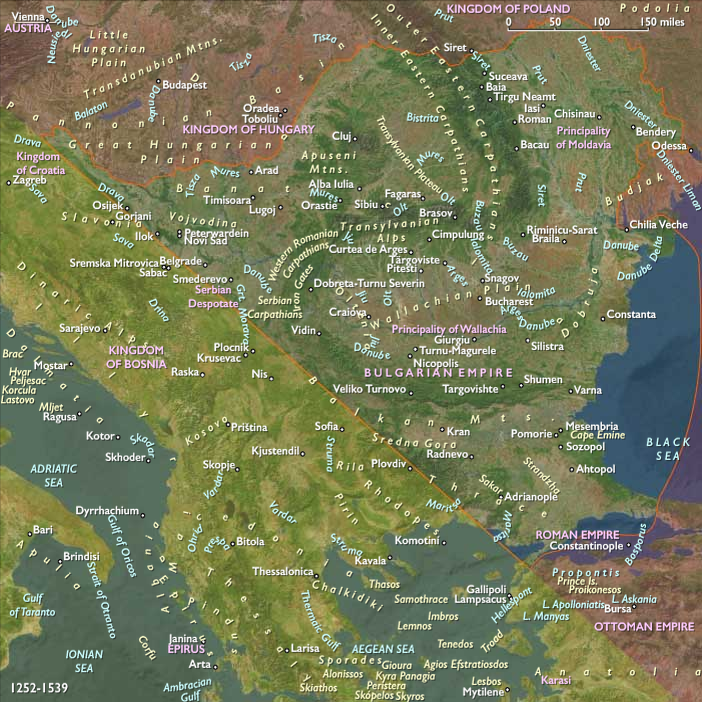
Eastern Southeast Europe (with civilization) ©2024-25 Electric Prism, Inc. All rights reserved.
People
- Andronikos II Palaiologos
- Andronikos III Palaiologos
- Basarab I
- Bogdan I of Moldavia
- Dragoș
- Ivan Shishman of Bulgaria
- Ivan Sratsimir
- Lazar of Serbia
- Murad I
- Peter I of Moldavia
- Roman I
- Stefan Uroš IV Dušan of Serbia
- Tvrtko I
Groups
- Slavonia region
- Islam
- Bulgarian Orthodox Church
- Romanians
- Genoa, (Most Serene) Republic of
- Christians, Roman Catholic
- Christians, Eastern Orthodox
- Croatia, Kingdom of
- Venice, (Most Serene) Republic of
- Bulgarian Empire (Second), or Empire of Vlachs and Bulgars
- Latin Empire of Constantinople (“Romania”)
- Nicaea, Empire of
- Serbia, Kingdom of
- Serbian Orthodox Church
- Blue Horde, Khanate of the
- Hungary, Kingdom of
- Roman Empire, Eastern: Palaiologan dynasty
- Moldavia, Hungarian province of
- Ottoman Emirate
- Ottoman Emirate
- Wallachia, Principality of
- Ottoman Empire
- Moldavia, Principality of
- Ragusa, Republic of
Topics
- Middle Subatlantic Period
- Little Ice Age, Warm Phase I
- Little Ice Age (LIA)
- Savoyard Crusade
- Kosovo, Battle of
Commodoties
Subjects
Regions
Subregions