
Eastern Southeast Europe (1324–1335 CE): Byzantine Civil…
1324 CE to 1335 CE
Eastern Southeast Europe (1324–1335 CE): Byzantine Civil Conflict and Rising Ottoman Influence
Settlement and Migration Patterns
Byzantine Civil War and Fragmentation
Between 1324 and 1335, the Byzantine Empire was engulfed in internal strife, notably the civil war between Emperor Andronikos II Palaiologos and his rebellious grandson, Andronikos III. Following a temporary compromise in 1325, the younger Andronikos received control over Thrace and Macedonia, but peace was short-lived. In 1328, he ultimately forced his grandfather's abdication, becoming sole emperor amidst the empire's deepening fragmentation.
Ottoman Expansion and Settlement
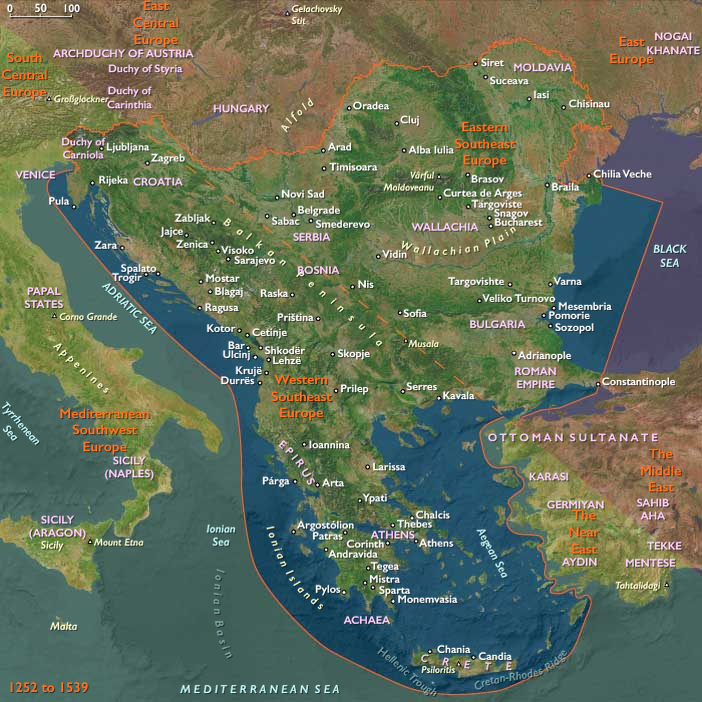
Capitalizing on Byzantine internal divisions, the Ottoman Turks intensified their presence. In 1331, they captured the strategic city of Nicaea, a symbolic and strategic loss that significantly weakened Byzantine control in Anatolia. The Ottomans soon established a foothold on the Gallipoli Peninsula, enabling them to launch further incursions into Byzantine-held territories in Thrace and Macedonia.
Political Dynamics and Regional Rivalries
Byzantine Imperial Weakness
The destructive civil war (1321–1328) left the Byzantine Empire financially crippled and militarily weakened, severely undermining its capacity to defend against external threats, especially the advancing Ottomans. Andronikos III’s reign (1328–1341) would be dominated by attempts—often unsuccessful—to stabilize and protect the diminished empire.
Hungarian Influence and Serbian Expansion
Under the Angevin ruler Charles I of Hungary (r. 1308–1342), Hungarian political influence intensified in Slavonia, reflecting broader ambitions in the Balkans. Simultaneously, Serbia, having earlier shaken off Hungarian domination, expanded significantly northward after 1331, reaching strategic boundaries at the Sava and Danube Rivers, asserting itself as a leading Balkan power under Stefan Dušan.
Economic and Technological Developments
Decline in Byzantine Trade and Stability
Ongoing civil conflicts and territorial losses disrupted Byzantine economic activity, although major urban centers like Constantinople maintained diminished yet critical trade networks, primarily through Venetian and Genoese merchants who dominated maritime commerce.
Military and Defensive Infrastructure
The Ottoman threat accelerated defensive enhancements across Byzantine territories. However, depleted imperial resources constrained large-scale fortification efforts, leaving many regional defenses inadequate against persistent Turkish incursions.
Cultural and Artistic Developments
Continuation of Byzantine Cultural Patronage
Despite political and economic hardships, Byzantine culture experienced a continued patronage under Andronikos III, focusing on religious art, literature, and scholarly activities. This era witnessed the production of illuminated manuscripts and religious frescoes, reflecting ongoing cultural vitality in a declining empire.
Regional Cultural Continuity
In neighboring Bulgaria and Serbia, artistic and literary traditions remained robust, with monastic centers continuing their roles as key cultural institutions. Bulgarian religious and literary traditions particularly flourished in Turnovo, bolstering national identity during uncertain times.
Social and Religious Developments
Orthodoxy and Social Stability
Orthodox Christianity remained a critical stabilizing force across the region. Byzantine ecclesiastical institutions retained significant social influence, even amid imperial decline, providing essential social cohesion and cultural continuity.
Ecclesiastical Influence Amidst Conflict
In both Bulgaria and Serbia, religious leaders navigated turbulent political environments, maintaining societal order through religious and cultural leadership. Ecclesiastical diplomacy and influence became increasingly vital, especially in regions experiencing political instability.
Long-Term Consequences and Historical Significance
The era from 1324 to 1335 CE marked a pivotal period of Byzantine internal conflict and rising external threats, notably from the Ottomans. The weakening of Byzantine power, concurrent with expanding Serbian and Hungarian influence, significantly reshaped the region's geopolitical landscape. These developments laid critical foundations for subsequent Ottoman expansion and established enduring shifts in regional power dynamics.
People
Groups
Subjects
Regions
Southeast Europe
View →Subregions
