Eastern Southeast Europe (1348–1359 CE): Civil War,…
1348 CE to 1359 CE
Eastern Southeast Europe (1348–1359 CE): Civil War, Regional Ascendancy, and Early Ottoman Incursions
Settlement and Migration Patterns
Civil War and Population Displacement
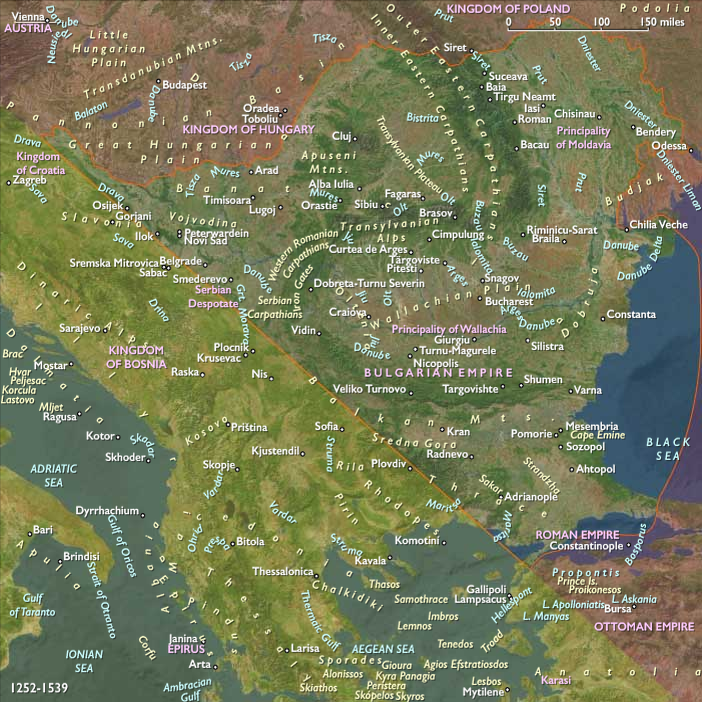
From 1348 to 1359, Eastern Southeast Europe endured continued internal upheaval and population displacement caused by the protracted Byzantine civil wars. The Byzantine civil war of 1352–1357, marking the continuation and conclusion of the earlier conflict (1341–1347), severely disrupted urban and rural life, leading to economic collapse and significant demographic shifts within Byzantine territories.
Moldavian Frontier and Hungarian Settlements
In Moldavia, new settlements emerged under Hungarian influence. In 1353, Hungarian King Louis I dispatched Dragoș, a Vlach leader from Maramureș, to establish defensive settlements against incursions from the Golden Horde along the Siret River. This initiative formed the nucleus of what would become the principality of Moldavia, centered around Baia (Târgul Moldovei or Moldvabánya), reinforcing Hungarian dominance east of the Carpathians.
Political Dynamics and Regional Rivalries
Byzantine Civil War and Imperial Decline
The Byzantine civil war of 1352–1357 between John V Palaiologos and the Kantakouzenoi (John VI Kantakouzenos and his son Matthew Kantakouzenos) further weakened Byzantine central authority. John V eventually emerged victorious as sole emperor, but the protracted internal conflicts left the empire critically vulnerable to external threats, particularly the rapidly expanding Ottoman Turks.
Serbian Ascendancy under Stefan Dušan
Under King Stefan Dušan (r. 1331–1355), the Serbian kingdom reached its zenith, expanding from Belgrade to the southern Greek territories, nearly forming a new Serbo-Greek empire. His sudden death in 1355 at age forty-seven halted further Serbian consolidation, significantly altering Balkan power dynamics and inadvertently enabling Ottoman expansion into the region.
Bulgarian Fragmentation
The weakening of the Bulgarian Empire, exacerbated by territorial losses to Serbia and internal feudal conflicts, resulted in the fragmentation of Bulgarian territories into two rival kingdoms in the late 1350s: one centered at the imperial capital Veliko Tŭrnovo, and the other at Vidin along the Danube, reflecting Bulgaria’s declining political cohesion.
Economic and Technological Developments
Economic Devastation from Civil Strife
The Byzantine civil wars inflicted lasting economic devastation, undermining trade networks, agricultural productivity, and urban commercial activities. The resulting fiscal collapse severely weakened Byzantine economic structures, making recovery difficult and further exposing the empire to external threats.
Hungarian Frontier Defense and Development
The Hungarian fortifications along the Moldavian frontier, initiated by Dragoș’s expedition, significantly influenced local economies and settlements. Defensive structures along the Siret River region—including the fortified settlements near Chilia and other strategic locations—facilitated trade and agricultural stability while ensuring frontier security.
Cultural and Artistic Developments
Continuation of Byzantine Cultural Traditions
Despite political upheaval, Byzantine cultural traditions persisted. Art, literature, and religious practices maintained continuity, particularly within ecclesiastical centers. However, resources for monumental cultural projects sharply declined due to political instability and economic devastation.
Serbian Cultural Flourishing
Under Stefan Dušan, Serbian culture experienced considerable advancement, marked by significant architectural and artistic patronage, notably monasteries and churches that exemplified a fusion of Byzantine and Serbian stylistic traditions, contributing to a distinctive Serbian cultural legacy.
Social and Religious Developments
Deepening Societal Fragmentation
Byzantine society experienced deeper fragmentation along aristocratic and populist lines due to the prolonged civil war. The aftermath left a weakened social structure susceptible to external manipulation and internal division, complicating governance and social cohesion.
Religious and Ethnic Dynamics in Transylvania
The Hungarian influence in Transylvania intensified the process of Magyarization among Romanian nobility. The Romanian serf class retained their language and Orthodox Christian faith, highlighting significant cultural and religious divides reinforced by feudal dynamics and Hungarian political dominance.
Long-Term Consequences and Historical Significance
The era from 1348 to 1359 CE was marked by catastrophic internal conflicts within Byzantium, Serbian ascendancy and subsequent decline, Bulgarian fragmentation, and the emergence of Moldavia under Hungarian influence. Collectively, these developments reshaped Eastern Southeast Europe, critically weakening established powers and setting the stage for the accelerated Ottoman advance into the Balkans.
People
Groups
Subjects
Regions
Southeast Europe
View →Subregions