
Eastern Southeast Europe (1360–1371 CE): Ottoman Expansion, …
Years: 1360 - 1371
Eastern Southeast Europe (1360–1371 CE): Ottoman Expansion, Balkan Fragmentation, and Emerging Powers
Settlement and Migration Patterns
Ottoman Settlement and Administration
Between 1360 and 1371, the Ottoman Turks firmly established their dominance in the Balkans. Lands conquered by the Ottomans were systematically reorganized into feudal fiefs governed by cavalry officers. Local notables who converted to Islam participated actively in this new administration, facilitating Ottoman integration and consolidation throughout Thrace and southern Bulgaria.
Moldavian Expansion under Bogdan
In Moldavia, Bogdan of Cuhea, a Vlach voivode from Maramureş, solidified his rule following his successful rebellion against Hungarian authority. Establishing a new political center at Siret, he extended Moldavian territory northward to the Cheremosh River, reinforcing Moldavia’s independence from Hungarian suzerainty. Nonetheless, the southern Moldavian territories remained under the influence of the Tatar Mongols.
Political Dynamics and Regional Rivalries
Byzantine Vulnerability and Crusader Intervention
The Byzantine Empire remained vulnerable, exemplified by Emperor John V Palaiologos’ captivity by the Bulgarians. In 1366, responding to Pope Urban V's call, Amadeus VI, Count of Savoy, led a crusading force to aid Byzantium. Initially successful, Amadeus recaptured Gallipoli from the Turks and seized Black Sea ports including Mesembria and Sozopolis, later laying siege to Varna. Under pressure, Bulgarian Tsar Ivan Alexander released Emperor John V. However, atrocities committed by Catholic crusaders against local Orthodox populations significantly soured relationships, causing many Bulgarians to prefer Ottoman rule over alliances with the Latin West.
Fall of the Serbian Empire
Serbia experienced critical fragmentation following the death of childless Emperor Uroš the Weak in 1371. The absence of a legitimate heir led to the decentralization of power among regional magnates (velikaši), who assumed independent control over various provinces, adopting titles such as gospodin and despot. This fragmentation marked the definitive end of Serbia’s imperial unity, leaving the region vulnerable to Ottoman advances.
Economic and Technological Developments
Ottoman Administrative and Military Innovations
The Ottomans under Murad I (r. 1362–1389) institutionalized key imperial administrative structures. Positions such as the kaziasker (military judge), beylerbeyi (regional governor), and grand vizier (chief minister) were formalized, granted to non-dynastic officials to ensure efficient governance. Military innovations included the creation of the elite Janissary corps (Yeniçeri, "New Force"), recruited through the devshirme (child levy) system, and the establishment of the Kapikulu Corps ("Palace Guards"), modeled after earlier Seljuk and Abbasid traditions.
Cultural and Artistic Developments
Ottoman Urban and Religious Patronage
Ottoman ruler Orhan significantly contributed to cultural integration and Islamization in newly conquered areas. His construction of mosques, medreses (Islamic theological schools), and caravanserais across Anatolia and the Balkans facilitated the spread of Islamic culture and Ottoman urban life, marking the beginning of lasting architectural and cultural legacies in the region.
Serbian Cultural Fragmentation
As the Serbian Empire fragmented politically, its previously centralized cultural patronage dispersed among regional courts. Local Serbian rulers continued patronage of monasteries and religious art, albeit on a smaller and more localized scale, reflecting a broader cultural fragmentation accompanying political decentralization.
Social and Religious Developments
Religious and Ethnic Integration under Ottoman Rule
The Ottoman administrative system fostered religious and ethnic integration, encouraging conversion among local Balkan elites to Islam. This policy contributed to the development of a diverse yet structured Ottoman society, blending Islamic, Turkish, and Balkan Christian traditions.
Religious Tensions from Crusader Activity
The aggressive behavior of the Catholic crusaders, exemplified by the crusade of Amadeus VI, exacerbated existing religious tensions between Latin Christianity and Orthodox communities. The resulting animosity facilitated Ottoman expansion, as Orthodox populations increasingly viewed Ottoman rule as comparatively tolerable.
Long-Term Consequences and Historical Significance
The period from 1360 to 1371 CE marked a critical phase of Ottoman consolidation in Eastern Southeast Europe, the definitive fragmentation of the Serbian Empire, and the rise of independent Moldavia. These developments profoundly reshaped Balkan geopolitics, laying crucial foundations for long-term Ottoman dominance and significantly impacting regional cultural and religious identities.
People
- Amadeus VI
- Bogdan I of Moldavia
- Ivan Alexander of Bulgaria
- John V Palaiologos
- Murad I
- Orhan
- Pope Urban V
- Stefan Uroš V
Groups
- Slavonia region
- Islam
- Bulgarian Orthodox Church
- Romanians
- Christians, Eastern Orthodox
- Christians, Roman Catholic
- Croatia, Kingdom of
- Bulgarian Empire (Second), or Empire of Vlachs and Bulgars
- Serbia, Kingdom of
- Serbian Orthodox Church
- Hungary, Kingdom of
- Roman Empire, Eastern: Palaiologan dynasty
- Moldavia, Hungarian province of
- Ottoman Empire
- Moldavia, Principality of
Topics
Commodoties
Subjects
Regions
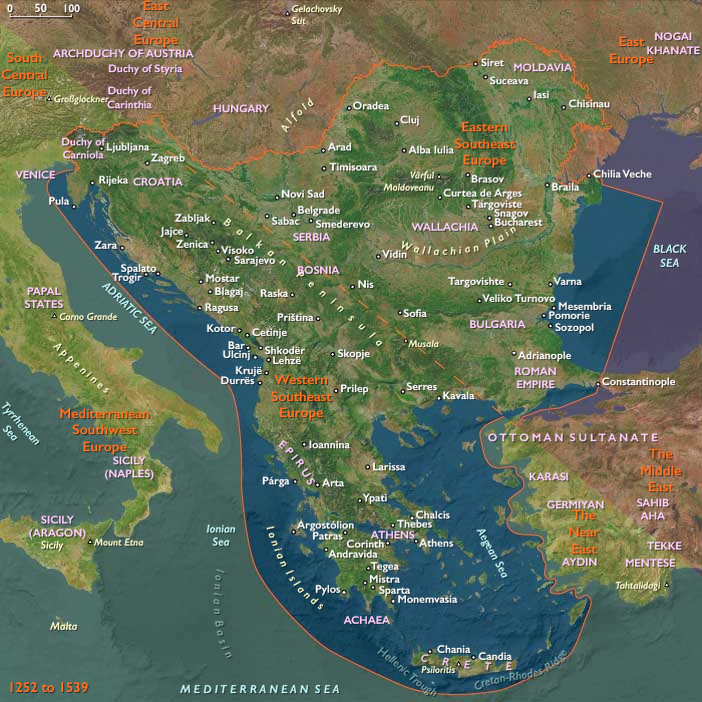
Subregions
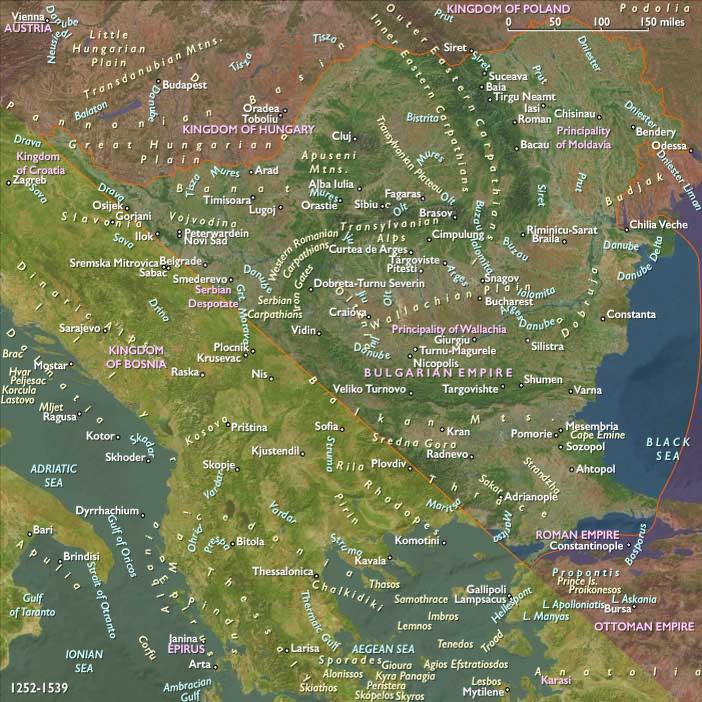
Years: 1360 - 1371
People
- Amadeus VI
- Bogdan I of Moldavia
- Ivan Alexander of Bulgaria
- John V Palaiologos
- Murad I
- Orhan
- Pope Urban V
- Stefan Uroš V
Groups
- Slavonia region
- Islam
- Bulgarian Orthodox Church
- Romanians
- Christians, Eastern Orthodox
- Christians, Roman Catholic
- Croatia, Kingdom of
- Bulgarian Empire (Second), or Empire of Vlachs and Bulgars
- Serbia, Kingdom of
- Serbian Orthodox Church
- Hungary, Kingdom of
- Roman Empire, Eastern: Palaiologan dynasty
- Moldavia, Hungarian province of
- Ottoman Empire
- Moldavia, Principality of
Topics
Commodoties
Subjects
Regions
Subregions