
Eastern Southeast Europe (532–675 CE): Transformation, Crisis, …
Years: 532 - 675
Eastern Southeast Europe (532–675 CE): Transformation, Crisis, and Regional Consolidation
Settlement and Migration Patterns
Plague, Recovery, and Demographic Shifts
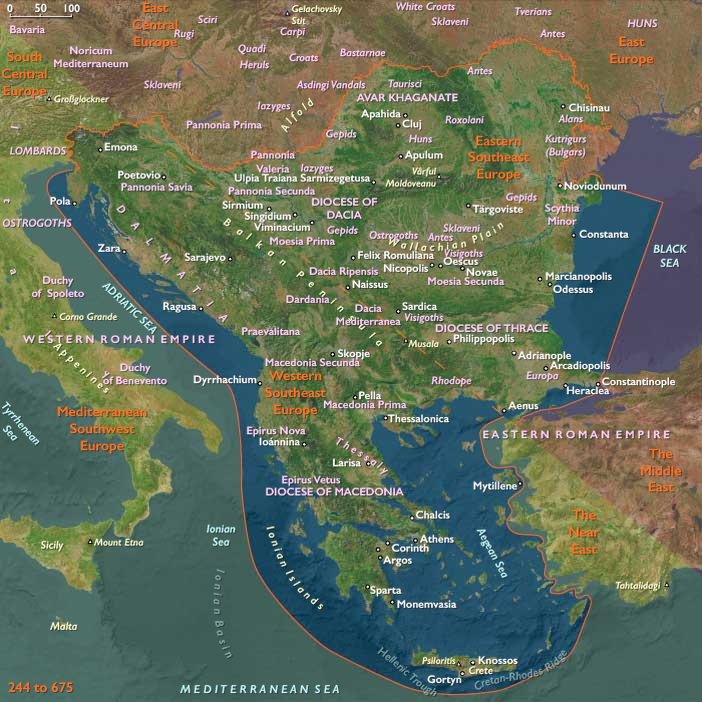
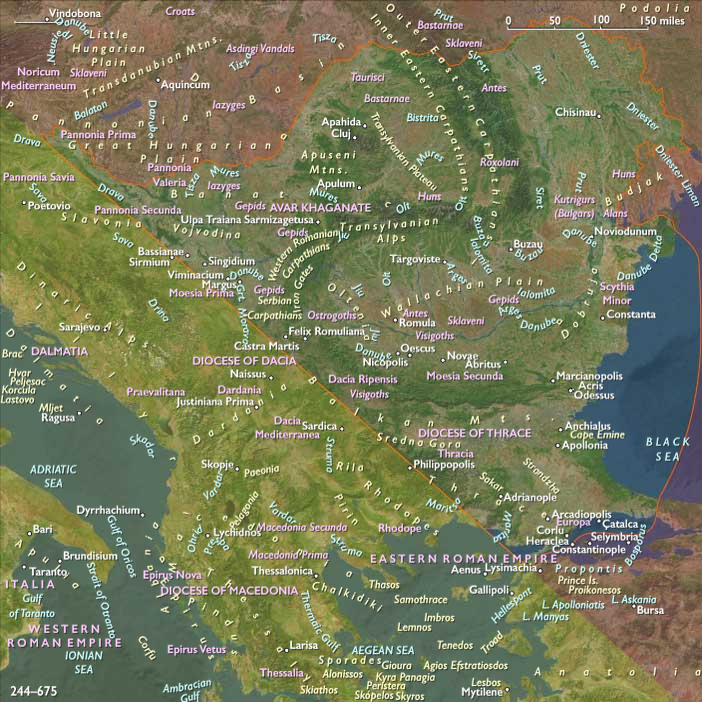
The devastating Plague of Justinian (541–542 CE) severely impacted regional demographics, drastically reducing populations, especially in urban centers like Constantinople. Concurrently, significant Slavic migrations reshaped the Balkan region, permanently altering its ethnic and cultural landscape.
Slavic and Bulgar Integration
Slavic tribes, sedentary farming and livestock-raising groups organized into clan-based societies, intensified their presence. Allied initially with the more powerful Avars, the Slavs settled extensively, significantly reshaping the demographics and social structures of Eastern Southeast Europe. Together, they virtually erased Christian life in Dalmatia and surrounding regions by the early seventh century, marking a pivotal cultural transformation.
Political and Military Developments
Justinian’s Reconquests and Administrative Reforms
Emperor Justinian achieved major territorial reconquests, briefly reuniting Italy, North Africa, and Southern Hispania with the Eastern Empire. He implemented significant administrative reforms, strengthening the centralized bureaucracy and enhancing provincial governance.
Defense and Military Innovations
Persistent invasions prompted substantial advancements in military infrastructure, including fortified cities, improved defensive logistics, and strengthened regional security. These enhancements were crucial to maintaining imperial cohesion amid continuous external threats, such as those from Avars and Slavs.
Religious and Imperial Controversies
Religious and political tensions intensified significantly under Emperor Constans II, who imposed the controversial doctrine of Monothelitism and imprisoned Pope Martin I, deepening internal divisions within the empire.
Transition to Byzantine Identity
Emperor Heraclius (622–627 CE) successfully reorganized the empire as a Greek monarchy, marking the definitive emergence of the Byzantine Empire. His successful defenses against Persian and Avar threats solidified this transformation, reshaping regional political and cultural identity.
Economic and Technological Developments
Economic Stability and Recovery
Despite challenges, economic resilience persisted, supported by sustained agricultural productivity and stable trade networks. Constantinople retained its crucial economic role, facilitating regional stability and prosperity despite demographic and military upheavals.
Infrastructure and Defense
Continuous fortification and infrastructure improvements significantly enhanced regional defense and administrative efficiency, reflecting sustained investments in military readiness and urban resilience.
Cultural and Artistic Developments
Byzantine Cultural Flourishing
Cultural activity flourished in the Byzantine Empire, exemplified by iconic architectural projects such as Hagia Sophia, intricate mosaics, and religious art rooted in both classical and Christian traditions. This period witnessed considerable Byzantine cultural expansion throughout Eastern Southeast Europe.
Intellectual Continuity
Scholarly and educational institutions preserved and transmitted classical Greek and Roman knowledge, sustaining intellectual and theological discourse amidst societal changes, ensuring cultural continuity.
Social and Religious Developments
Governance Adaptation and Stability
Imperial governance adapted effectively to demographic shifts and internal controversies, maintaining societal coherence through crises. Provincial administration under Byzantine rule ensured sustained regional stability and effective response to challenges.
Christianity's Expanding Influence
Eastern Orthodox Christianity increasingly shaped societal norms, cultural identity, and community structures. The religion’s growing prominence fostered communal resilience and moral cohesion amid persistent turmoil and societal transformations.
Long-Term Consequences and Historical Significance
The period from 532 to 675 CE was defined by significant demographic transformations, imperial crises, economic resilience, and substantial cultural developments. These elements collectively laid the essential foundations of Byzantine civilization, shaping the region’s historical identity and significantly influencing its trajectory for centuries.
People
Groups
- Dacians, or Getae, or Geto-Dacians
- Thrace, Theme of
- Thracia (Roman province)
- Persian Empire, Sassanid, or Sasanid
- Dacia Ripensis (Roman province)
- Dacia Mediterranea (Roman province)
- Moesia II (Roman province)
- Scythia Minor (Roman province)
- Moesia I (Roman province)
- Christianity, Arian
- Bulgars
- Macedonia, Diocese of
- Europa (Roman province)
- Dacia, Diocese of
- Macedonia, (East) Roman
- Slavs, South
- Christianity, Chalcedonian
- Gepids, Kingdom of the
- Avars, Eurasian
- Sclaveni (Slavic tribal confederation)
- Antes (Slavic tribal confederation)
- Roman Empire, Eastern: Justinian dynasty
- Roman Empire, Eastern: Non-dynastic
- Roman Empire, Eastern: Heraclian dynasty
- Christians, Monotheletist
Topics
Commodoties
Subjects
- Commerce
- Architecture
- Decorative arts
- Faith
- Government
- Scholarship
- Custom and Law
- Theology
- Human Migration
Regions
Subregions
Related Events
Showing 1 events out of 1 total
Years: 532 - 675
People
Groups
- Dacians, or Getae, or Geto-Dacians
- Thrace, Theme of
- Thracia (Roman province)
- Persian Empire, Sassanid, or Sasanid
- Dacia Ripensis (Roman province)
- Dacia Mediterranea (Roman province)
- Moesia II (Roman province)
- Scythia Minor (Roman province)
- Moesia I (Roman province)
- Christianity, Arian
- Bulgars
- Macedonia, Diocese of
- Europa (Roman province)
- Dacia, Diocese of
- Macedonia, (East) Roman
- Slavs, South
- Christianity, Chalcedonian
- Gepids, Kingdom of the
- Avars, Eurasian
- Sclaveni (Slavic tribal confederation)
- Antes (Slavic tribal confederation)
- Roman Empire, Eastern: Justinian dynasty
- Roman Empire, Eastern: Non-dynastic
- Roman Empire, Eastern: Heraclian dynasty
- Christians, Monotheletist
Topics
Commodoties
Subjects
- Commerce
- Architecture
- Decorative arts
- Faith
- Government
- Scholarship
- Custom and Law
- Theology
- Human Migration
Regions
Subregions