
Event
Eastern Southeast Europe (477–334 BCE): Regional Kingdoms,…
Eastern Southeast Europe (477–334 BCE): Regional Kingdoms, Greek Poleis, and Macedonian Ascendancy
Settlement and Migration Patterns
Consolidation of the Odrysian Kingdom
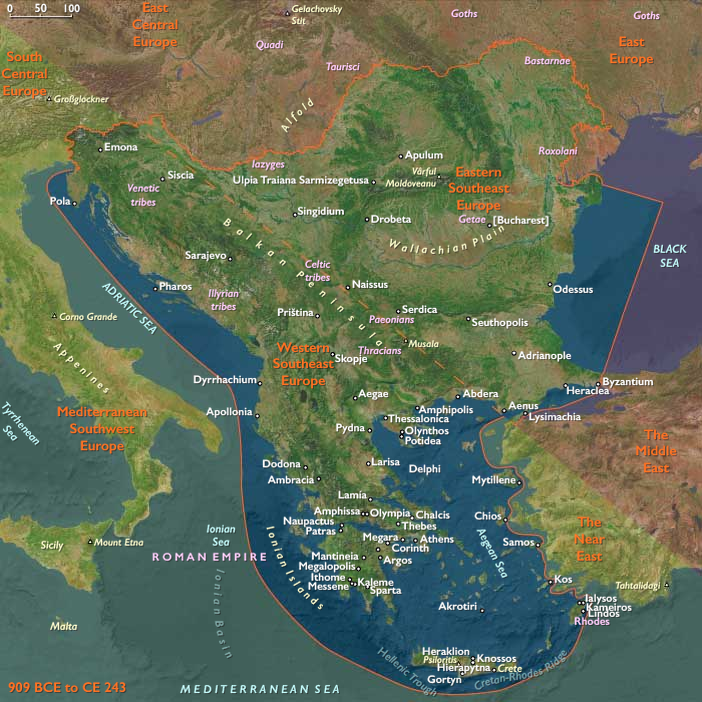
Between 477 and 334 BCE, the Odrysian Kingdom emerged as the dominant indigenous political power in Eastern Southeast Europe. Under rulers such as Teres I, Sitalces, and Seuthes I, much of Thrace was gradually united into a powerful monarchy extending across present-day Bulgaria, northeastern Greece, European Turkey (Thrace), and portions of southeastern Romania. Fortified administrative centers expanded, regional road systems improved, and the kingdom exercised increasing authority over agricultural production, trade, and diplomacy.
North of the Danube, Getic communities continued occupying the fertile plains and foothills of present-day Romania and Moldova. Their fortified settlements expanded in both size and complexity, maintaining active commercial and political relationships with the Greek colonies and the Thracian kingdoms to the south.
Flourishing Greek Poleis
The Greek colonies established during the previous centuries matured into prosperous urban communities. Histria, Callatis, Tomis, Apollonia Pontica, Mesambria, Odessos, Chalcedon, and Byzantium developed thriving harbors, marketplaces, temples, defensive walls, and civic institutions while serving as principal commercial gateways between the Mediterranean and the Lower Danube basin.
Although politically independent, these poleis increasingly interacted with Thracian rulers through diplomacy, commerce, military alliances, and occasional conflict. Their prosperity depended upon productive relationships with the surrounding indigenous populations as much as upon maritime trade.
Economic and Technological Developments
Expansion of Regional Commerce
Commercial integration reached unprecedented levels during this period. Grain, livestock, timber, salt, fish, wax, honey, hides, wine, olive oil, ceramics, precious metals, and luxury goods circulated continuously between the Greek colonies, the Odrysian Kingdom, Getic communities, and the wider Mediterranean.
The Lower Danube, Bosporus, and western Black Sea formed one of the principal commercial corridors of southeastern Europe, while inland roads increasingly connected fortified settlements, agricultural districts, mining regions, and coastal ports.
Iron Technology and Military Innovation
Iron technology became fully established throughout the region, improving agricultural productivity, forestry, transportation, and warfare. Thracian and Greek metalworkers produced increasingly sophisticated weapons, armor, horse equipment, and ceremonial objects, while advances in siegecraft and military organization reflected growing competition among regional powers.
Mining expanded throughout the Balkan and Carpathian regions, providing gold, silver, copper, and iron that supported both local craftsmanship and long-distance trade.
Slavery and Economic Organization
Slavery formed an important component of the regional economy. Greek colonies relied upon enslaved labor in agriculture, domestic service, craftsmanship, and maritime commerce, while Thracian rulers acquired captives through warfare, tribute, and trade. The movement of enslaved peoples became one element within the broader commercial networks linking Eastern Southeast Europe to the Mediterranean world.
Cultural and Artistic Developments
Maturation of Classical Greek Culture
The Greek colonies experienced remarkable cultural development during the fifth and fourth centuries BCE. Temples, public buildings, theaters, fortifications, sculpture, pottery, and civic architecture reflected the mature artistic traditions of Classical Greece while adapting to local conditions along the Black Sea frontier.
Writing, coinage, philosophy, and historical scholarship increasingly shaped civic life within the colonies, strengthening their cultural connections with the wider Hellenic world.
Thracian Artistic Achievement
Thracian aristocratic culture reached extraordinary levels of sophistication. Gold and silver vessels, ceremonial armor, horse trappings, jewelry, weapons, and richly furnished tumulus burials demonstrated both exceptional craftsmanship and the growing wealth of the Odrysian elite.
Interaction with the Greek colonies encouraged artistic exchange while preserving distinctly Thracian forms of political symbolism, ceremonial display, and religious expression.
Social and Religious Developments
Mature Political Institutions
Political organization became increasingly sophisticated throughout the region. The Greek poleis maintained established civic governments, councils, magistracies, and commercial institutions, while the Odrysian Kingdom developed a centralized monarchy supported by regional governors, aristocratic elites, tribute systems, and diplomatic alliances.
During the closing decades of the age, the rapid rise of Macedon under Philip II fundamentally altered the political balance of southeastern Europe. Macedonian victories gradually reduced both Greek and Thracian political independence while laying the foundations for the Hellenistic world that would follow.
Religious Continuity and Cultural Exchange
Traditional Thracian religious practices continued flourishing throughout the interior. Sacred mountains, groves, springs, tumuli, and sanctuaries remained central to political legitimacy and communal identity, while beliefs associated with the Thracian Horseman and Zalmoxis continued shaping indigenous religious life.
Greek temples dedicated to the Olympian gods remained focal points within the coastal cities, encouraging continued religious interaction without eliminating local traditions. Increasing political and commercial integration fostered a rich frontier where Greek and Thracian religious practices developed alongside one another while retaining their distinct identities.
Long-Term Consequences and Historical Significance
Between 477 and 334 BCE, Eastern Southeast Europe achieved its highest level of political organization before the Hellenistic age. The Odrysian Kingdom emerged as the region's first large indigenous state, the Greek Black Sea poleis reached their greatest prosperity, and expanding commercial networks integrated the Lower Danube more closely than ever with the Mediterranean economy.
By the close of the age, Philip II's expansion had transformed the political landscape. Macedonian influence increasingly overshadowed both the Greek city-states and the Thracian kingdoms, preparing the region for the sweeping conquests of Alexander the Great and the profound Hellenistic transformations that would define the following age.

-
{# Image navigates to the detail page; the magnifying-glass chip is the only Fancybox lightbox trigger (kept a separate sibling — anchors can't nest). #}
 The Great Crossroads
World
-
{# Image navigates to the detail page; the magnifying-glass chip is the only Fancybox lightbox trigger (kept a separate sibling — anchors can't nest). #}
 Southeast Europe
Region
-
{# Image navigates to the detail page; the magnifying-glass chip is the only Fancybox lightbox trigger (kept a separate sibling — anchors can't nest). #}
 Eastern Southeast Europe
Subregion
