
Eastern Southeast Europe (1000–1011 CE): Byzantine Advances, …
Years: 1000 - 1011
Eastern Southeast Europe (1000–1011 CE): Byzantine Advances, Bulgarian Decline, and Hungarian Consolidation
Settlement and Migration Patterns
Continued Demographic Stability
From 1000 to 1011 CE, Eastern Southeast Europe maintained its demographic stability, despite ongoing conflicts and shifting power dynamics caused by Byzantine expansion and Bulgarian resistance.
Political and Military Developments
Bulgarian Expansion under Tsar Samuel
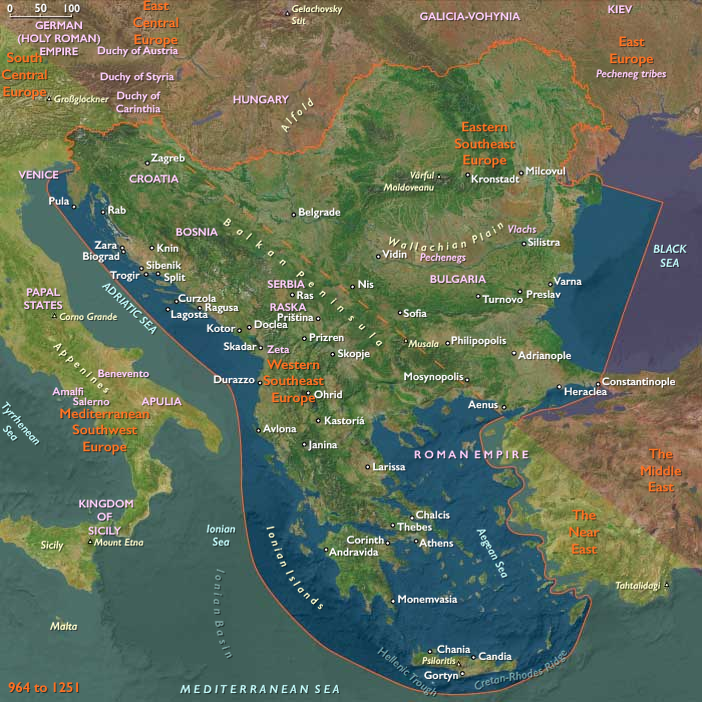
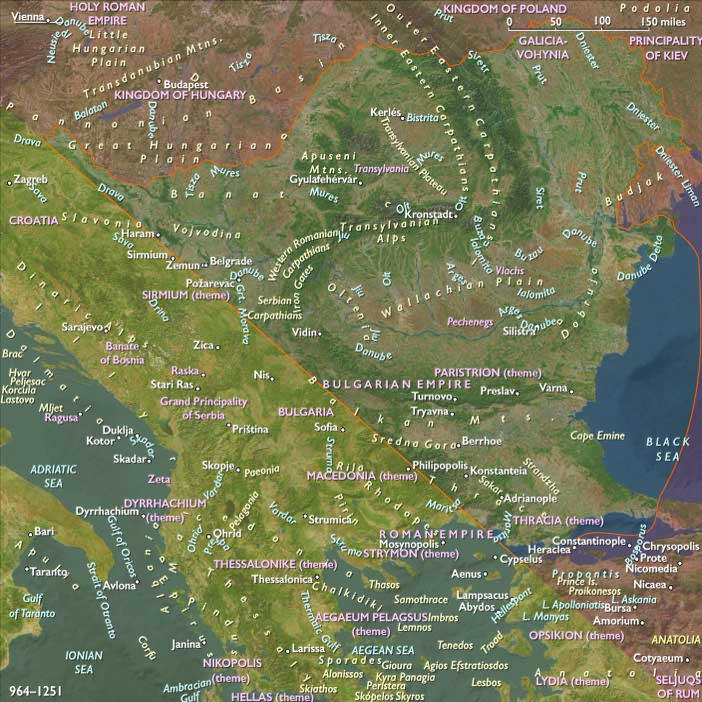
Tsar Samuel of Bulgaria significantly expanded Bulgarian territory, ruling from the Adriatic to the Black Sea and reclaiming regions lost during earlier conflicts with Kievan Rus'. Samuel’s forces conducted successful raids into Byzantine territory, penetrating as far as central Greece, posing a considerable challenge to Byzantine authority.
Byzantine Counteroffensive and Samuel’s Defeat
The Byzantine Empire, under Emperor Basil II, began to systematically counter Bulgarian advances. After a pivotal victory at the Battle of the River Spercheios in Thessaly in 996, led by general Nikephoros Ouranos, the tide turned decisively against Bulgaria. Samuel narrowly escaped capture along with his son Gabriel.
Basil II's Strategic Campaigns
From the year 1000, Basil II intensified a persistent and strategically insightful campaign against Bulgaria. Byzantine forces, led by generals Nikephoros Xiphias and Theodorokan, successfully captured key Bulgarian cities, including Great Preslav, Lesser Preslav, and Pliskova, marking significant advances into Bulgarian territory.
Hungarian Territorial Consolidation
Many Hungarian lords refused to accept Stephen I's suzerainty even after his coronation. Stephen initially confronted his maternal uncle, Gyula the Younger, ruler of a notably prosperous territory described by the Illuminated Chronicle as "most wide and rich." Stephen invaded Transylvania around 1002 or 1003, capturing Gyula and his family. According to the contemporary Annals of Hildesheim, Stephen forcibly converted his uncle's lands to Christianity following their conquest. Consequently, historians typically date the establishment of the Diocese of Transylvania to this period. If the identification proposed by Hungarian historians, such as Kristó and Györffy, linking Gyula with Prokui (Stephen's uncle mentioned by Thietmar of Merseburg), is correct, Gyula later escaped captivity and sought refuge with Bolesław I the Brave, Duke of Poland (r. 992–1025). The establishment of the Transylvanian Catholic episcopacy was completed in 1009, confirmed by the bishop of Ostia acting as papal legate.
Economic and Technological Developments
Economic Stability Amidst Conflict
Despite ongoing warfare, regional economies remained resilient, sustained by local crafts, trade activities, and stable agricultural production, particularly within fortified towns.
Military Infrastructure
Strategic investments in fortifications and military logistics continued, especially by Byzantine forces, reinforcing their territorial gains and ensuring logistical support for prolonged campaigns.
Cultural and Artistic Developments
Emergence of Popular Poetry
This era witnessed the emergence of popular poetry written in vernacular Greek, marking an important cultural shift and reflecting broader trends in cultural and literary expression across Byzantine territories.
Continued Cultural Resilience
Cultural and artistic traditions persisted robustly in Byzantine and Bulgarian territories, sustaining regional identities and traditions despite political and military upheaval.
Social and Religious Developments
Dominance of Orthodox Christianity
Orthodox Christianity maintained its crucial role, providing spiritual and societal stability amid persistent conflict. Ecclesiastical institutions continued to reinforce community cohesion and religious practices across the region.
Influence of Bogomilism
The Bogomil religious movement retained influence, particularly in rural areas, shaping local religious beliefs and societal structures with its dualistic doctrines.
Long-Term Consequences and Historical Significance
The period from 1000 to 1011 CE was marked by significant Byzantine territorial gains, Bulgarian setbacks, and important Hungarian territorial consolidation. Basil II’s successful campaigns fundamentally shifted regional power balances, paving the way for complete Byzantine reconquest of Bulgaria and shaping Eastern Southeast Europe's historical trajectory for subsequent generations.
People
- Basil II
- Nikephoros Ouranos
- Nikephoros Xiphias
- Samuel of Bulgaria
- Stephen I of Hungary
- Theodorokanos
Groups
- Transylvania, region of
- Thrace, Theme of
- Christianity, Chalcedonian
- Greeks, Medieval (Byzantines)
- Bulgarians (South Slavs)
- Bulgarian Empire (First)
- Macedonia, East Roman Theme of
- Roman Empire, Eastern: Macedonian dynasty
- Bulgarian Orthodox Church
- Kievan Rus', or Kiev, Great Principality of
- Bogomilism
Topics
Commodoties
Subjects
Regions
Subregions
Related Events
Showing 10 events out of 52074 total
Years: 1000 - 1011
People
- Basil II
- Nikephoros Ouranos
- Nikephoros Xiphias
- Samuel of Bulgaria
- Stephen I of Hungary
- Theodorokanos
Groups
- Transylvania, region of
- Thrace, Theme of
- Christianity, Chalcedonian
- Greeks, Medieval (Byzantines)
- Bulgarians (South Slavs)
- Bulgarian Empire (First)
- Macedonia, East Roman Theme of
- Roman Empire, Eastern: Macedonian dynasty
- Bulgarian Orthodox Church
- Kievan Rus', or Kiev, Great Principality of
- Bogomilism
Topics
Commodoties
Subjects
Regions
Subregions